Tag Archives: no sugar life

A Year Of No Sugar: Post 83

Sally Makes a "Burner"

Lately, I’ve gotten the feeling that I’m going back in time… cleaning our cast iron pan, gathering the eggs from our chickens, buying our milk from the local farm in half-gallon mason jars, selecting apples out of wooden bins at the Farmer’s Market, ordering bread from our local general store. Our freezer is full of meat: half a cow and half a pig locally raised and slaughtered. I buy butter by the 36 pound case and flour by the 50 pound bag. The other day I realized I needed something from the actual supermarket and I felt kind of… disappointed.

It’s not entirely intentional, it just seems to be the natural evolution of things when you try to get away from processed foods (read: added sugar.) Want good bread? If you aren’t prepared to make it in the quantity your family will consume, you order it from Jed in Rupert who makes the area’s best no sugar bread with only four ingredients. Want organic meat? Unless you want to remortgage your house to buy it at the Farmer’s Market, or pick over the sad, non-existant selection at our local supermarkets, you find a guy who knows a cow, and a reputable slaughterhouse. And so on.

As if to complete the effect, last Saturday I had an adventure I’d been waiting for since October. For a birthday present my husband arranged something I’ve always wanted to do: a hearth cooking workshop. So early Saturday morning I, and six friends, converged on the home of Sally Brillon in Hebron, New York.

As we walked up the path in the crisp morning air I looked around at the ancient outbuildings- remnants of the many different jobs having a family farm used to entail. Standing on the rough flagstone step, we knocked on the saltbox door and entered another world.

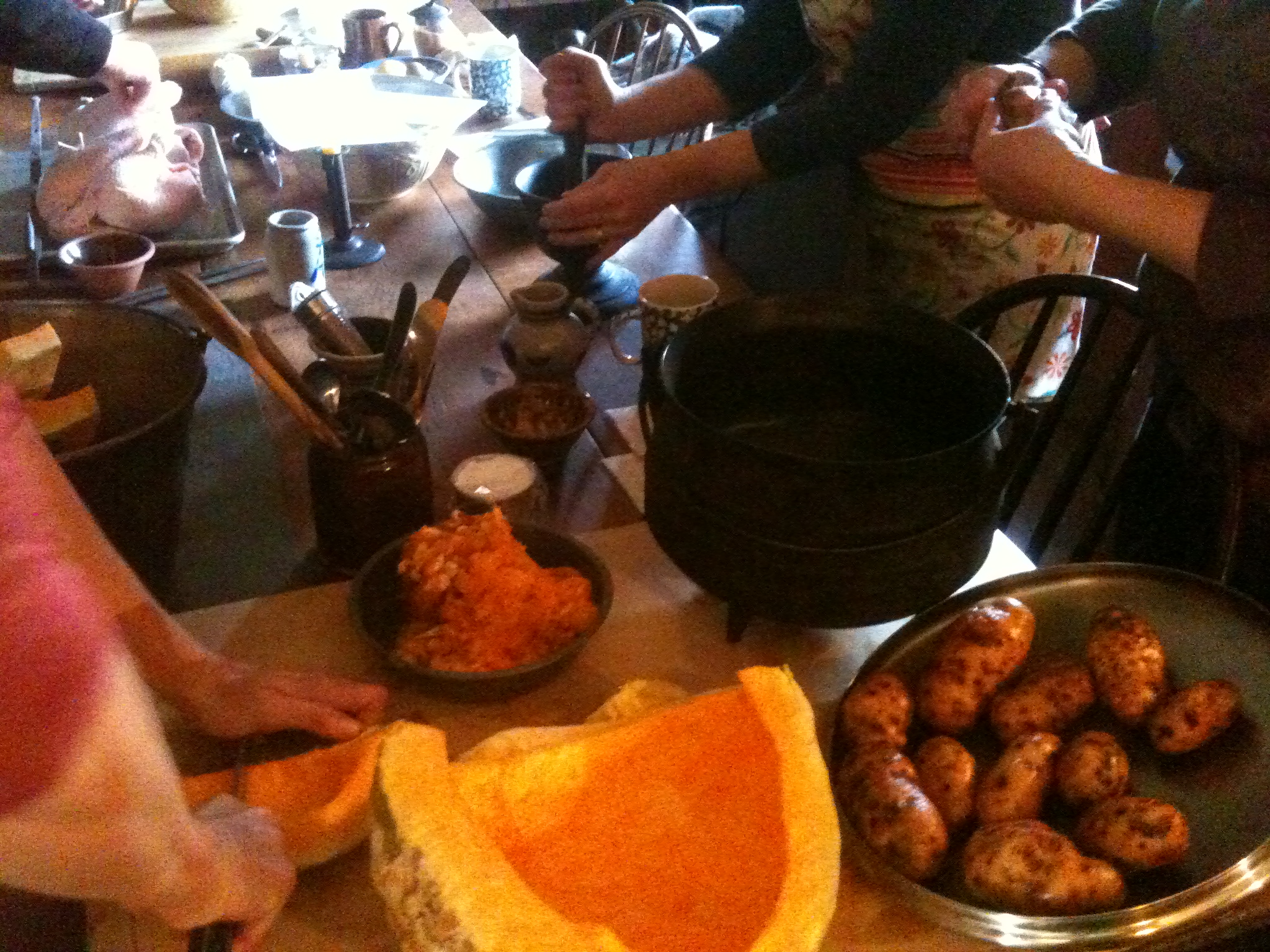
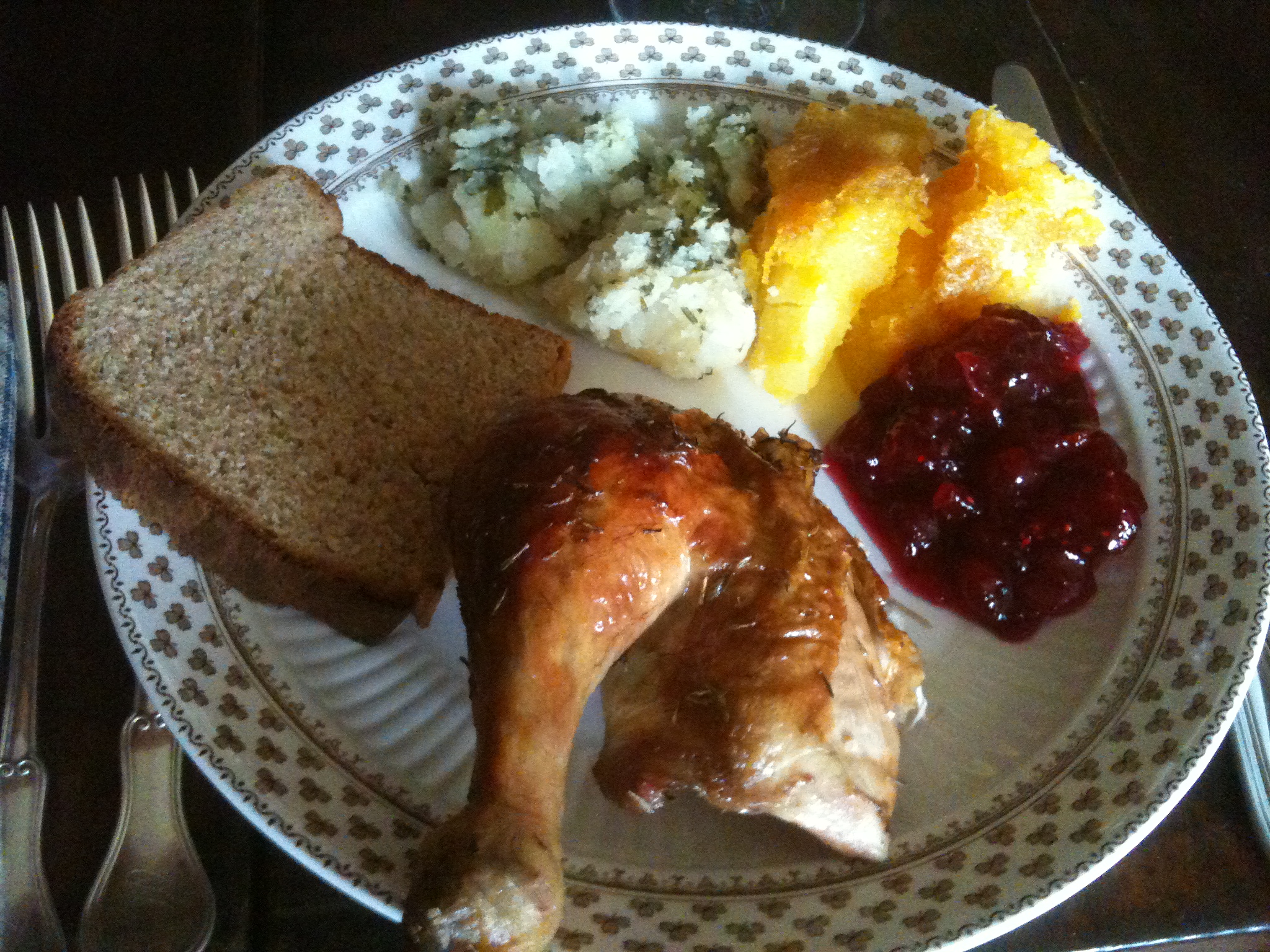
I was in heaven. Immediately upon entering you were warmed by waves emanating from the enormous slate hearth which dominated the room. Sally had started the fire two hours earlier to get it up to the temperatures we’d be needing to cook the meal for the day: roast chicken, potatoes with parsley, mashed Hubbard squash, cranberries, bread and apple pie for dessert. We seven students and Sally spent the next five hours accomplishing this task.
Many Hands

Now I am a little obsessed with this time period… if PBS ever does “Frontier House” again I will politely beat people out of the way with a stick to volunteer. Why do I love this stuff so much, I wonder? After all, we are talking about the age when the average lifespan for a woman was, like, twelve or something. And of course, we must remember Sally would make it all quite painless for us: we didn’t have to stoke the fire at 7am… we didn’t have to wash the cast iron pans and dishes for eight afterwards in a tub of lukewarm water. She had a real bathroom for us and none of us was in danger of dying from appendicitis, childbirth or from an infected scab on the knee. We had it sooooo easy.

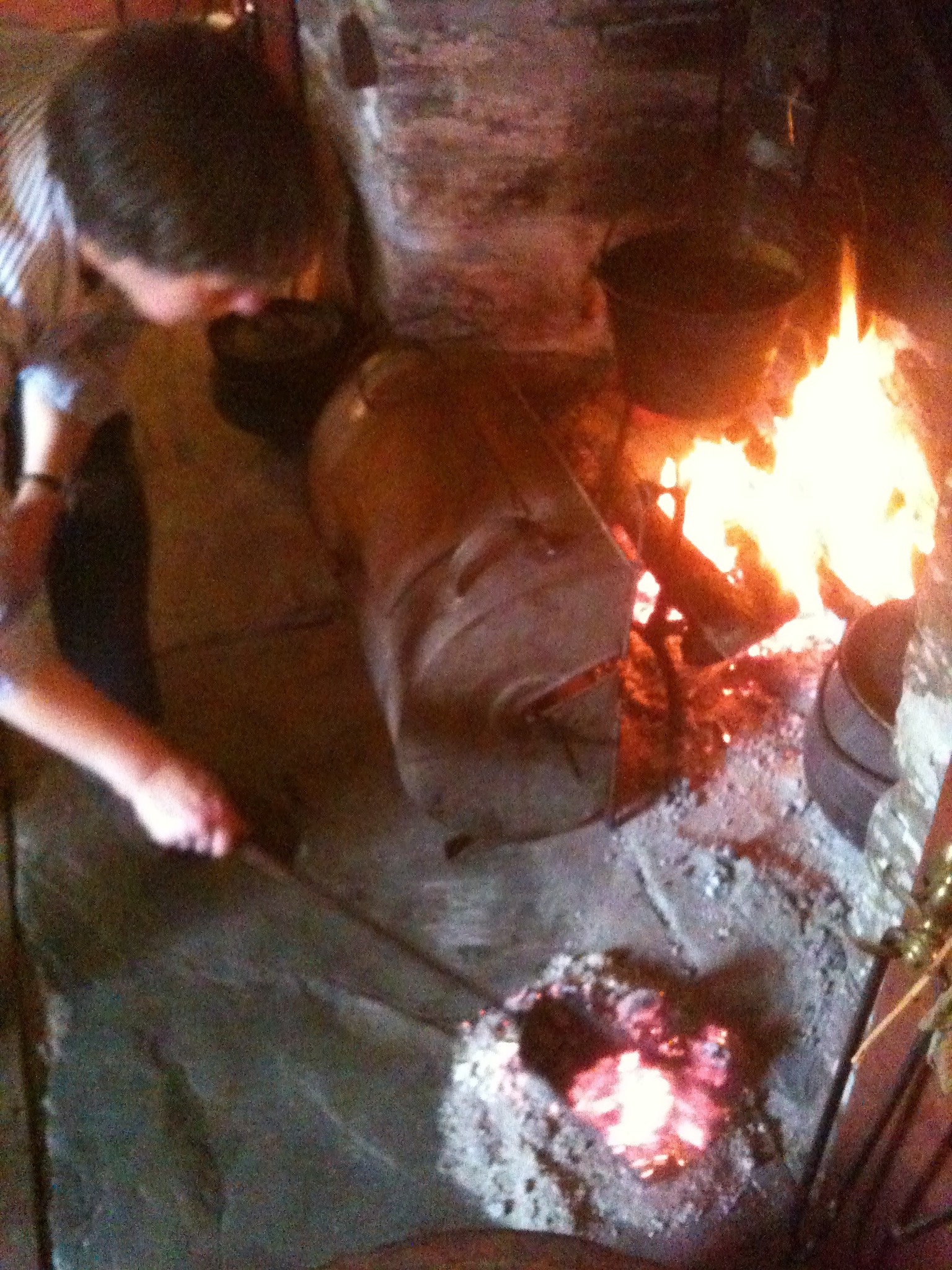
Instead, we got to do the fun part: we cooked two chickens in a reflecting oven before the fire, turning the spit every fifteen minutes. We boiled pots full of vegetables that hung from “S” hooks off of a crane that swung into place over the flames. We started a soft-wood fire in the bake oven and filled it with red coals until it was ready to bake our two loaves of bread. Lastly, after assembling a lovely apple pie, we laid it carefully in a cast iron pot, placed it on a “burner” of hot coals right on the hearth, and then shoveled coals on the lid- after a time those coals would be removed and replaced with fresh. It was really starting to smell good in there.

And you can imagine it tasted good too. Not gourmet, not fancy recipe good, but good. Wholesome. Filling. Real.

I loved that we used pot lid lifters and tin ladles and yellowware bowls. There was no Teflon, no plastic, no mixers or microwaves. In fact, there was only one modern toxin I could see: sugar.

When Sugar Was Expensive

Of course, you must’ve already guessed there was sugar in the cranberries and in the apple pie. For good measure Sally’s recipe also had us drizzle maple syrup onto the top of the mashed squash. After some thought I had decided ahead of time not to request any recipe changes- it was authenticity we were going for here, after all. The cranberries tasted almost painfully sweet to me, but the squash and the pie were very mildly sweet, even to my recently more sensitive tongue. Sally later told me that one class she had actually left the sugar out of the pie by mistake and nobody even noticed- it was just as good.

Back in those days sugar was a lot harder to come by, and boiling your own maple syrup was a task that took up a considerable portion of one’s Spring energies. As we waited for the chicken and bread loaves to finish baking, Sally read to us snippets from the diaries of Major James Wilson, who built the house in 1786, and lived there for the rest of his life with his wife and eight children. A few entries described the gargantuan undertaking of making maple syrup: sterilizing the sap buckets, soaking the wood barrels in the nearby stream, gathering the sap bucket by bucket, and finally building the arch for the long evaporating process, not in a saphouse like today, but actually out in the open air of the woods. If only sugar was that hard to come by nowadays.

So, I got to live out my Laura Ingalls fantasy, at least for a morning. Too bad my 1870s-era house isn’t quite old enough to have had a cooking hearth of it’s own- Sally tells me that they likely used a cast iron stove. Hmmmmm- I wonder what that would be like?

You can see how I get into trouble.
A Morning's Work

A Year Of No Sugar: Post 82

Do you remember that movie The Incredible Shrinking Woman, starring Lily Tomlin? I saw it when it came out- I must’ve been about twelve. The movie’s premise is that suburban housewife Pat Kramer (Tomlin) gets exposed to some experimental chemicals and consequently begins to shrink: she shrinks to her children’s size, and later she is living in her children’s dollhouse. Kramer ultimately shrinks to microscopic size, landing in a puddle of household chemicals, which- luckily!- cause her to begin to grow again.

The last scene of the movie is of Kramer, at her normal size, looking down to see her shoe splitting open. Kramer and the audience realize at the same moment… now, she is continuing to grow.

AAAAAAAAAAAAA!!!!!

This movie scared the crap out of me as a kid.

Thirty years later, instead of watching Lily Tomlin get chased by mad scientists, I can scare myself silly by simply reading about actual chemicals in our environment to which we are exposed each and every day: Phthalates, Bisphenol A (BPA), Triclosan, Mercury, Teflon, Brominated Flame Retardants (PCBs, PBBs, PDBEs) and Pesticides (DDT and 2,4-D).

Recently I finished Slow Death by Rubber Duck, which is all about the chemical soup in which we collectively marinate as a society. But authors Rick Smith and Bruce Lourie go one better than just writing about the omnipresence of these chemicals in our everyday environment- they also chose to experiment on themselves. Over the course of a few days they exposed themselves to “normal” levels of common everyday chemicals to see what levels of them would later be traceable in their blood and urine (such as eating a tuna fish sandwich or sitting on a stain-resistant couch). The implications of what they found are perhaps even more scary than the prospect of shrinking to the size of a molecule on your own kitchen floor.

“But, wait a minute” you say, “what does this all have to do with sugar?”

Well, I’ll tell you. While reading Rubber Duck, it struck me that there are many points of similarity between the runaway proliferation of chemicals and that of sugar, namely:

  1. They’re both everywhere
  2. They’re both cheap
  3. They’re both linked to convenience
  4. They’re both hugely profitable industries
  5. They’re both perpetuated by a culture of denial and status quo

and of course…

  1. The more you try to avoid or eliminate them, the more insidious you realize their infiltrations to our everyday life have become.

It begs the question: do we have to go live under a rock to escape the health hazards of modern life? I mean, I’m starting to feel a little surrounded here. Sometimes it seems to me that the price of being a member of contemporary society is, knowingly or not, to put our very lives on a roulette wheel.

After reading Rubber Duck, my husband and I were inspired to get rid of our Teflon pans and replace them with a non-Teflon alternative. At the nearby kitchen store we were sold some pricey “Swiss Diamond” pans which were promoted to us by the salesperson as a great non-stick alternative to Teflon.

Later I wondered why, however, the literature that came with the pans was very careful to avoid saying the pans were Teflon-free. Wouldn’t that be a selling point? Something was fishy in Denmark… or perhaps Sweden.

After some online research the truth came out: Teflon by any other name… is still Teflon. PFOA is what they use to bond to the diamond in the Swiss Diamond pans. Which is… Teflon. Under its non-trademark name.

So here’s my question: why is it that we, non-chemistry majors most of us, are required to sleuth out that “PFOA” is the same thing as Teflon, and that “fragrance” is code for pthalates, that juice is just as bad for you as soda and that sugar is what is making people fat, not fat? Whenever I find out one of these things for the first time, my first reaction is always the same: why didn’t somebody tell me this sooner?? Why don’t more people know this? There are plenty of people being paid very well to argue that the status quo is fine, but is there really no one out there looking out for us? Who is our lobbyist?

In the end, even though the fake-No-Teflon pans had been used, we explained the situation and the kitchen store nicely allowed us to return them for store credit. This we promptly used to buy a large cast iron pan, the kind great-grandma would’ve used. It’s huge, requires some special cleaning instructions (No soap! Special scrub-brush! Dry immediately to avoid rust!) and is incredibly heavy. It isn’t what most people would consider “convenient” in our no-muss, no-fuss, flame-retardant, lavender-scented and oh-so-sweet world. But you know what? I’m starting to think that convenience is in the eye of the beholder.

Just ask Pat Kramer.

A Year Of No Sugar: Post 81

Among my many experiments this year I tried making a No-Sugar Grape Jelly. I had my work cut out for me: if you’ve never made jelly or jam then you might be astounded to know exactly how much sugar actually goes in the average batch. It’s not uncommon at all for a batch of, say, blueberry jam to call for seven cups of sugar. Yes. Seven. This works out roughly to a cup of sugar per pint jar. Think of that the next time you have toast.

Like baking, jam isn’t improvisable. Unlike making a stew or omelette where you can just throw in what you’ve got and get something edible at the end, jam is really a science. In order to get jam or jelly to “set up” correctly, ie: get that gelatinous, not-liquid-not-solid consistency, you have to have an appropriate amount of pectin, which naturally occurs in fruit, and more so in unripe fruit. In the olden days jam must’ve truly been an art form, figuring out what percentage of ripe to unripe fruit to use, testing with a cold spoon to see if after cooking the jam had “set” properly, before beginning the long, hot procedure of “processing” your sterile jars filled with jam to make them seal correctly for storage.

These days, most jelly and jam makers add powdered pectin to the cooking fruit, which ensures that your jam will set up like a golden retriever every time. In recent years, I’ve made many batches of delicious jam in just this way. So I wondered: what if I made a jelly that followed all the instructions, but substituted dextrose for sugar? Would it work?

This was going to be a lonely journey, however. If you a modern canner, then you know that the literature available about canning today is not for the faint of heart. “WHATEVER YOU DO” they all read in the most alarming font they could find, “DO NOT, REPEAT DO NOT TAMPER WITH THESE RECIPES IN ANY WAY OR YOU AND EVERYONE YOU’VE EVER LOVED WILL MOST ASSUREDLY DIE FROM SOME TERRIBLE FLESH-EATING BACTERIA!!!!” I have at least four books with canning recipes and they all say virtually the same thing: no improvisation allowed. NONE. Story’s over, go to bed.

Meanwhile, if you talk to the old-timers, the ones who canned decades ago with things like rubber seals and wax, you get an entirely different story. They all say the same thing: “Oh, it’s fine. Don’t worry. Jam is incredibly hard to spoil! And even if it does mold on the top a bit, you just scrape that bit off and eat it anyway.” !!!! Now, I probably wouldn’t go so far as to eat mold-encrusted jam, but wasn’t there a happy medium we could arrive at here? Was a homemade “no sugar” jam possible?

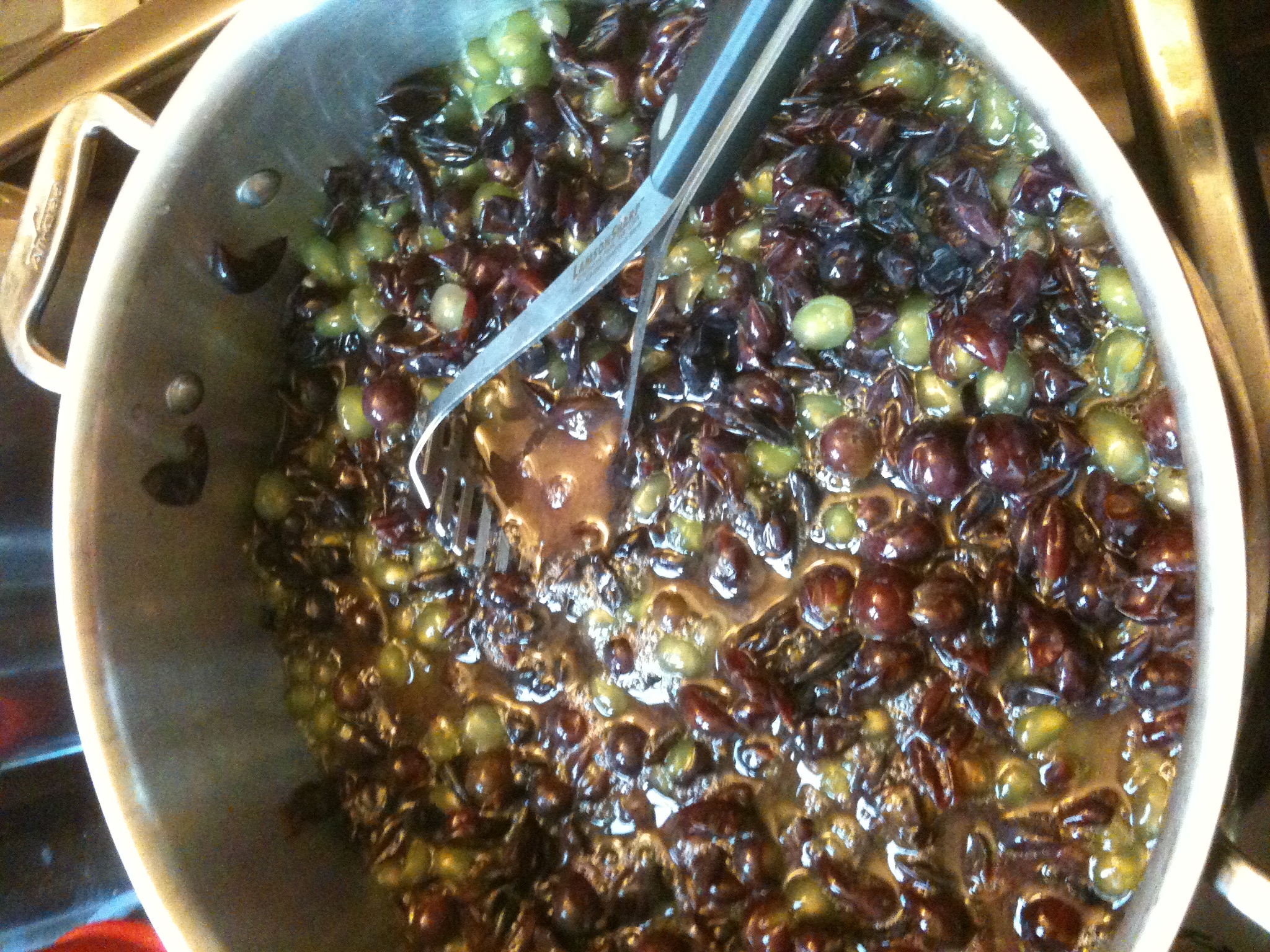
At the end of September the concord grape vines in my backyard were sagging with fruit and I decided I would try my experiment on these. This adds an extra step- I usually prefer jam with nice big chunks of fruit and skin throughout, but Concord grapes have to be made into jelly, not jam, because of the seeds and tough skins which must be removed. After cooking and straining the grapes through cheesecloth, I began to boil the sweet juice.

Now right here I realized I already had a problem. Juice? I stopped right in the middle of my steaming, juice-slopped kitchen, with the sudden realization. We haven’t had juice since January 1, even as a sweetener, where it crops up often at the health food store. The family rule is: fruit must have corresponding fiber attached. Period. Huh. Why hadn’t I thought of this before? What should I do? Well, I was dying to know if my experiment would work, and, I rationalized, if it did, it could be extrapolated to jams which would include the skins and pulp. But today grapes were what I had to work with. Onward.

Now, every box of pectin from the supermarket comes with a long list of instructions for most types of jam or jelly you might want to make, so I dutifully followed the grape instructions to the letter: After discarding the seeds, skins and pulp, I brought 5 ½ cups of my fresh concord grape juice to a boil in a large open pot on the stove. This, by the way, is the very best part of making jam or jelly- the incredible fresh cooking-fruit smell that permeates every corner of your home. Potpourri has nothing on this. If I were to invent a perfume I think it might be “Concord Grape #5,” or possibly “L’eau de Peach.”

At this part of the procedure, with the boiling fruit in one pot and empty glass jars sterilizing surgically in another, I always feel like I’m engaged in some wonderful alchemical process that will transform some delicious but humble fruit into pure edible magic. They’re so beautiful, jars of jam in translucent hues sitting glinting on our shelves, waiting to remind us in the depths of a Vermont winter what the tastes of summer were. In the case of our concord grapes it’s even better because they’re free: the things grow like weeds in our backyard, no matter how badly we treat them, but due to the seeds and skins they aren’t much of a tasty snack. Without the jelly, this wonderful taste would pretty much go to waste, enjoyed by our backyard birds alone.

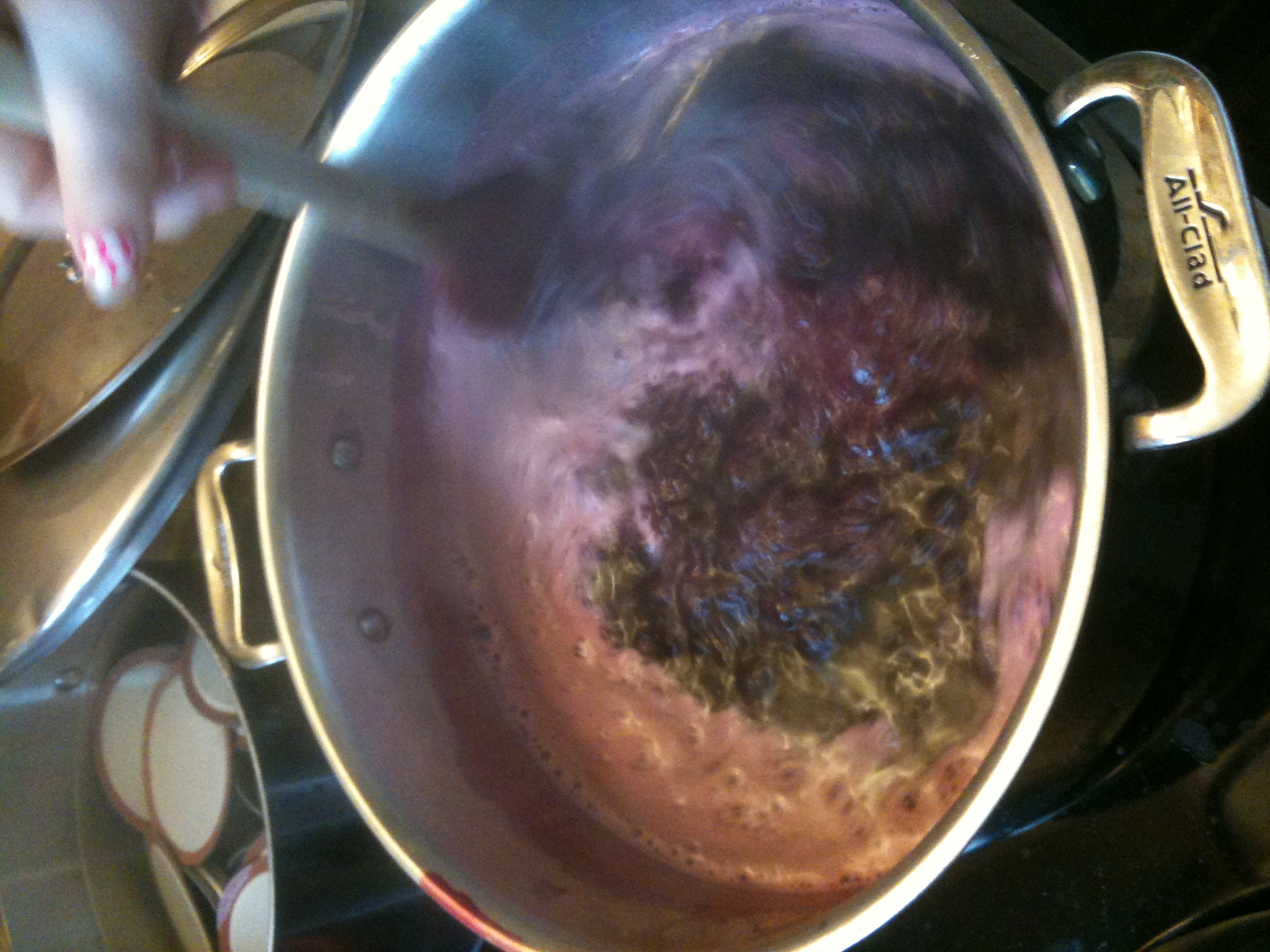
So I followed the recipe. After boiling the intense, incredibly purple juice for ten minutes I added ¼ cup of dextrose (instead of the called-for sugar) to a bowl containing the pectin powder and stirred this into the pot. (This is an extra step which you do with what I buy, which is “Low-Sugar Pectin”: it enables you to use less sugar in your jam, say five cups of sugar instead of seven. Seriously.) Brought to a boil, I then added the rest of the dextrose- 3 ½ more cups. Boiled exactly one minute, and then removed from heat and I began ladling into sterilized jars.

Actually, I cooked it a little longer than one minute, trying to ascertain whether the set-up would really occur using the dextrose. It looked right- gelatinous and jelly-ish. But I’d always relied on pectin to do this part for me… The boiling purple lava was ladled into the jars, hot lids screwed on “finger-tip tight” and into the bigger pot they went for the final sterilization. The filled jars boiled underwater for the requisite five minutes before being pulled out with jar tongs to cool on a dishtowel.

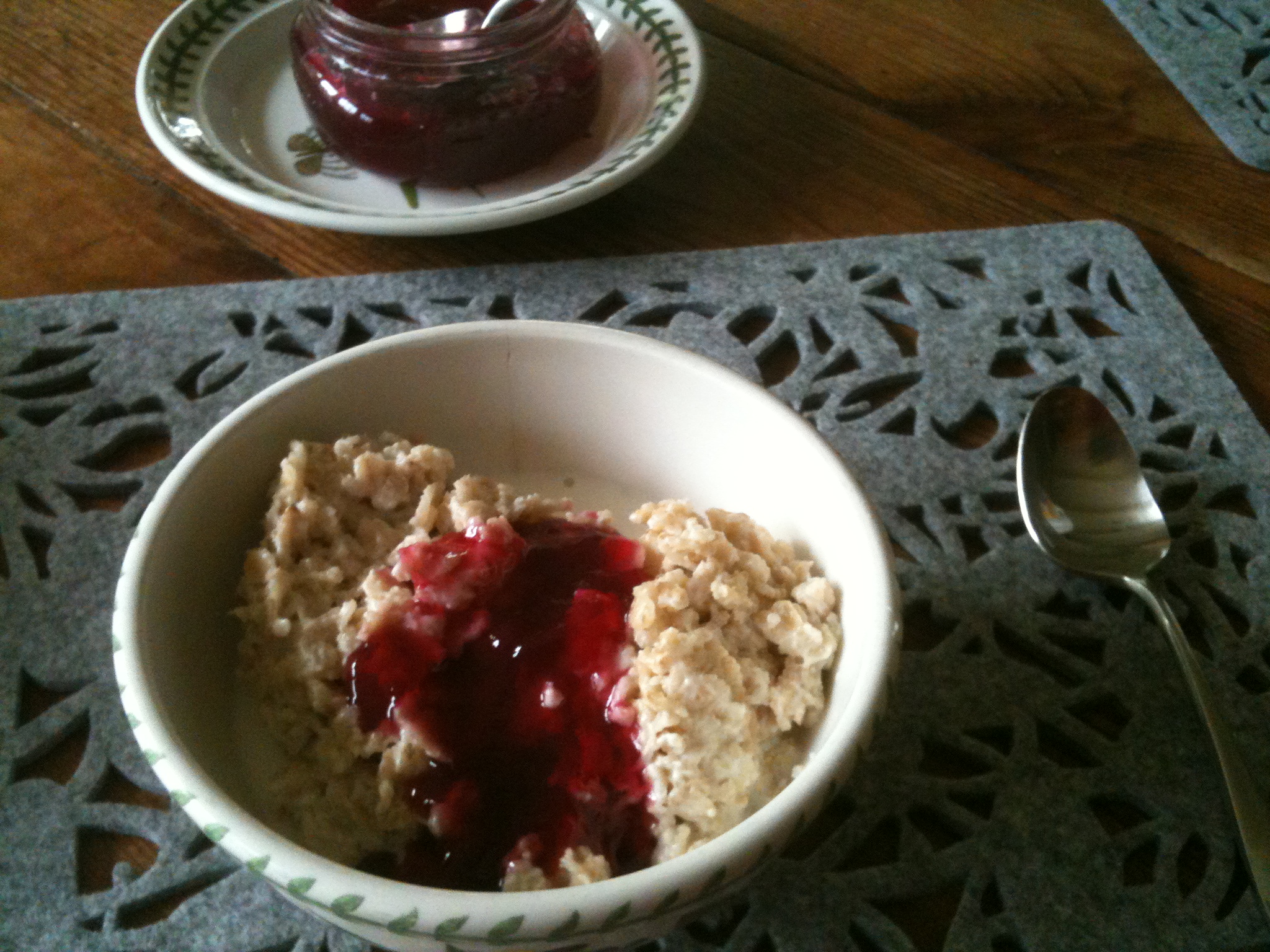
The sad news is that my jelly didn’t set. We proceeded to do what jelly and jam makers have done with failed jelly and jam since time immemorial: we had a lovely sauce. The kids liked it on crackers and on toast. It was sweet…ish. Unlike any jelly I’d had or made before, it truly tasted of the unalloyed grapes. Now, if only the set could be improved…

My research continued. I was determined to figure out what went wrong- and I began to learn a lot of disturbing things. For one, guess what store-bought low-sugar pectin has in it? Now, if you can’t guess by now I’m going to be very disappointed. Yes! SUGAR. That’s right: the low-sugar pectin- “for use with less sugar!” has sugar in it. How ironic. How totally predictable.

Turns out, there is a pectin that you can order or find at the health food store that contains NO sugar, called Pomona’s Universal Pectin. (Instead of being activated by sugar, it is instead activated by calcium.) Even Pomona’s, however, doesn’t list recipes omitting sugar- sugar, honey, artificial sweetener and juice concentrate are all listed, but no sign of the No Added Sugar recipe I’ve been searching for.

(Incidentally, I realized, it helps not to call it Jelly or Jam. “Fruit Spread” seems to be the term of choice for No Sugar variants of this process. Recipes are available online for Fruit Spread which look promising, although the ones I found don’t allow for canning. Rather, they produce a batch that lives in the refrigerator or freezer, which is functional if not quite so beautiful. That might be worth a try.)

But still, I wondered, was there some magical reason sugar was absolutely needed in canned jam and jelly? Was I going to kill my family with my homemade grape “sauce”? Why was the answer so strangely, incredibly elusive? Fortunately a few credible resources do exist online to help those of us who wish to cross over to the dark side of messing with/ understanding our canning recipes: both Oregon State and Colorado State Universities have good Extension websites which finally helped explain what I wanted to know: that, yes, sugar acts not only as a flavoring agent, but also acts as a preservative. And it activates the pectin to activate the “set.”

Silly me, this meant I was adding pectin to my grapes, without the required mountain-load of sugar present to activate it. Did putting it my jelly do virtually nothing? Or would dextrose do the same but just require different amounts? Also, tragically, my grape “sauce” would likely have a shorter shelf-life than the average estimate of a year for canned items. I could live with that.

Wow. You’d think they’d cover all this in Canning and Preserving for Dummies, right? But they don’t. Just shut up and follow the recipe, people. And anyway, what kind of crazy person would ever want to make grape jelly without sugar?