Category Archives: Year Of No Garbage

Happy… Earth Day?

Well, hell. This is not the Earth Day I was expecting.

Not that I’ve ever been exactly sure how I was supposed to celebrate Earth Day… but surely this can’t be it.

Last week they brought BACK the plastic bags at my supermarket whose ban I was so delighted to witness only a few short weeks ago. There’s talk there of prohibiting reusable bags altogether. And bottle and can or plastic film recycling are out of the question: the doors are locked. No more bringing my own containers anywhere. No more buying anything in bulk.

Suddenly I find myself much more worried about getting in and out of the store with the efficiency of a Navy Seal than about whether a product has a non-recyclable plastic ring around the lid. (Get in! Get out! Go home! Stay there!)

Although these changes are deeply dismaying, they’re for the most part hard to argue with. Do we need to be as careful as we can possibly manage to avoid the spread of disease? Of course. Saving lives trumps bringing my plastic bags back to the supermarket.

However, while we’re busy being distracted or panicked, sometimes it’s hard to know when the measures stop making sense anymore. Unfortunately the pandemic presents a golden opportunity to justify anti-environmental behavior under the guise of necessity. Exhibit A: The Environmental Protection Agency has suspended enforcement of environmental laws. That’s right! No more pesky monitoring, lab analysis or reporting. In the United States there are now effectively no penalties for breaking pollution rules. And Coronavirus necessitates this because… if we can’t pollute our own country the germs win?

But don’t worry. “The EPA expects all regulated entities to continue to manage and operate their facilities in a manner that is safe and that protects the public and the environment.” Translation: big corporations are now operating under the honor system. I’m sure everything will be fine.

It’s complicated on the local level too. Sure, everyone agrees waste removal is an essential service, but whether or not recycling is also essential has been left up to the local governments to decide. Cue the chaos. Here in Vermont— Vermont mind you— there’s a proposal to landfill recycling and postpone a ban on landfilling food scraps. Even if these steps are truly necessary, once the crisis has passed, how long will it be before those hard-won environmental gains are re-established? There’s just no telling.

Saving the earth seems to be discontinued until further notice.

It’s a weird time. There’s so much depression, boredom, isolation and fear but at the same time there are moments of unexpected beauty. Polluted skylines the world over are clearing because the world is standing still. The polluted canals of Venice are crystal clear. Wild boar are wandering the streets of Barcelona and a herd of wild deer cavort on Indian streets. We watch from our windows, take videos with our phones. We are a captive audience, literally and figuratively. In our absence, what will nature do to surprise us next?

What can we find to celebrate in such a Through-the-Looking-Glass Earth Day, the 50th anniversary of the first Earth day, no less? I read an article on the World Economic Forum that had a good answer. It argued that what the pandemic offers us is the chance to see the huge difference humans can make when they make individual change.

“Our collective ability to address the damage we’ve done to nature has seemed impossible. Until now… The virus is raging, but we all can help stop it. When’s the last time you felt you could freeze a glacier, or actually help extinguish a forest fire? What we do here – and what we learn – could save lives and help us all endure and thrive as individuals, as communities, as a species.”

Meanwhile, our family is limping our way along in our Year of No Garbage turned Year of Keeping All Our Nice, Clean, Washed Garbage In A Pile In The Kitchen. Today, while cooking, I held up a piece of plastic food packaging and shook my head, and sighed. Was I disappointed at it, or me?

Ilsa laughed.

Today, on the 50th anniversary of Earth Day, I’m asking myself a simple but deeply important question: on the other side of The Great Pause, what will we do with what we’ve learned?
In Search of the Great Intergalactic Space Plastic Solution

Last night, I dreamed I had invented a way to turn clear plastic wrapping into food. I had made a lovely plastic salad that looked like transparent coleslaw. Fortunately I woke up before eating it.

The kitchen is getting… interesting.

Probably this is because one of the concessions the current pandemic has wangled from me is that, I’m not really able to avoid plastic in the manner to which I had become accustomed only a few short weeks ago when this project began. Cheese and meat are the big offenders: my butcher now operates on a “call us and we set it aside for you in lovely vacuum-sealed packages” system and in the interest of limiting shopping trips we visit the supermarket once per week and not the smaller stores that are happy to let us bring our own containers and beeswrap for cheese.

In the grand scheme of illness and hospitalizations, is it important that I can’t stick to my guns as much as I’d like? No. Nevertheless, I’m a rather hopelessly stubborn person, so it’s hard not to feel like I’m somehow failing as I slice open yet another plastic package, (sigh) admitting that at least for the moment I’m in some ways choosing the higher priority of keeping the family happily fed over a family project about the health of the planet.

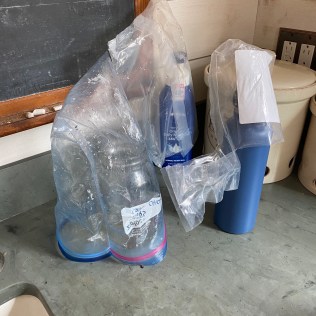
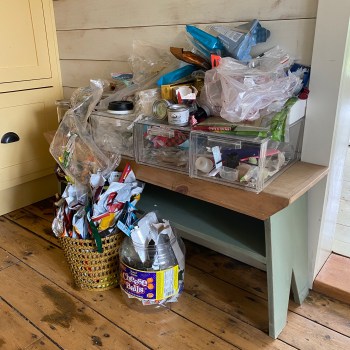
But I’m not giving up. So I dutifully wash and air-dry each and every plastic package, determined to adhere to my No Garbage pledge: plastic it is, yes. However this plastic, at least, is not landfill bound. But where is it bound? And, by the way could we answer this soon, because the recycling corner of my kitchen, as my husband Steve has been quick to point out, is beginning to look more like a Krakatoa composed of plastic wrappers?

The Problem: WHAT IS IT?

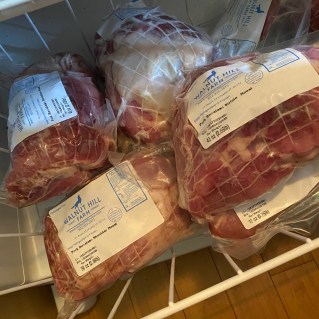
I began by investigating the vacuum pouches meat often comes in. A few months ago we purchased a half a pig for our freezer from a local farmer and it was all packaged this way. I wanted to know: What kind of plastic is this and is it recyclable? I asked the farmer, my friend Rico, who didn’t know, but directed me to the local facility who had processed the meat: Locust Grove Farm. Locust Grove Farm didn’t know, but directed me to their wrapping supplier: the Teri Equipment Company. I called the Teri Equipment Company and they didn’t know, but they directed me to their supplier: UltraSource. Is this starting to sound like one of those circular nursery rhymes where at the end you go right back to the beginning?

But no, at last I got C’eria (pronounced “Sierra”) from UltraSource on the phone who was working from home as evidenced by the baby sounds in the background. And wonderful C’eria solved my problem because she was happy to send me the spec sheet on the plastics used in their vacuum seal plastic.

That’s the good news. The bad news was that, even though vacuum seal plastic looks like it could very well be made of one kind of material, it is in fact made of a whole buffet of different kinds of plastic, including: polyethylene (which can either be plastic #2 or 4), polypropylene (#5), ethylene vinyl alcohol, and ethylene vinyl acetate, (which as far as I can tell both fall into the “other” category.)

These materials are sandwiched together, what they call “co-extruded,” resulting in something called “Multi-Film,” although I think a much better name would have been Intergalactic Space Plastic. (They should really put writers in charge of all naming things.) And the problem with co-extrusion, as I’ve touched on previously, is that different materials that have been scientifically smooshed together are Very Bad for recycling, because most of the time it is too costly or difficult to un-smoosh them, and so no one does it. Voila! Intergalactic Space Plastic becomes landfill fodder for all time.

You’d never know I was a 20 year vegetarian, would you?

Doing a cursory online search of the properties of each of the different materials I could see that each plastic lent a different property to the overall wrapping material, and I’m sure if I were a Packaging Science major I could tell you much more about how amazing the invention of co-extruded, multi-film packaging is, and all of that would be true. Before the Year of No Garbage, did I love that I could buy a package of lovely, sealed, organic ground beef at the supermarket that would keep good for much, MUCH longer than other, mere mortal organic ground beef? Of course– it’s convenient and efficient. It saves waste and money. Longer shelf-life probably even made my supermarket more likely to carry organic meat in the first place.

But where Space Plastic saves waste of food it creates waste of something arguably even worse: permanent, forever garbage. At least wasted food can degrade back into the environment.

On top of that we have our bodies to think of: how much of these different plastics leaches into our meat and ends up in our bodies? I don’t know about you, but I’m not too excited by the idea of becoming a human landfill for all these awesome science-y chemicals. BPA ,PVC, PFA and PFOAs have all gotten a lot of attention in recent years for being cancer-causing and endocrine disrupting, not to mention in the bloodstream of pretty much everybody (according to the CDC, 95% of Americans have PFAs in their bloodstream). Consequently they’ve been removed from much- but not all- food packaging. Does that mean we can assume what’s left is definitively safe? Or is it more likely just a matter of time before we understand what other bad things these chemicals may be doing?

It just seems to make the most sense to avoid plastic wrapping for food as much as possible. Bringing my own container to the butcher was working great until the pandemic caused them to prepackage everything for ordering customers. My butcher was so kind as to even offer to unpackage it when I arrived so I could still use my own containers, but as lovely as that offer was, I knew it just meant he would do the throwing away himself- it was just a loophole.

Nope. I’d have to find a home for this forlorn, unwanted, Super Space Plastic myself.

Plastic Bags? OR Future Hair Scrunchie?

So far I’ve identified two promising options for my burgeoning Mount Everest of Meat Plastic. One is Terracycle, which is a private U.S. company that will recycle your hard-to-recycle stuff if you send it to them in the mail in a pre-paid box (read: expensive.) The other is Precious Plastic, which is an open-source alternative plastic recycling movement supported by grants and volunteers. (read: will I have to join a cult?) In both cases I suspect that my not-normally-recyclable multi-film plastics would be chipped, melted and molded into new recycled plastic products… but I don’t really know for sure. Which means it’s time to make more phone calls.

So stay tuned! Maybe I can make a new yoga mat out of all my old meat wrappers? Now if you’ll excuse me, I have to figure out something to make for lunch besides Plastic Salad. Pandemic cooking is one thing but that’s ridiculous.

Happy Little Tortillas

Confession: I’m not a gluten avoider. Like, in Any. Way. I think homemade bread is one of the most delicious things in the world, and luckily no one in our house has a gluten intolerance because in our pandemic seclusion we are baking a LOT of bread.

I find baking bread to be very meditative and stress relieving, but it is also money-saving and trips-to-the-store-saving. You can avoid unnecessary and unhealthy added sugar (it is a popular misconception that bread needs added sugar to rise) and all those horrible things Big Food loves to add: trans fats, mold inhibitors, colorings and emulsifiers. The amazing thing about bread is that you really only need a handful of simple ingredients, and time.

Of course yet another huge bonus is that making your own bread also serves to eliminate lots of wasteful packaging, much of which is bound for the landfill (I’m looking at YOU, cellophane windows).

In my last post I included a favorite sandwich bread recipe … shortly after that I made these flour tortillas. It makes a big bunch up all at once- like 30 or so- good for anything you can think of: burritos, quesadillas, wraps, etc. They definitely take time, but right now that’s something many of us have in abundance. Give these a try and let me know how they turn out.

Flour Tortillas

In a large bowl whisk together:

  • 6 cups flour
  • 1 Tbsp salt
  • 1 Tbsp baking powder

Then add:

  • 1 cup of bacon fat OR lard OR room temperature butter

Use a pastry cutter or your hands to combine thoroughly.

Add 2 1/4 cups very hot water and combine with hands again.

Knead for 3 minutes.

Let sit 15-20 minutes.

Then pull off small, golf-ball amounts of dough and roll flat with a rolling pin until very, very thin. Kate Moss thin. You will almost be able to see through them. Heat a cast iron pan until very hot (NO need to add oil or butter) and fry until both sides bubble a little and have small brown spots.

If possible, it’s easiest to have one person rolling and another frying. Ilsa and I like to tag team on these jobs. She has become an EXPERT fryer.

As you make them, place them on a plate wrapped in a clean dishtowel to keep them from drying out. I like to store them in our breadbox this way, but if you don’t think you’ll eat them all up in a few days you can freeze some for later.

NOTE: You do not use a tortilla press for these flour tortillas; a press is useful for corn tortillas.

Steve’s Happy Little Tortillas Recipe in Pictures

My husband Steve’s favorite thing to use these for is something he made up: he sprinkles a tortilla with olive oil, Parmesan, chopped garlic and rosemary and toasts in the toaster oven to make these lovely little… what? I don’t know what to call them except Steve’s Happy Little Tortillas, and they are delicious.