All posts by Eve Ogden Schaub

Unknown's avatar

About Eve Ogden Schaub

Serial memoirist Eve O. Schaub lives with her family in Vermont and enjoys performing experiments on them so she can write about it. Author of Year of No Sugar (2014) and Year of No Clutter (2017) and most recently Year of No GARBAGE (2023). Find her on Twitter @Eveschaub IG or eveschaub.com.

A Year of No Sugar: Post 23

Okay! I’ve done my homework and you get to be the beneficiary of that morning-long endeavor, unless of course I have got it all backwards in which case I am here to mislead you terribly. After watching Dr. Robert Lustig’s “Sugar: the Bitter Truth” on YouTube for the third time, as well as doing further slogging around on the internet, I’ve gotten to what I hope is a slightly better understanding of the “ose” question. Here is what I have come up with, which is very likely a gross oversimplification of the matter:

Sucrose– is processed table sugar in all it’s many forms: raw, white, brown etc. It is made up of both glucose and fructose and is harvested from sugar cane or sugar beets.

Fructose– This is the naturally occurring sugar present in fruit, fruit juice, honey, etc.

Glucose– This is the “breakdown product of ingested carbohydrates and the form of sugar that the body uses for energy.” Also known as dextrose.

The quotation above comes from livestrong.com which had several helpful articles on the “ose” question, which was good, because Dr. Lustig’s talk makes the assumption that his audience already knows the difference between these terms.

As a side note, I have to say that I was once again dumbfounded at what an incredible, informative and persuasive talk “Sugar” is… Maybe it’s just me, but then again it has been watched, as of today, 766,122 times on YouTube, so I guess I’m not the only one to find it compelling. And this is despite the fact that he bandies about terms such as “hepatic steatosis” and “dyslipidemia” with unsettling ease.

One of the most striking, if complicated, parts of this video is where Lustig goes through and, point by point, details exactly what happens in your body biochemically when one ingests two pieces of white bread versus a shot of bourbon versus a glass of orange juice. You might be surprised to see his very clear demonstration that the glass of orange juice (fructose) behaves in one’s body most like the alcohol, with the exception that alcohol is processed by the brain while fructose is processed by the liver. Acute toxin meet chronic toxin. As Lustig puts it:

“You wouldn’t think twice about not giving your kid a Budweiser, but you don’t think twice about giving your kid a can of Coke. But they’re the same. In the same dosing. For the same reason. Through the same mechanism. Fructose is ethanol without the buzz.”

Whoa. And that goes for fruit juice too, by the way. Pediatric patients coming to Dr. Lustig are advised to drink only milk or water. And by a funny coincidence, that’s exactly what you are left with after omitting all drinks containing either sucrose or fructose.

So the only question that I’m still ruminating on for the moment is that of dextrose specifically: is added dextrose okay on the No-Added Sugar Project as Devised and Implemented by Eve? After all, it isn’t sucrose and it isn’t fructose. According to just about everybody it’s glucose– which Dr. Lustig describes as “the energy of life.” So, does it matter that it’s added as an ingredient, rather than manufactured by my body after eating a piece of bread? Or, is it like other ingredients such as artificial colorings or preservatives, ie: better to do without, but not expressly prohibited under No-Added Sugar? And if so, does this mean my kids can eat the french fries at the skating rink again, resulting in my popularity as a mom going up by about ten-thousand points?

These are the questions that keep me up at night.

A Year of No Sugar: Post 22

“So we are being poisoned by this stuff and its been added surruptitiously to all of our food; every processed food.”
-Dr. Robert Lustig – “Sugar: The Bitter Truth”

You’d think it’d be simple to exclude sugar from your diet, right? Not easy perhaps, but at least reasonably simple. You wouldn’t have to be an Einstein. Just look at the ingredients, and then when you find sugar- don’t eat it. Simple.Yet lately I’ve been running into some ingredients that have been defying my supposedly fool-proof plan. Dextrose for one.

Flashback to last week: for several days I wasn’t feeling so well, and as a result I was behind: behind on my cooking, behind on my shopping, behind on my meal-planning. Somehow we muddled through, but one night when I was feeling particularly desperate, half-ill and starving, I hauled out an industrial size bag of frozen “Bertolli” chicken with cream sauce and bowtie pasta. Okay, the ingredient list was longer than my arm, and appeared to have been at least partially written in some unknown foreign language, but this was a food emergency. At least there was no sugar; I had purchased this on my first “no sugar” BJ’s run a few weeks ago.

Of course, silly me had to double check, which as we have already thus far learned can be a big mistake if you’d like to actually eat anytime in the near future. What I found was within the chicken ingredients of meat, water and seasoning, the first sub-ingredient under “seasoning” was: “dextrose.” Dextrose? %^&*#$!

So you know what? I felt crappy. I was starving. And there was pretty much nothing else in the kitchen at that moment that seemed even remotely appealing. I cut open the bag, dumped it into the non-stick pan, cooked it for the requisite ten minutes and we ate it anyway… dextrose or no dextrose.

Upon completing our meal my first thought was that something was amiss- what was it? I realized it seemed really odd to me how quickly our meal had come together- I mean, a meal like chicken and bow-tie pasta with spinach and cream sauce doesn’t just happen all by itself! How long would a recipe like that normally take me? At least an hour but very likely more, not to mention all the dirty dishes that would result from washing spinach, separately cooking chicken, carefully simmering the cream sauce in a pan while boiling the pasta in another pot.

So it occurred to me that this meal had been sponsored: brought to you by dextrose! (As well as its friends isolated soy protein product and sodium phosphate!) The inverse correlation was very clear: the fewer chemicals and additives, the greater amount of meal prep/ cooking and clean-up time, and vice versa.

But it had also become clear to me that there are so many pseudonyms for sugar and it’s variants that I need to do some homework. When I look up “dextrose” on the internet I find a host of confusing answers: “Better known today as glucose, this sugar is the chief source of energy in the body.” While another advertisers hail dextrose powder as “Corn sugar!” that is “30% less sweet than pure or refined sugar.” So, forgive me for being dense, but which is it? Is it something that we create in our bodies to provide energy, or is it an added sugar?

True confessions time: biochemistry was not my best subject. Can you tell? So what is sugar? What are the differences between terms like sucrose, glucose and fructose? And where the heck does dextrose come in? Are all “ose” words sugar-related? What about bellicose? Today I happened upon a website of diabetes information that listed a frightening amount of “reduced calorie sweeteners” to look out for, without so much as an “-ose” ending to tip us off:

…found primarily in packaged foods such as cookies, gum, and candy. Reduced-calorie sweeteners include sorbitol, mannitol, lactitiol, maltitol, xylitol, isomalt, erythritol, and hydrogenated starch hydrolysates.

Am I the only one who is starting to break out in a sweat just trying to define “sugar” in a list of ingredients? Probably. I don’t know too many other people who would worry whether their food contained isomalt or not.

It’s clear to me that sometimes I’m splitting hairs, because I have to. I put back a box of cereal in the supermarket because it contains “two percent or less” of molasses or cane syrup, and yet how sure am I really that the waitress in the restaurant knows there is no sugar in the tortillas? Did she check for isomalt? Or xylitol? Of course not.

So I’m off to watch Dr. Lustig’s talk “Sugar: the Bitter Truth” for the third time, in hopes of decoding the mystery of the “-ose.”

A Year of No Sugar: Post 21

I’ve never been very good at improvising. Despite my established status as a crafty-arty person, I am, I’m afraid, heartbreakingly literal in some ways- especially when it comes to food.

Just ask Katrina. She’s the friend who made me realize it was, perhaps, just a teensy bit rigid of me to time the pasta cooking to the second, just to make a pot of Annie’s Mac and Cheese. Have I made this mom-staple three thousand times? Yes. No matter: it takes an extreme force of will to get me to dump the pasta out a few seconds early, and it would plainly never occur to me to dump the milk in unmeasured. Gasp!

I’ve been known not to make a recipe at all for lack of a single, tangential ingredient, such as ½ tsp of tarragon. After all, I reason, that might make the dish! And why go through all the effort to make something not as good as it is supposed to be?

Over time, I have learned to loosen up somewhat- but it is on the No Sugar Project that my improvising wings have been forced to take flight, for better or worse. It started with me bravely leaving out a teaspoon of sugar here, a tablespoon of honey there. And so far everything had been- fine! I baked baguettes without ¾ of a teaspoon of sugar, cheddar cheese soup without Worcestershire sauce (couldn’t find a no-sugar version), and sweet potato biscuits without 2 tablespoons sugar.

But I’ve been feeling… empty lately: hungry not just for food per-se but for richness and variety in our diet. My older daughter mentioned that she could not eat another hard-boiled egg for breakfast and I know just what she means. So, following a certain degree of success with the somewhat unconventional apple-raisin cookie recipe I found online, I’ve decided to branch out and experiment in the name of enlarging our no-sugar dessert possibilities. After all we’ve given up sugar, not sweet.

So last night I tried making an apricot bar recipe that we have loved in the past, but omitting the ¾ cup of brown sugar called for in the butter and flour crust. Now ¾ cup is a lot more than a tablespoon, and I realized some sort of replacement would be necessary to round out the crust, and provide it with the correct density and stick-together-i-ness.

I ended up deciding to try ¾ cup mushed banana. I felt very adventurous, and half-sure we’d end up with an inedible mess.

Good news! The apricot bars weren’t just edible, they were actually good! I mean, the kids ate them up, which is really the true test. Turns out the banana pulp provided just the right amount of stickiness to form a proper crust and emitted a delicious sweet smell while baking. Of course, the bars weren’t nearly as sweet as before, but they were sweet, primarily due to the cooked apricot filling; despite the smell, the banana taste wasn’t very detectible in the end product. I cooked them a little longer in an attempt to get them to brown on the top in an appetizing way, but in the end I thought maybe adding an egg to the crust next time would do more to help in this regard.

Isn’t that nice? I’m ridiculously proud of myself, and am happy to have sent that empty feeling packing for the moment. I’ll have to remember this moment for times in the future when I’m hacking failed experiments into the trash with an ice pick.

For those of you who’d like to play along at home, here’s the recipe as modified from the original “Lemon Date Bars” found in Moosewood Restaurant Cooks at Home:

Eve’s No Sugar Apricot Bars

  • 2 cups chopped dried apricots
  • juice of 1 lemon
  • 1/2 cup water
  • 1/2 cup butter, softened
  • 3/4 cup mushed up ripe banana
  • 1 3/4 cups all-purpose flour
  • 1 tsp salt
  • 1/2 tsp baking soda
  • 1 cup rolled oats

Preheat oven to 350

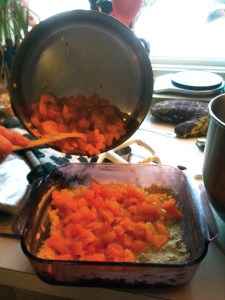
In a saucepan, combine the apricots, lemon juice and water. Cook, covered, on low heat for 10 minutes, stirring occasionally. Remove from heat and set aside.

In a bowl, cream together butter and banana. Stir in flour, salt and baking soda. Add oats and mix well, using your hands. The dough should be crumbly, but hold together when squeezed. Press two-thirds of the dough into a buttered 8 or 9 inch square pan. Stir the apricot mixture and spread it over the dough. Crumble the remaining dough on top. Bake for 40-45 minutes. Cool in the pan. Cut into bars.