All posts by Eve Ogden Schaub

Unknown's avatar

About Eve Ogden Schaub

Serial memoirist Eve O. Schaub lives with her family in Vermont and enjoys performing experiments on them so she can write about it. Author of Year of No Sugar (2014) and Year of No Clutter (2017) and most recently Year of No GARBAGE (2023). Find her on Twitter @Eveschaub IG or eveschaub.com.

In Search of the Great Intergalactic Space Plastic Solution

Last night, I dreamed I had invented a way to turn clear plastic wrapping into food. I had made a lovely plastic salad that looked like transparent coleslaw. Fortunately I woke up before eating it.
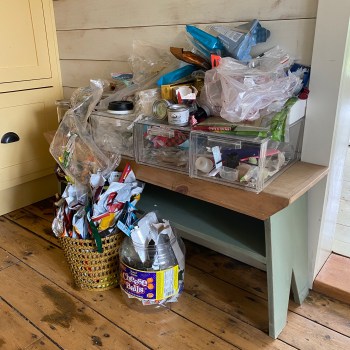
The kitchen is getting… interesting.

Probably this is because one of the concessions the current pandemic has wangled from me is that, I’m not really able to avoid plastic in the manner to which I had become accustomed only a few short weeks ago when this project began. Cheese and meat are the big offenders: my butcher now operates on a “call us and we set it aside for you in lovely vacuum-sealed packages” system and in the interest of limiting shopping trips we visit the supermarket once per week and not the smaller stores that are happy to let us bring our own containers and beeswrap for cheese.

In the grand scheme of illness and hospitalizations, is it important that I can’t stick to my guns as much as I’d like? No. Nevertheless, I’m a rather hopelessly stubborn person, so it’s hard not to feel like I’m somehow failing as I slice open yet another plastic package, (sigh) admitting that at least for the moment I’m in some ways choosing the higher priority of keeping the family happily fed over a family project about the health of the planet.

But I’m not giving up. So I dutifully wash and air-dry each and every plastic package, determined to adhere to my No Garbage pledge: plastic it is, yes. However this plastic, at least, is not landfill bound. But where is it bound? And, by the way could we answer this soon, because the recycling corner of my kitchen, as my husband Steve has been quick to point out, is beginning to look more like a Krakatoa composed of plastic wrappers?

The Problem: WHAT IS IT?

I began by investigating the vacuum pouches meat often comes in. A few months ago we purchased a half a pig for our freezer from a local farmer and it was all packaged this way. I wanted to know: What kind of plastic is this and is it recyclable? I asked the farmer, my friend Rico, who didn’t know, but directed me to the local facility who had processed the meat: Locust Grove Farm. Locust Grove Farm didn’t know, but directed me to their wrapping supplier: the Teri Equipment Company. I called the Teri Equipment Company and they didn’t know, but they directed me to their supplier: UltraSource. Is this starting to sound like one of those circular nursery rhymes where at the end you go right back to the beginning?

But no, at last I got C’eria (pronounced “Sierra”) from UltraSource on the phone who was working from home as evidenced by the baby sounds in the background. And wonderful C’eria solved my problem because she was happy to send me the spec sheet on the plastics used in their vacuum seal plastic.

That’s the good news. The bad news was that, even though vacuum seal plastic looks like it could very well be made of one kind of material, it is in fact made of a whole buffet of different kinds of plastic, including: polyethylene (which can either be plastic #2 or 4), polypropylene (#5), ethylene vinyl alcohol, and ethylene vinyl acetate, (which as far as I can tell both fall into the “other” category.)

These materials are sandwiched together, what they call “co-extruded,” resulting in something called “Multi-Film,” although I think a much better name would have been Intergalactic Space Plastic. (They should really put writers in charge of all naming things.) And the problem with co-extrusion, as I’ve touched on previously, is that different materials that have been scientifically smooshed together are Very Bad for recycling, because most of the time it is too costly or difficult to un-smoosh them, and so no one does it. Voila! Intergalactic Space Plastic becomes landfill fodder for all time.
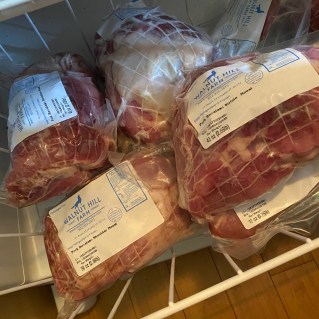
You’d never know I was a 20 year vegetarian, would you?

Doing a cursory online search of the properties of each of the different materials I could see that each plastic lent a different property to the overall wrapping material, and I’m sure if I were a Packaging Science major I could tell you much more about how amazing the invention of co-extruded, multi-film packaging is, and all of that would be true. Before the Year of No Garbage, did I love that I could buy a package of lovely, sealed, organic ground beef at the supermarket that would keep good for much, MUCH longer than other, mere mortal organic ground beef? Of course– it’s convenient and efficient. It saves waste and money. Longer shelf-life probably even made my supermarket more likely to carry organic meat in the first place.

But where Space Plastic saves waste of food it creates waste of something arguably even worse: permanent, forever garbage. At least wasted food can degrade back into the environment.

On top of that we have our bodies to think of: how much of these different plastics leaches into our meat and ends up in our bodies? I don’t know about you, but I’m not too excited by the idea of becoming a human landfill for all these awesome science-y chemicals. BPA ,PVC, PFA and PFOAs have all gotten a lot of attention in recent years for being cancer-causing and endocrine disrupting, not to mention in the bloodstream of pretty much everybody (according to the CDC, 95% of Americans have PFAs in their bloodstream). Consequently they’ve been removed from much- but not all- food packaging. Does that mean we can assume what’s left is definitively safe? Or is it more likely just a matter of time before we understand what other bad things these chemicals may be doing?

It just seems to make the most sense to avoid plastic wrapping for food as much as possible. Bringing my own container to the butcher was working great until the pandemic caused them to prepackage everything for ordering customers. My butcher was so kind as to even offer to unpackage it when I arrived so I could still use my own containers, but as lovely as that offer was, I knew it just meant he would do the throwing away himself- it was just a loophole.

Nope. I’d have to find a home for this forlorn, unwanted, Super Space Plastic myself.
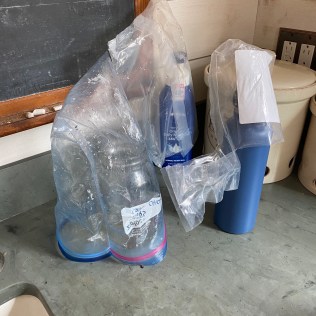
Plastic Bags? OR Future Hair Scrunchie?

So far I’ve identified two promising options for my burgeoning Mount Everest of Meat Plastic. One is Terracycle, which is a private U.S. company that will recycle your hard-to-recycle stuff if you send it to them in the mail in a pre-paid box (read: expensive.) The other is Precious Plastic, which is an open-source alternative plastic recycling movement supported by grants and volunteers. (read: will I have to join a cult?) In both cases I suspect that my not-normally-recyclable multi-film plastics would be chipped, melted and molded into new recycled plastic products… but I don’t really know for sure. Which means it’s time to make more phone calls.

So stay tuned! Maybe I can make a new yoga mat out of all my old meat wrappers? Now if you’ll excuse me, I have to figure out something to make for lunch besides Plastic Salad. Pandemic cooking is one thing but that’s ridiculous.

Happy Little Tortillas

Confession: I’m not a gluten avoider. Like, in Any. Way. I think homemade bread is one of the most delicious things in the world, and luckily no one in our house has a gluten intolerance because in our pandemic seclusion we are baking a LOT of bread.

I find baking bread to be very meditative and stress relieving, but it is also money-saving and trips-to-the-store-saving. You can avoid unnecessary and unhealthy added sugar (it is a popular misconception that bread needs added sugar to rise) and all those horrible things Big Food loves to add: trans fats, mold inhibitors, colorings and emulsifiers. The amazing thing about bread is that you really only need a handful of simple ingredients, and time.

Of course yet another huge bonus is that making your own bread also serves to eliminate lots of wasteful packaging, much of which is bound for the landfill (I’m looking at YOU, cellophane windows).

In my last post I included a favorite sandwich bread recipe … shortly after that I made these flour tortillas. It makes a big bunch up all at once- like 30 or so- good for anything you can think of: burritos, quesadillas, wraps, etc. They definitely take time, but right now that’s something many of us have in abundance. Give these a try and let me know how they turn out.

Flour Tortillas

In a large bowl whisk together:

  • 6 cups flour
  • 1 Tbsp salt
  • 1 Tbsp baking powder

Then add:

  • 1 cup of bacon fat OR lard OR room temperature butter

Use a pastry cutter or your hands to combine thoroughly.

Add 2 1/4 cups very hot water and combine with hands again.

Knead for 3 minutes.

Let sit 15-20 minutes.

Then pull off small, golf-ball amounts of dough and roll flat with a rolling pin until very, very thin. Kate Moss thin. You will almost be able to see through them. Heat a cast iron pan until very hot (NO need to add oil or butter) and fry until both sides bubble a little and have small brown spots.

If possible, it’s easiest to have one person rolling and another frying. Ilsa and I like to tag team on these jobs. She has become an EXPERT fryer.

As you make them, place them on a plate wrapped in a clean dishtowel to keep them from drying out. I like to store them in our breadbox this way, but if you don’t think you’ll eat them all up in a few days you can freeze some for later.

NOTE: You do not use a tortilla press for these flour tortillas; a press is useful for corn tortillas.

Steve’s Happy Little Tortillas Recipe in Pictures

My husband Steve’s favorite thing to use these for is something he made up: he sprinkles a tortilla with olive oil, Parmesan, chopped garlic and rosemary and toasts in the toaster oven to make these lovely little… what? I don’t know what to call them except Steve’s Happy Little Tortillas, and they are delicious.

Lunch at Our Table

Lately, a surprising amount of my energy is devoted to the task of not being terrified. I’m a person who suffers from obsessive anxiety, so even pre-Corona virus I was really, really good at washing my hands. Like, I already sang the alphabet song.

Now I sing Wagner’s Ring cycle.

Luckily, for me, I have enough other things to keep my circular thought patterns at bay: the task of keeping a houseful of teenagers and young adults fed, for example. Ever since my daughter’s acting conservatory closed two weeks ago, we’ve had six under our roof, which is double our usual number, including Greta, her actor boyfriend, and her dear friend who is also studying acting.

I was delighted to have them all here, refugees from the panic that has become New York City. I was delighted too, that I could cook for them, because that always makes me feel that I am caring for people. It gives me purpose, makes me feel that I’m literally making the people around me more happy and healthy by feeding them nutritious, homemade food.

The only problem is that I’ve never cooked for the Brady Bunch before, and I keep wondering where the heck Alice is. Between the fact that I make pretty much everything from scratch, and was doing all the dishes? Three meals a day? With no “Hey! Let’s go out tonight and give Mom a break!” in sight?

It has knocked me for a serious loop. I was going to bed exhausted, planning meals in my head, and waking up exhausted, planning meals in my head. Why, you may be wondering, didn’t I ask for help? I don’t know. Part of it is sheer stubbornness. Another part of it is probably my unconscious, deciding that it was better to be on the brink of exhaustion than to think about the scary things that are going on in the world right now.

Thank goodness, things on the Eve Exhaustion Front have now significantly improved. I finally started accepting help when it was offered (imagine that!) and even asking for it upon occasion. We set up a calendar of chores so everyone in the house is now contributing every day. And Greta’s friend made the decision to fly home to her parents, which made us sad to lose her company, but in sheer practical terms also meant one less mouth to feed.

That’s a phrase that strikes me as very old-fashioned: “one less mouth to feed.” It reminds me of stories about the Depression, and the Little Rascals short films that took place in orphanages (“Don’t drink the milk!” “Why?” “It’s spoiled!”). I think about the American Girl historical fiction movies with their young characters living through World Wars and the Depression and their fictional family members who died or disappeared and all anyone could do was bring you a casserole.

What does any of this have to do with No Garbage? In my mind it’s all connected. In fact, weirdly enough, all three of my family adventure-projects seems bound up together for me in living through this current crisis: sugar, clutter, waste. All of these themes have to do with how we live our lives, and- perhaps you’ve noticed?- currently how we live our lives has been thoroughly upended.

For example: my younger daughter, Ilsa, needed a quiet place to park her laptop and attend “school” every morning, and our under-used upstairs room seemed the obvious choice. But, truth be told, this “Hell Room” (the room I spent the entirety of my Year of No Clutter clearing out) has been backsliding into Hellishness for some time now. So I had some work to do.

Interestingly, I discovered some newfound decluttering energy, and Ilsa and I cleared a neat space for her with little trouble. I think it was easier than my past efforts because I had a practical problem to solve, quickly, and thinking practically changes me: it makes me not think quite as much about tomorrow and some future self, but about what we need now, today. I liked the change. So much so that I’ve continued to clean and organize the rest of the room since: if I can manage to clear it out still further it could also become another good space for other things… reading, relaxing, being. I was surprised to realize that all it took was actually needing the space, to make me more effective and efficient.

Meanwhile, in the kitchen we are running a tighter, more efficient ship as well. Yes, No Sugar taught me to cook things from scratch, and yes, No Clutter has been teaching me about planning and thinking ahead to avoid packaging. But this new normal has been bringing home cooking and planning in our house to a new level, and it’s pretty much all lunch’s fault.

Once upon a time, the midday meal in our house had been a “winging it” affair, an amalgam of leftovers, “just in case” foods (“Don’t we have a frozen burrito left in there somewhere?”) and school lunches. Now? Now we have meals. Planned ones. Only. Every day I make sure we have a hot, sit-down meal to feed five people three separate times. This is because social distancing makes our grocery shopping no longer casual- “oh I’ll pick up some milk on the way home”- but instead infrequent, targeted and specific. It is also because we are feeding more people, and therefore the only way I can be sure there’s actually enough food for everyone to eat. It’s a lot of work, for sure, and sometimes I get very overwhelmed, but it’s no different than our ancestors have done for centuries.

As it turns out— and I’m as surprised as anyone about this— living No Sugar, No Clutter and No Garbage all lead to the same place: being thoughtful and devoting the time. When people are nostalgic for the “good old days” they’re not pining for beef shortages and the Whooping Cough, I’m pretty sure what they’re captivated by, when it comes down to it, is the pace. Even the Little Rascals sat down for breakfast together. Being thoughtful about your space, your resources, your food, where the objects of our life come from and where they all go; devoting the time to put those ideals into practice… getting objects to people who will love and use them, recycling and reusing, cooking as much as possible from scratch. These all sound like old-fashioned ideals that many will tell you just aren’t possible in modern society, but all they require is being thoughtful and devoting time.

How do we want to live? What kind of people do we want to be? If we try to find a silver lining in this crisis it could be that it is forcing so many of us to stop running headlong through life, believing we don’t have time for things. Life is time. If we are alive we have time, and don’t let anyone tell you it isn’t up to you how to spend it. What we, as a culture, need to do is stop ceding control of that time, those decisions about how we spend it, to someone or something else- our culture, our job, our technology, our expectations, or someone else’s.

Right now my daughter Greta is downstairs baking bread for lunch today. She won’t use sugar, create clutter or make any garbage in the process. Today we’ve done the best we can do, and that’s good enough. I know I was born with a truly exceptional ability to worry about the future, and that’s what comes easily. The harder part is reminding myself instead that today is what we have and often- often- that’s pretty darned good. The harder part is reminding myself to just be grateful for a family lunch at our table, and a still-warm loaf of bread.

—-

Homemade bread nourishes you twice: it’s relaxing to make it and delicious to eat it.

Here’s my favorite bread recipe, what Greta made today. If you make it let me know how it turns out!:

Oatmeal Sandwich Bread

  • 1 cup old fashioned oats
  • 3 cups boiling water
  • 1 1/2 Tbsp active dry yeast
  • 2 teaspoons kosher salt
  • 2 Tbsp olive oil
  • 1/2 cup barley malt syrup or brown rice syrup (in a pinch you can even use dark corn syrup, which is glucose not fructose)
  • 2 cups whole wheat flour
  • 5 cups all-purpose flour

In the bowl of a mixer, put a cup of oats. Pour boiling water over oats and let sit one hour.

At one hour, sprinkle the yeast, salt, and olive oil on top. Add the barley malt syrup and mix with dough hook. Stir in whole wheat flour. Stir in 2 cups of all-purpose flour. Then stir in 2 more cups of all-purpose flour, 1/2 cup at a time, mixing in between each addition.

Turn dough out onto a foured surface for kneading. Use the final cup of flour to add to dough whenever it gets sticky. Knead for five minutes, until dough has absorbed most of the final cup of flour and feels smooth. Place in a bowl and allow to rise for one hour.

Butter two loaf pans and heat oven to 350 degrees. After the hour has passed, turn dough onto counter, cut in half, and place each half in a bread pan. Allow to rise another 30 minutes.

Bake at 350 for 33 minutes. Remove bread from oven and allow to sit for five minutes before turning loaves out and letting cool on a rack.