Tag Archives: family project

There’s a Crazy Lady in the Kitchen

Steve walked into the kitchen today as I sat in the middle of what most people would call a pile of garbage, and asked “What are you doing?”

“Playing.” I said.

“Oh, okay.” he said, walking back out again.

There was a pause before I called after him, “Do you think I’m crazy?”

“Oh, I know it.”

I love my husband.
Hiding it all under the bed suddenly seems like a very viable option.

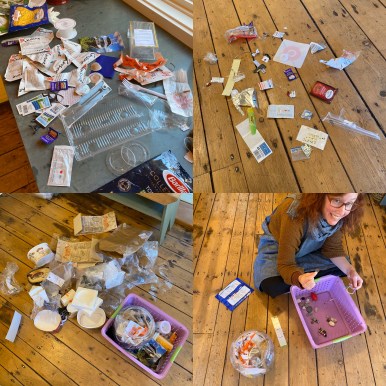
Of course, I wasn’t sitting in a pile of garbage, because in our house garbage doesn’t exist. Instead I was sitting in the middle of a whole bunch of items we no longer want or need, and now have to figure out exactly what to do with.

Although I was having fun sorting all my non-treasure into piles, it had all started because I had gotten angry. Earlier that morning, in the back of a cabinet, I had come across some ancient, expired boxes of yogurt starter and what normally would have been a two-second flip over my shoulder into the garbage can turned into twenty minutes of me opening each individual foil packet and dumping the powder into our compost, all the while fuming that the foil packages were going to be The Next Problem. Because foil/paper packages are designed to be garbage and nothing else; there is no second life for expired packages of yogurt starter. As I sat there getting yogurt starter powder on my feet and all over the floor I imagined a conversation with the yogurt company that began with me yelling at the folks in the packaging science department.

EXACTLY WHAT are we supposed to do with these after they are used? What do you mean you don’t have a plan? These are just supposed to go sit in an airless, non-decomposing hole for the rest of ETERNITY- is that it? That’s your brilliant solution??

Ah, the poor yogurt starter people. After imagining yelling at them I felt kind of bad about it. Making yogurt starter is a noble profession, and one which enables people to use less packaging in other ways, since they’re making homemade yogurt and not buying those packages, after all.

It’s just that I can’t figure our why on earth the world wide packaging industry is allowed to make things that we have no plan for after their initial use is done. It’s like this giant invisible loophole in our produce-and-consume economy that no one wants to talk about.

And as I wondered about this I was inspired to proceed to the recycling corner of my kitchen and angrily dump out onto the floor the three successive containers of “I don’t know” that I’ve accumulated over the past ten weeks. Surveying the devastation, certain key themes emerged, but one reigned supreme.

Multilayers. By this I mean extruded combinations of paper, foil and/or plastic. Multilayers are almost always pure, unadulterated landfill fodder and have now arisen as the bane of my existence. Frozen food packaging, plasticized produce tags, pull-off seals, stickers, tickets and receipts are among the items that show up repeatedly in my big pile. All of them are multilayers.

It’s hard not to look at this depressing pile and think of the zero-wasters online explaining how all their garbage for the year fits into a thimble. I remind myself for the frillionth time that we’re learning as we go. I make a resolution to attend the farmers market more, so to avoid things like vegetable tags and frozen food wrappers. I vow to redouble my efforts on the “No receipt please!” front, without actually screaming at anyone, although it is difficult when so many places don’t ask if you want a receipt- they just hand it to you. I know it sounds odd, but sometimes I just don’t have the heart to tell them I don’t want it. I need to get better about that.

Lastly, I ‘m tempted to call the information hotline for these multilayer-wrapped products and ask whoever answers the phone, What do I do with this?

I’m pretty sure the response I’d get is a confused, What do you mean? Throw it away!

Then I’d go back to my yogurt-starter-tirade and tell them:

Don’t you know there is no such thing as “away”?

The Mysterious Milkman and Aseptic Cartons

I can still recall the milk box we had when I was a kid. A cube-shaped metal container sat outside our front door and would fill with fresh, new glass bottles of milk once a week. I never saw the milkman, so it seemed rather like a magic trick: put empty bottles in and- poof– new milk appears! Whenever my parents got home from work, they’d bring them inside.

Our old milk box looked just like this one and now I feel very old.

It kind of boggles my mind now. At the time no one seemed particularly worried about the milk spoiling out there in the non-insulated box… or freezing… or that someone would tamper with the milk. The bottles each had a little round foil cap that peeled off the top when you wanted to open a new one, and it never sealed perfectly again once opened, but no one seemed too concerned about that either.

I know this makes me sound like perhaps I grew up sometime just before the invention of the icebox but this was the seventies, people.

Fast forward to my No Garbage project of today and here I am again thinking about milk. The pile of HELP WHAT DO I DO WITH THIS in my kitchen is ever-so gradually getting smaller, but the empty containers for milk are comparatively large and stacking up, effectively presenting themselves as the next urgent question to answer.

Before this project began I used to recycle milk cartons, thinking: paper. But soon after beginning the project I thought: Wait. Paper coated with plastic. If I have learned anything in the first two months of the Year of No Garbage, it’s that Frankenstein combinations of materials- such as paper and plastic squashed together by heat, say- are inherently evil, unrecyclable landfill fodder, probably invented by Satan.

I hear the cartons are meeting in secret at night behind the blender. I don’t like it.

But I realized that when it came to cartons I just really didn’t know. In search of answers online, I came upon the Carton Council, an industry organization that promotes carton recycling. Oh, hooray!! I thought. On their site you can input your zip code and it will instantly tell you whether recycling that includes cartons is available in your area. Now, when you live in Vermont NOTHING is ever available in your area, so I was sad, but not terribly surprised, to see that mine did not.

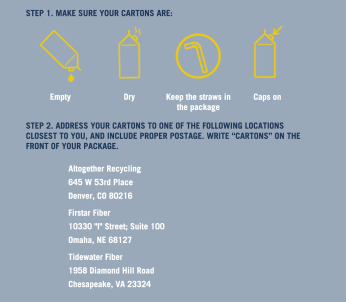
Fear not! the Carton Council website assured me, because you can mail your cartons in for recycling. To places like Virginia and Nebraska. It’s free except for postage, and, after all, this is not super-heavy material we’re talking about.

Okay, at least there’s something I can do, I thought. I didn’t love it, first because any additional level of complexity or cost is going to make it that much less likely for the average person to actually do it, and second because the environmental footprint of mailing boxes of cartons across the country to recycle them raises serious questions about the net impact of the whole endeavor. Aren’t we defeating the purpose a bit here?

The Carton Council’s list of places you can mail your cartons to currently.

Then I just happened to take a closer look at my garbage service “recyclable” list. Waitaminute! Contrary to what the all-knowing Carton Council website had indicated, milk cartons are on the list! This was excellent news.

But what about other cartons? The Carton Council’s mail-in locations also accept lots of other cartons, i.e. the boxes that hold shelf-stable things like juice boxes, soup and chicken broth. These items are labeled “Tetra Paks.” I don’t encounter them often, because we don’t drink juice and I usually make my own broth from leftover chicken bones and freeze it, but now that I’m having trouble buying whole chickens without plastic, my broth supply has dwindled to nothing.

Perhaps I could solve this problem, I thought, by buying Tetra Paks of broth for soups and sauces? Maybe those would be the only things I’d have to mail to Denver or Omaha.

But then I noticed something else intriguing on the list for curbside recycling: they also accepted something called aseptic cartons. What was that? The lady who answers the phone for my garbage service had no idea. Back to the Internet.

AHA! It turns out there are two kinds of cartons: refrigerated “gable top” (like the kind milk comes in) and shelf stable “aseptic ” (like the kind chicken broth comes in.) Both are combinations of polyethylene and paper, but aseptic includes a layer of aluminum as well. And aseptic is the generic name for Tetra Pak, which is a brand name. They’re the same thing.
The good news is that both of these kinds of cartons, unlike other paper/plastic amalgams— such as thermal receipts—can be separated back into their components for recycling.

The bad news is that this process still requires a fair amount of energy and effort, such as trucking giant bales of the cartons hundred of miles for elaborate processing. Although it keeps these materials out of the landfill, this still seems to defeat the purpose of being sustainable and earth friendly.

Hmm. So I can put my cartons, both gable top and aseptic/Tetra Pak, in the curbside recycling, and putting them in recycling is better than not putting them in recycling. But better still would be to find alternatives. For milk, I’m looking into a local dairy that has returnable glass bottles just like those of my youth. For chicken broth, my local butcher tells me if I call him ahead of time I can purchase chicken carcasses he’s butchered for parts, and bring it home in my own container no less. Promising leads, for sure.

I do miss the mysterious ways of the Dellwood milkman, though. He made it all seem so effortless.

Demystifying the Big Supermarket Box

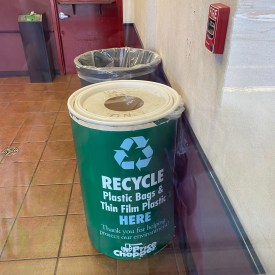
For a while now I’ve wondered what the deal is with those mysterious boxes at the front of the supermarket offering to recycle your plastic shopping bags. Often they’re just big cartons or barrels with a slot in the top and a green recycling arrow on the side. I can’t imagine I’m the only person who’s ever wondered, yeah, but what is this? I mean:

A Mystery Worthy of a Scooby Doo Episode?
Admit it. You’ve wondered.

Who collects the bags?

Where do they go?

What can you make plastic bags into anyway- more plastic bags?

Can you recycle other plastics in these boxes?

But after a little research the other day, I was able to call up Stephanie, who helped me to sort it all out. Stephanie works for Trex, and Trex is the answer to the question “Who wants a bunch of empty plastic shopping bags?” This is because Trex turns them into composite decking for outdoor porches and railings.

Yes! There is a company that really does want these plastic shopping bags, and that really will do something constructive with them. Best of all, none of this is part of an elaborate hoax to relieve our guilt at having forgotten the reusable bags at home. Again.

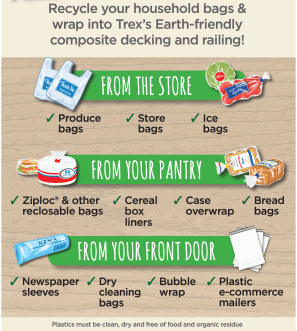
But it gets even better, because Trex doesn’t just want your plastic shopping bags; they want all your polyethylene, which is a science-y word for plastic film, and includes a whole lot of things you’re probably throwing away right now. I found a fabulous poster on the Trex website that I printed out and am hanging in our kitchen to remind us of all the many things that— as long as they are clean and dry— can go into this magical box at our supermarket, including:

  • bread bags
  • ice bags
  • produce bags (both the kind that come on rolls in the store and the kind apples and oranges are already bagged in)
  • plastic overwrap from things like paper towels, toilet paper and water bottle cases
  • bubble wrap, bubble mailers and air pillows (deflated)
  • dry cleaning bags
  • Ziploc bags
  • newspaper bags
  • cereal box liners (unless they tear like paper)


If you don’t find that list super exciting, then you clearly are not me. For one thing, this opens up a whole host of products I thought I wouldn’t be able to buy at all this year, from sandwich bread to cereal. Yes, I’ll still make my own bread and buy it from the bakery. Yes, I’ll still be bringing my reusable mesh produce bags with me on my shopping expeditions.

Print the full poster by clicking here

Yes, I will still always choose the lowest-plastic option of any product, because at 300 million tons of new plastic made per year the world certainly doesn’t need my encouragement to make any more, whether it gets recycled or not. But still. The other day when my daughter Ilsa felt crappy and asked for toast, it was a relief not to have to drive for an hour or wait for bread dough to rise all afternoon- I could just buy her a loaf at the store ten minutes away.

(When your kid is sick, not having to make a choice between them and the entire planetary ecosystem can be worth a lot.)

Now if you are like me you’ve tried to be good. When you read various recycling instructions you inevitably read the recycling warnings too. This is the part that says, in effect: IF YOU PUT ONE WRONG ITEM IN HERE YOU WILL DESTROY AN ENTIRE BATCH OF RECYCLING AND PROBABLY MURDER A POLAR BEAR IN THE PROCESS. These dire warnings all send the same message: “when it doubt, throw it out.” I take issue with this. We don’t need more encouragement to throw things into the landfill. What we need is better information.

Which is why I like people like Stephanie at Trex so much. Her job has everything to do with giving people more information so they can recycle correctly. More companies should have a Stephanie, to answer questions from the public not just about their products, but about their product packaging, and what exactly they expect us to do with it so as to not strangle the planet.

Stephanie answered other questions I had too. She told me that when the plastic film recycling boxes are full they get returned to the supermarket’s distribution centers, where they are converted into 1000-pound bales. She explained that most distribution centers ship one semi-load of these plastic bales to Trex every two weeks.

Oh, this is WAY too small for you to read! Instead check here to see if your supermarket sends its Plastic Film to Trex

Wow. That’s a lot of not-landfill.

Most importantly, she told me some simple steps to help people avoid putting the wrong kind of plastic film into the Trex boxes. First, check if it is marked with a #2 or #4 plastics recycling number. If so, this is polyethylene and YES! Trex wants it.

If, however, there is no number to be found, here is an easy test:

  1. Is the plastic able to be stretched? YES! Trex wants it.
  2. Is it shiny or crinkly? NO!! Trex cannot use this.

Things that fall into the shiny/crinkly NO!! category include:

  • pre-washed salad mix bags
  • frozen food bags
  • candy wrappers
  • chip bags
  • 6-pack rings.

So there you have it: some bona-fide good news, courtesy a company that is totally getting a Valentine from me this year. On recycled paper, of course.