Category Archives: A Year of No Sugar

A Year of No Sugar: Post 22

“So we are being poisoned by this stuff and its been added surruptitiously to all of our food; every processed food.”

-Dr. Robert Lustig – “Sugar: The Bitter Truth”

You’d think it’d be simple to exclude sugar from your diet, right? Not easy perhaps, but at least reasonably simple. You wouldn’t have to be an Einstein. Just look at the ingredients, and then when you find sugar- don’t eat it. Simple.Yet lately I’ve been running into some ingredients that have been defying my supposedly fool-proof plan. Dextrose for one.

Flashback to last week: for several days I wasn’t feeling so well, and as a result I was behind: behind on my cooking, behind on my shopping, behind on my meal-planning. Somehow we muddled through, but one night when I was feeling particularly desperate, half-ill and starving, I hauled out an industrial size bag of frozen “Bertolli” chicken with cream sauce and bowtie pasta. Okay, the ingredient list was longer than my arm, and appeared to have been at least partially written in some unknown foreign language, but this was a food emergency. At least there was no sugar; I had purchased this on my first “no sugar” BJ’s run a few weeks ago.

Of course, silly me had to double check, which as we have already thus far learned can be a big mistake if you’d like to actually eat anytime in the near future. What I found was within the chicken ingredients of meat, water and seasoning, the first sub-ingredient under “seasoning” was: “dextrose.” Dextrose? %^&*#$!

So you know what? I felt crappy. I was starving. And there was pretty much nothing else in the kitchen at that moment that seemed even remotely appealing. I cut open the bag, dumped it into the non-stick pan, cooked it for the requisite ten minutes and we ate it anyway… dextrose or no dextrose.

Upon completing our meal my first thought was that something was amiss- what was it? I realized it seemed really odd to me how quickly our meal had come together- I mean, a meal like chicken and bow-tie pasta with spinach and cream sauce doesn’t just happen all by itself! How long would a recipe like that normally take me? At least an hour but very likely more, not to mention all the dirty dishes that would result from washing spinach, separately cooking chicken, carefully simmering the cream sauce in a pan while boiling the pasta in another pot.

So it occurred to me that this meal had been sponsored: brought to you by dextrose! (As well as its friends isolated soy protein product and sodium phosphate!) The inverse correlation was very clear: the fewer chemicals and additives, the greater amount of meal prep/ cooking and clean-up time, and vice versa.

But it had also become clear to me that there are so many pseudonyms for sugar and it’s variants that I need to do some homework. When I look up “dextrose” on the internet I find a host of confusing answers: “Better known today as glucose, this sugar is the chief source of energy in the body.” While another advertisers hail dextrose powder as “Corn sugar!” that is “30% less sweet than pure or refined sugar.” So, forgive me for being dense, but which is it? Is it something that we create in our bodies to provide energy, or is it an added sugar?

True confessions time: biochemistry was not my best subject. Can you tell? So what is sugar? What are the differences between terms like sucrose, glucose and fructose? And where the heck does dextrose come in? Are all “ose” words sugar-related? What about bellicose? Today I happened upon a website of diabetes information that listed a frightening amount of “reduced calorie sweeteners” to look out for, without so much as an “-ose” ending to tip us off:

…found primarily in packaged foods such as cookies, gum, and candy. Reduced-calorie sweeteners include sorbitol, mannitol, lactitiol, maltitol, xylitol, isomalt, erythritol, and hydrogenated starch hydrolysates.

Am I the only one who is starting to break out in a sweat just trying to define “sugar” in a list of ingredients? Probably. I don’t know too many other people who would worry whether their food contained isomalt or not.

It’s clear to me that sometimes I’m splitting hairs, because I have to. I put back a box of cereal in the supermarket because it contains “two percent or less” of molasses or cane syrup, and yet how sure am I really that the waitress in the restaurant knows there is no sugar in the tortillas? Did she check for isomalt? Or xylitol? Of course not.

So I’m off to watch Dr. Lustig’s talk “Sugar: the Bitter Truth” for the third time, in hopes of decoding the mystery of the “-ose.”
A Year of No Sugar: Post 21

I’ve never been very good at improvising. Despite my established status as a crafty-arty person, I am, I’m afraid, heartbreakingly literal in some ways- especially when it comes to food.

Just ask Katrina. She’s the friend who made me realize it was, perhaps, just a teensy bit rigid of me to time the pasta cooking to the second, just to make a pot of Annie’s Mac and Cheese. Have I made this mom-staple three thousand times? Yes. No matter: it takes an extreme force of will to get me to dump the pasta out a few seconds early, and it would plainly never occur to me to dump the milk in unmeasured. Gasp!

I’ve been known not to make a recipe at all for lack of a single, tangential ingredient, such as ½ tsp of tarragon. After all, I reason, that might make the dish! And why go through all the effort to make something not as good as it is supposed to be?

Over time, I have learned to loosen up somewhat- but it is on the No Sugar Project that my improvising wings have been forced to take flight, for better or worse. It started with me bravely leaving out a teaspoon of sugar here, a tablespoon of honey there. And so far everything had been- fine! I baked baguettes without ¾ of a teaspoon of sugar, cheddar cheese soup without Worcestershire sauce (couldn’t find a no-sugar version), and sweet potato biscuits without 2 tablespoons sugar.

But I’ve been feeling… empty lately: hungry not just for food per-se but for richness and variety in our diet. My older daughter mentioned that she could not eat another hard-boiled egg for breakfast and I know just what she means. So, following a certain degree of success with the somewhat unconventional apple-raisin cookie recipe I found online, I’ve decided to branch out and experiment in the name of enlarging our no-sugar dessert possibilities. After all we’ve given up sugar, not sweet.

So last night I tried making an apricot bar recipe that we have loved in the past, but omitting the ¾ cup of brown sugar called for in the butter and flour crust. Now ¾ cup is a lot more than a tablespoon, and I realized some sort of replacement would be necessary to round out the crust, and provide it with the correct density and stick-together-i-ness.

I ended up deciding to try ¾ cup mushed banana. I felt very adventurous, and half-sure we’d end up with an inedible mess.

Good news! The apricot bars weren’t just edible, they were actually good! I mean, the kids ate them up, which is really the true test. Turns out the banana pulp provided just the right amount of stickiness to form a proper crust and emitted a delicious sweet smell while baking. Of course, the bars weren’t nearly as sweet as before, but they were sweet, primarily due to the cooked apricot filling; despite the smell, the banana taste wasn’t very detectible in the end product. I cooked them a little longer in an attempt to get them to brown on the top in an appetizing way, but in the end I thought maybe adding an egg to the crust next time would do more to help in this regard.

Isn’t that nice? I’m ridiculously proud of myself, and am happy to have sent that empty feeling packing for the moment. I’ll have to remember this moment for times in the future when I’m hacking failed experiments into the trash with an ice pick.

For those of you who’d like to play along at home, here’s the recipe as modified from the original “Lemon Date Bars” found in Moosewood Restaurant Cooks at Home:

Eve’s No Sugar Apricot Bars

  • 2 cups chopped dried apricots
  • juice of 1 lemon
  • 1/2 cup water
  • 1/2 cup butter, softened
  • 3/4 cup mushed up ripe banana
  • 1 3/4 cups all-purpose flour
  • 1 tsp salt
  • 1/2 tsp baking soda
  • 1 cup rolled oats

Preheat oven to 350

In a saucepan, combine the apricots, lemon juice and water. Cook, covered, on low heat for 10 minutes, stirring occasionally. Remove from heat and set aside.

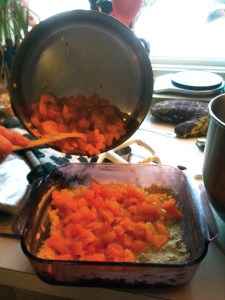
In a bowl, cream together butter and banana. Stir in flour, salt and baking soda. Add oats and mix well, using your hands. The dough should be crumbly, but hold together when squeezed. Press two-thirds of the dough into a buttered 8 or 9 inch square pan. Stir the apricot mixture and spread it over the dough. Crumble the remaining dough on top. Bake for 40-45 minutes. Cool in the pan. Cut into bars.

A Year of No Sugar: Post 20

It’s hard to know whether I’m being a killjoy or not. I mean- of course I am. No sugar? Hel-lo? But my thought along the way has been that there are lots of ways to celebrate, to have fun, to mark milestones… we’re just removing one of them, right?

And yet. My mom put it best when she mentioned she had purchased Valentines for the girls with no candy. It was hard, she said, not only because sugar is everywhere, but because buying special celebratory treats with sugar in them is “a lot of the fun.” Taking the sugar out of Valentine’s Day for my mom might be akin to taking the roller coasters out of amusement parks for others: like, why would you do that? Isn’t that messing with the point of the whole thing?

Yes- but, in our culture at least, we don’t ride roller coasters for breakfast, lunch and dinner. Riding a roller coaster is, I even would venture to say, a “special” activity. Over time, and due to the ever-increasing cheapness of corn-based sugars in particular, food manufacturers have become expert at hiding sugar in virtually every ingredient in practically every meal. So what’s my problem? Here is my problem: sugar isn’t special anymore. We just think it is.

This is how one can go, for example, to a kid’s birthday party and have a meal consisting of pizza with sugar in the crust, sugar in the tomato sauce, and a big glass of sugar to drink, by which I mean fruit juice. By the time we get to the overt sugar of dessert, we often don’t realize how much sugar we’ve already had. Multiply this by three times a day…? Add in the fact that dessert in Brobdingnagian portions is available at practically every restaurant into which one ventures? “Death by Chocolate” may be right.

So last night my husband Steve and I enjoyed a much more successful date night than two weeks ago, managing to have a nice meal at a restaurant in a nearby town. When I asked the waitress if the nachos contained any sugar (hey- you didn’t think I was going to eat tofu and dirt, did you?) she immediately asked if I was avoiding carbs, or sugar in particular. “No sugar as an ingredient,” I clarified, impressed with her quickness on the topic; clearly she has dealt with many a client seeking to satisfy the requirements of one eating plan or another. I mentioned that I was particularly wondering about the corn chips or the salsa.

She assured me that there was no sugar in any aspect of the nacho appetizer. Despite her confidence, I had to wonder… really? I mean, how do you know? Are we counting all of sugar’s many aliases too? I mean, it’s been a month plus and I’m still learning new ones. It makes me think of the two girls in my older daughter’s class who are deathly allergic to nuts… if I end up unknowingly eating some dextrose or evaporated cane syrup in my meal, it isn’t going to kill me after all. It’s difficult to imagine how worrisome an ordinary thing like dinner at a restaurant must be for anyone with such serious ingredient concerns.

Food in our society has gotten sufficiently complicated that one feels the need to bring a magnifying glass and a wikipedia search engine to every list of ingredients one encounters, not to mention adding an extra hour to our day for deciphering. And who does that? It’s just too hard. Eat the darn thing- we say in surrender- it’s probably not going to kill you. It seems to me that today’s time-saving food products are like tax returns: the only people who know what’s in them anymore are the professionals.