Category Archives: A Year of No Sugar

A Year of No Sugar: Post 34

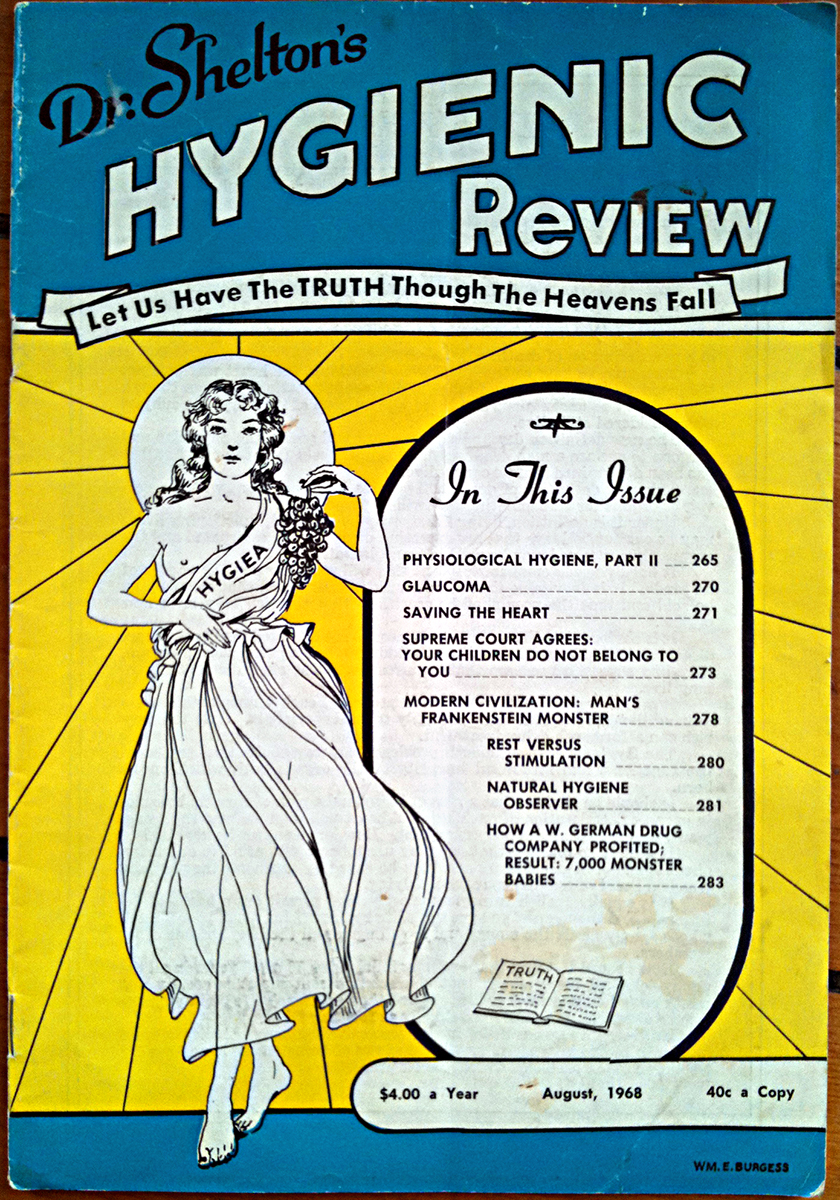
Food extremism is nothing new to my husband Steve. He grew up in a home that was a bit of a nutritional house divided: his mom serving the foods most people were eating in the mid-west in the seventies and eighties- pot roast, mac and cheese, pudding, etc.- while his dad frequently ate a different meal altogether, experimenting with various different nutritional theories he was reading about in specialty magazines like “Dr. Shelton’s Hygienic Review.” (motto: “Let Us Have Truth Though The Heavens Fall.”)

Steve’s father, who passed away a few years ago, was a vegetarian before people even knew what that was, back when health food stores were still fringe operations frequented and operated by folks who still thought communes might be a really good idea. But Bill Schaub was no long-haired hippy; he was a trim, clean-shaven lawyer who would one day rise to become Regional Director of the National Labor Relations Board and be conferred the rank of Meritorious Executive in the Senior Executive Service by President Bill Clinton. I try to picture him walking into the Toledo-area granola shop in his suit, his aftershave clashing with the smell of patchouli and wheat grass.

My husband recalls the time his father took him to see the watershed movie Star Wars. Steve was not very excited to go, because outings with his father were often nutrition oriented and pretty dry stuff for an eight year old: “I thought we were going to a lecture on carrot juice or something.”

In another favorite Bill Schaub story, he grew a mustache, (of course! it was the seventies!) This development coincided with the peak of his interest in the nutritional value of mangos and his decision to import boxes of the fruit himself, which of course resulted in his brown mustache turning mango-colored from the sheer volume of orange fruit that passed his lips.

There are lots of Bill Schaub anecdotes like this, illustrating his passion and single-mindedness when it came to the subject of nutrition and food. Steve is his father’s son, and inherited from him not only an attentive attitude toward food and nutrition, but also the unusual ability to endure strange and restrictive diets for various goals.

For example, in addition to our family’s ongoing No Sugar Project, Steve has for the last seven weeks also been shunning all dairy, and all bread products. Also no potatoes. Basically just meat, eggs, and any vegetable and fruit which you could eat raw. You can imagine how much fun we are in restaurants.

Eve: “I have a strange question. Does the lasagna have sugar in it? And also, what about the soup?”

Steve: “Can you tell me, is there gluten in the sausage? What about in the cabbage? I’m also not eating dairy…”

Eve: “No, the kids don’t want lemonade, could they just have water…?”

Oh yes, the waitresses just love us.

The thing is it has worked. I mean, Steve looked completely fine before, and thin compared to your average American profile. But in a few weeks on this Paleo / Raw diet he’s lost over twenty five pounds. I know! We’ve been buying him new pants since nothing fits anymore- he looks great. More importantly, he’s clearly happier.

Interestingly, Steve’s father had an addiction to sweet things- cookies, ice cream- which he battled with all his life. Steve’s own addiction is much more specific: diet Dr. Pepper. Not to put to fine a point on it, Diet Dr. Pepper is Steve-crack.

The other day Steve sheepishly brought home a case of the stuff, justifying, “well, I thought it could just drink it in the evening as a snack…”

After I gently pointed out the Steve-crack phenomenon, even he agreed it probably should stop. I know it’s not easy- we all like to have our crutches to lean on when we feel depressed and deprived. For me, “mother’s little helper” is more vague… once upon a time pre-project I would’ve enjoyed a bit of chocolate or cookie after every lunch and dinner- a sweet of some kind albeit a small one. I still miss that ritual, that sweet little ending to a meal. Lately I supplement that desire with an alternate treat- a banana, an unsweetened cappuccino, a GoRaw granola bar with raisins in it. It gives rise to the question: do we have to chose between health (long-term happiness) and desire-gratification (short-term happiness)?

The other day Steve was talking about his dad. “If my dad was alive today he’d be fascinated by this project,” he said. “He’d be sending us articles and talking to us about it all the time…” I know. It’s sad he isn’t here to share it with us.
A Year of No Sugar: Post 33

After the harshest, wettest, and snowiest Vermont winter in recent memory, everyone I know is ravenously ready for Spring. It’s to the point that the sixty degree high on Sunday made us all delirious with hope, and conversely, made Monday morning’s rather ordinary snowfall seem much more ominous and depressing than it really ought to have been.

“It’s just a ‘sugar snow’,” my husband Steve announced. Apparently that was the word at Mach’s, our local general store, that morning. It’s a funny term I hadn’t heard before, and I wasn’t sure to what it referred: the fact that it literally looked like a sprinkling of sugar across the transitional brown and green mess of a landscape, or the fact that it’s “sugaring time,” when the rising and falling temperatures wreak havoc with the tree sap, allowing for the hallowed practice of maple syrup production to take place on scales large and small throughout the state.

It is hard to underestimate the impact that maple syrup, and it’s related products— maple (“Indian”) sugar, maple sugar candy, maple cream, maple “creemies” (soft ice cream), maple cotton candy, maple roasted nuts, and so on— have on the culture, economy, and collective unconscious of Vermont. Just look at our state quarter: a guy straight out of Vermont-stereotype casting, sporting a plaid jacket and sugaring with buckets the old fashioned way. (Although metal sap buckets are still used here and there, the preferred modern method for serious producers involves a much less bucolic plastic sap line which runs from tree to tree.)

If you’ve never had maple syrup fresh, by which I mean straight out of the boiling-down process, this is an experience you must try to have in your lifetime, because there is no other taste in the world like it. There is some sort of magic that is happening just then, as the water is evaporated out of the sap slowly, hovered over for hours in the warmth of the sugarhouse, that you can actually taste at no other time than right then. Likely, you will have wind burned cheeks and be stamping your muddy feet, when someone hands you a Dixie cup containing a tablespoon or two of warm, pure gold. Warning: your taste buds may very well be spoiled forever.

Every year our family looks forward to the best maple-themed event we’ve encountered yet: the Merck Forest annual maple sugaring breakfast. A fundraiser for this non-profit “working landscape” of cabins, trails, hunting, livestock and farming, the event featured their first warm syrup of the season poured liberally over some very good pancakes and sausage (which used to be from their own farmed hogs, but sadly is now brought in from elsewhere.) On this day, the large, recently-built sugarhouse is crammed with chairs and long tables, coats and mittens splayed everywhere, the air redolent with smells of sweet syrup, pork fat, and hot black coffee. The line always, always extends out the warm door and into the whiteness outside. Folks are arriving in their snow boots, on snowshoes, on skis or by horse-drawn cart. In the corner of the busy room are displays and dioramas explaining the sugaring process, as well as usually some young and fuzzy Vermont man strumming a guitar. Every so often a volunteer will take groups of kids outside to let them take turns tapping a tree.

When I saw the banner for the event this year hanging from Dorr’s red barn in Manchester, I was sad. Although there’s a lot I love about this project— trying an experiment, doing something differently and then writing about it, finding interesting new ways to eat, feeling healthier and more informed, bonding together as a family— I can’t say there isn’t a loss involved too. And because we are here in Vermont, that loss is inextricably intertwined with the sap of the maple tree. It would probably be going too far to say that we are alienated from our culture or our neighbors or our other family by our decision to shun sugar for a year, but it wouldn’t be an exaggeration to say that where there is gain, there must also be loss.

“It’s only for a year,” I say to myself, a little anxiously, hoping that for all the effort and denial involved that we will have found this experiment to be worth it in the end. “I mean, come on,” I think, “it’s only sugar, right?” Meanwhile the “sugar snow” lays delicately outside my window, waiting to melt.

—-

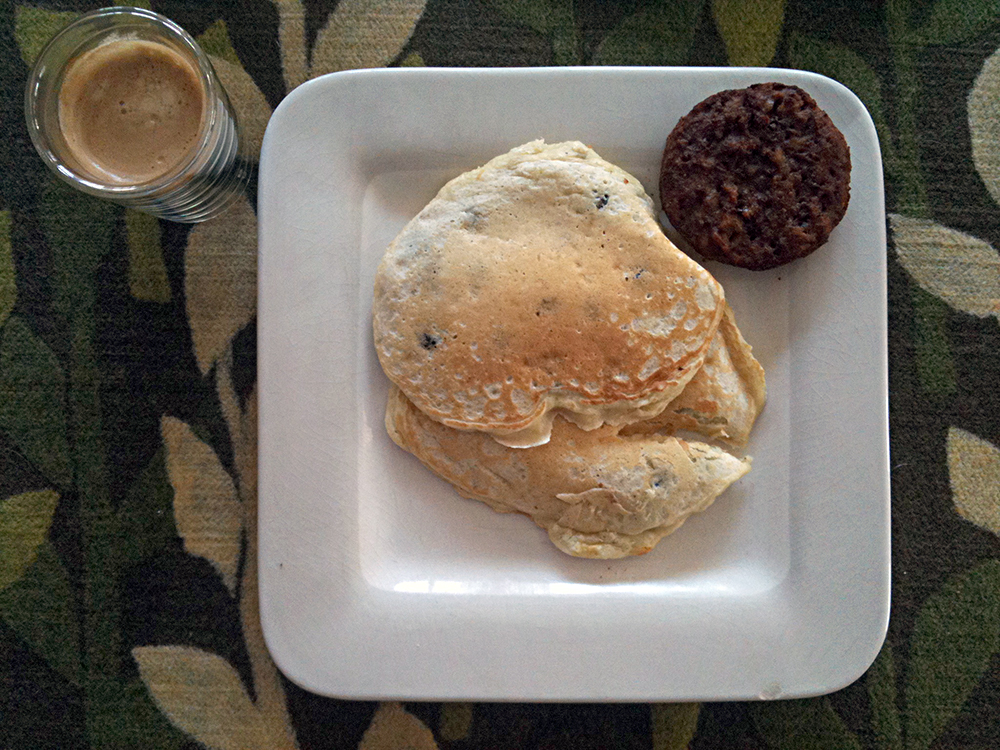
PS- At least we can still have great pancakes: this weekend Steve innovated his own version of a Joy of Cooking pancake recipe, omitting the sugar and adding in banana, blueberries and unsweetened coconut. You will truly not believe how good these are until you try them- they really are so good as to make the syrup issue superfluous.

Steve’s Heresy Pancakes*

Whisk together in a large bowl:

  • 1.5 cups all-purpose flour
  • 3 bananas mashed with a fork
  • 1.5 teaspoons baking powder
  • .5 teaspoon kosher salt
  • 1 cup unsweetened grated coconut
  • 1 cup blueberries, frozen is perfect.

Whisk together in another bowl:

  • 1.5 cups whole milk
  • 3 tablespoons unsalted butter, melted
  • 2 large fresh eggs
  • .5 teaspoon vanilla

Pour the wet ingredients over the dry ingredients and gently whisk them together. Heat pan to medium low and cook till both sides are nice and golden!!

(*what, no Vermont maple syrup? Heresy!)

A Year of No Sugar: Post 32

One day last week when I was still at the Mayo Clinic with my Dad, we were eating lunch in the cafeteria when a rather heavyset couple sat down at the other end of our table. Of course, you never know why someone is a Mayo, or even which person in a couple or group of people might be the “patient,” but wandering around you do tend to look at folks and wonder… why is she here? Is it him? All these people are suffering in some way, some more obviously than others. One day I met a woman at the hotel’s laundry machines who explained without prompting that her husband was so ill- with pancreatitis I think it was- that she couldn’t leave him in the room alone very long. As we were talking she got a cell phone call to tell her that her nephew had cancer.

Occasionally you would notice someone red-eyed and sniffling into a Kleenex as you sat down in one of the many waiting rooms… what could anyone really say? Or do? Who knows what news they may have just received? And then you see the children with parents heading to an appointment and you just pray they are here for something ridiculously benign, like an inverted hangnail.

But back to the large couple in the cafeteria. They had clearly gotten the “I’m trying to be good, or mostly good” meal: they each had purchased a large chef’s salad with a breadstick, she had added a banana and a skim milk, while he had a large diet soda and a piece of pie for dessert. I couldn’t help but wonder to myself if they wouldn’t have been better off enjoying a meal with much more fat but much less sugar/fake sugar. I mean, sugar (or the chemically fake stuff) was in the salad dressing, in the breadstick, in the diet soda and in the pie… it was freakin’ everywhere on their tray and it was as if I, through some mutant power which might qualify me to be a comic book superhero, was the only one who could see it. I idly wondered if perhaps one of them suffered from one of the many variants of metabolic syndrome, and if so, if anyone would ever offer the suggestion that they might be healthier forgoing the salad in favor of the pot roast and mashed potatoes…

Now, clearly, I’m no doctor, no nurse, and no dietitian. But it just seems to make a lot of sense to me when Dr. Robert Lustig says that we’re effectively missing the technicolor elephant in the living room when we caution people to watch their salt, watch their fat, watch their alcohol, but rarely if ever do we mention the deleterious effects of sugar, and it’s omnipresence in our contemporary diet.

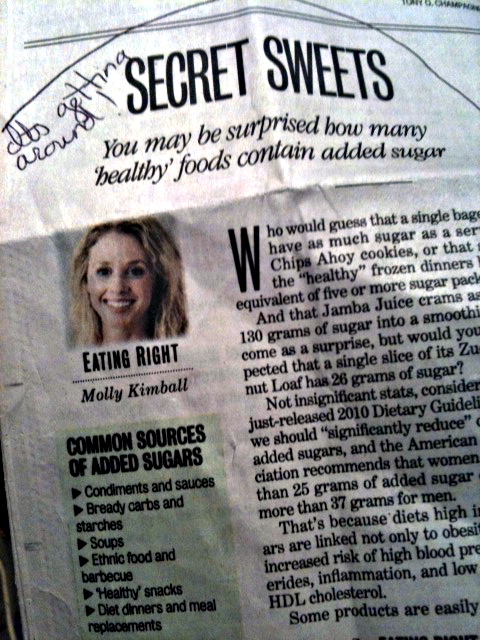
But maybe, if enough of us pester our poor waitresses for ingredients and start reading the depressing labels on the foods in our supermarket, just maybe that dialogue will change. Recently my mother sent me a short article that appeared in the February 11 issue of the New Orleans Times-Picayune by dietitian Molly Kimball, entitled, “Secret Sweets: You my be surprised how many ‘healthy’ foods contain added sugar.”

In the article, Kimball notes that the “just-released 2010 Dietary Guidelines say that we should ‘significantly reduce’ our intake of added sugars… That’s because diets high in added sugar are linked not only to obesity, but also to an increased risk of high blood pressure, triglycerides, inflammation, and low levels of good HDL cholesterol.”

Yes! Thank you! Of course, the article is minuscule, basically a list of how much sugar you find in products you’d never suspect such as salad dressing, ketchup, bagels, pasta sauce and bread. Sound familiar? If she wanted to she could’ve added to her list: chicken broth, mayonnaise, breakfast cereal, dried fruit, english muffins, pita bread, coleslaw, virtually every sauce known to man…

You and I know the list goes on and on. In fact it’s long enough to make one suspect Dr. Robert Lustig may be onto something when he observes that as fat consumption has gone down, obesity, type two diabetes, hypertension, heart disease and stroke have- nonetheless- gone up. In his YouTube lecture that I’m going to keep referencing until you break down and finally go watch it, “Sugar the Bitter Truth” he states it as plain as can be: “It’s not the fat, people. It’s not the fat.”

I wished, somehow, I could have communicated that to our table mates that day, and saved them from who knows how many bad salads, not to mention a lifetime of trying to be “good” and wondering why it still isn’t working.