Category Archives: A Year of No Sugar

A Year Of No Sugar: Post 84

If you had asked me to define “Game Supper” before I moved to Vermont 14 years ago, I probably would’ve guessed a potluck involving Scrabble, or possibly Bridge. Not only was I a “city mouse,” but I had been a devoted vegetarian for over a decade. To me, “game” meant only one thing: Monopoly.

I can imagine how horrified that version of me would’ve been- the me who insisted that our sit-down wedding dinner for one hundred consist entirely of vegetables and fish- to encounter the amazing annual phenomenon that is the local Game Supper.

Lucky for me, I’m a carnivore now. These days our whole family looks forward to enjoying the spoils of the hunt even though we didn’t get up at the crack of dawn to go sit in a cold tree stand sprinkled with deer urine for several hours. Then again, who knows? At the rate we’re going, maybe in another ten years we’ll be doing that too.

Pawlet Game Supper

Every November (read: deer season) each town around here has their own Game Supper benefitting deserving local causes such as the volunteer fire department and the sixth grade annual field trip to Boston. We’ve been to the Pawlet Game Supper for the last few years and the menu is reliable: Moose Meatballs (the whole reason to go), Bear Steak (to say you’ve had it), Chicken and Biscuits (for the very squeamish,) and Venison, Venison, Venison. Venison Stew, Venison Steak, Venison Sausage, and if you’re in luck maybe Gib made his famous Venison Salami- only one piece per customer please, supplies are limited.

Of course there are sides- mashed potatoes and squash- if you have any room left on your plate, which you won’t. Salads, rolls and paper plates filled with cocktail-sized blocks of Vermont cheddar wait on the tables once you’re done running the buffet line. And if you’re still hungry- which you won’t be- and still eating sugar, there’s always the football-field sized dessert table, with slices of apple, lemon merengue and chocolate pie making kids drool from all the way over by the fire exit sign.

But the word on the street was that “Rupert’s Game Supper is better.” So this year it was time to check that one out too. Which is how I came to try beaver. It’s also how I came to spit beaver out into my napkin .0395 seconds later.

Rupert Game Supper

If anyone ever asks you to define what “gamey” tastes like, you should send them to try a nice dish of beaver. One friend remarked that eating beaver is like “eating an oil slick” and I have to say I couldn’t agree more. But I tried it.

Rupert: Ze Menu

Another key difference between Pawlet and Rupert’s suppers is that they wear funny hats at the Rupert Game Supper- antler headbands, chicken hats, sombreros- you name it. Nobody I asked knew why.

This year, however, I had a whole new appreciation for our Game Suppers as the one local event we could attend with confidence in our Year of No Sugar. The distinctions were crystal clear, with one or two exceptions: the meat was on one side of the room, and the sugar was on the other. After all the back handsprings we’ve done to ferret out fructose this year, the clarity of this division was quite comforting.

Which returns me to an increasingly familiar refrain: the idea of going back in time a bit in order to avoid the health impacts our over-processed, over-convenient lifestyle has bestowed upon us. There is a point at which all these hippy-dippy themes- no sugar, no plastics, no pesticides, eat local- start to converge; suddenly we begin to see what it is we’re driving at- what great-grandma used to cook. And much of it looked a lot like the Game Supper.

Although I’m pretty sure Great-Grandma never wore a funny hat.
A Year Of No Sugar: Post 83

Sally Makes a "Burner"

Lately, I’ve gotten the feeling that I’m going back in time… cleaning our cast iron pan, gathering the eggs from our chickens, buying our milk from the local farm in half-gallon mason jars, selecting apples out of wooden bins at the Farmer’s Market, ordering bread from our local general store. Our freezer is full of meat: half a cow and half a pig locally raised and slaughtered. I buy butter by the 36 pound case and flour by the 50 pound bag. The other day I realized I needed something from the actual supermarket and I felt kind of… disappointed.

It’s not entirely intentional, it just seems to be the natural evolution of things when you try to get away from processed foods (read: added sugar.) Want good bread? If you aren’t prepared to make it in the quantity your family will consume, you order it from Jed in Rupert who makes the area’s best no sugar bread with only four ingredients. Want organic meat? Unless you want to remortgage your house to buy it at the Farmer’s Market, or pick over the sad, non-existant selection at our local supermarkets, you find a guy who knows a cow, and a reputable slaughterhouse. And so on.

As if to complete the effect, last Saturday I had an adventure I’d been waiting for since October. For a birthday present my husband arranged something I’ve always wanted to do: a hearth cooking workshop. So early Saturday morning I, and six friends, converged on the home of Sally Brillon in Hebron, New York.

As we walked up the path in the crisp morning air I looked around at the ancient outbuildings- remnants of the many different jobs having a family farm used to entail. Standing on the rough flagstone step, we knocked on the saltbox door and entered another world.

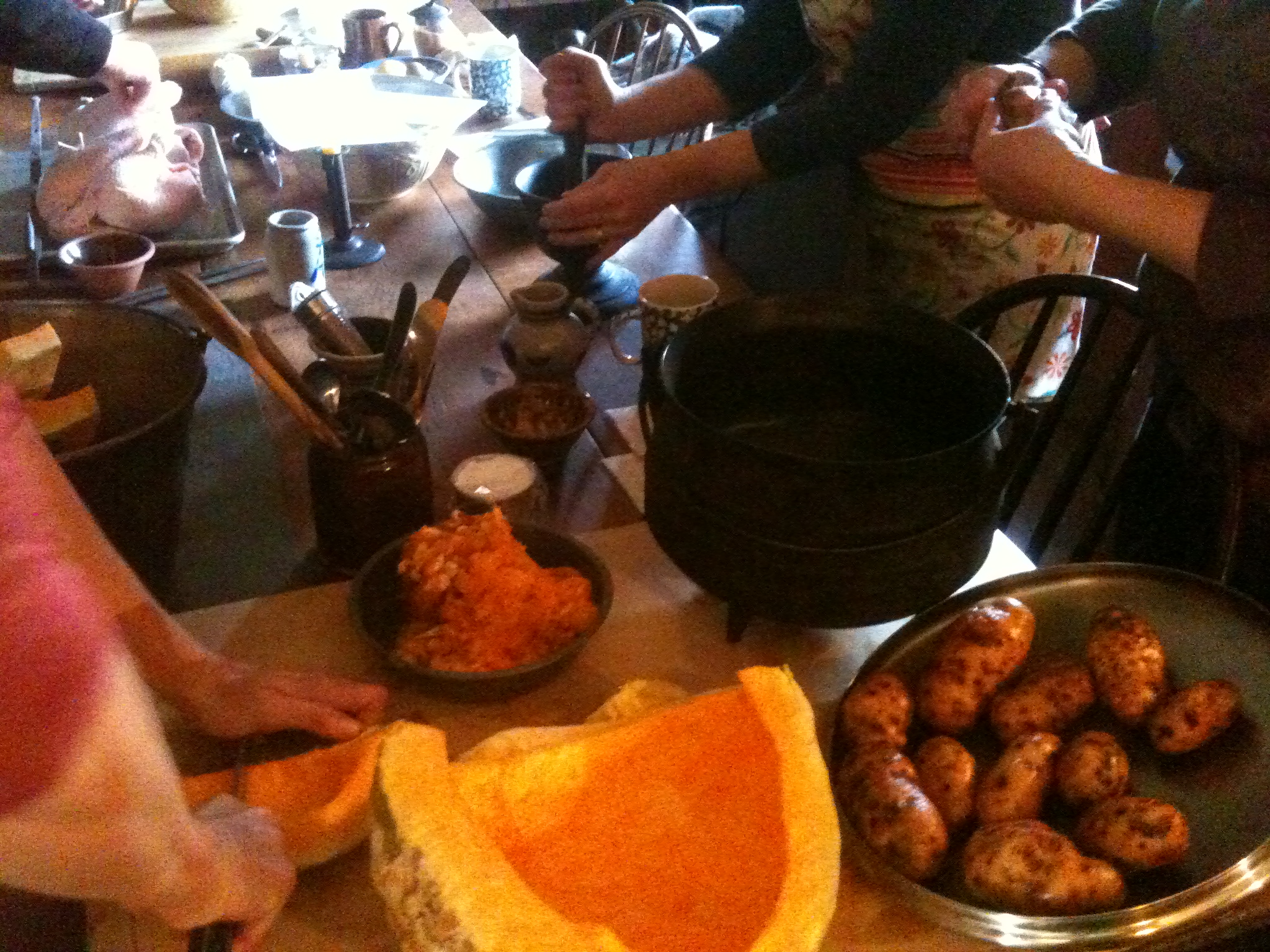
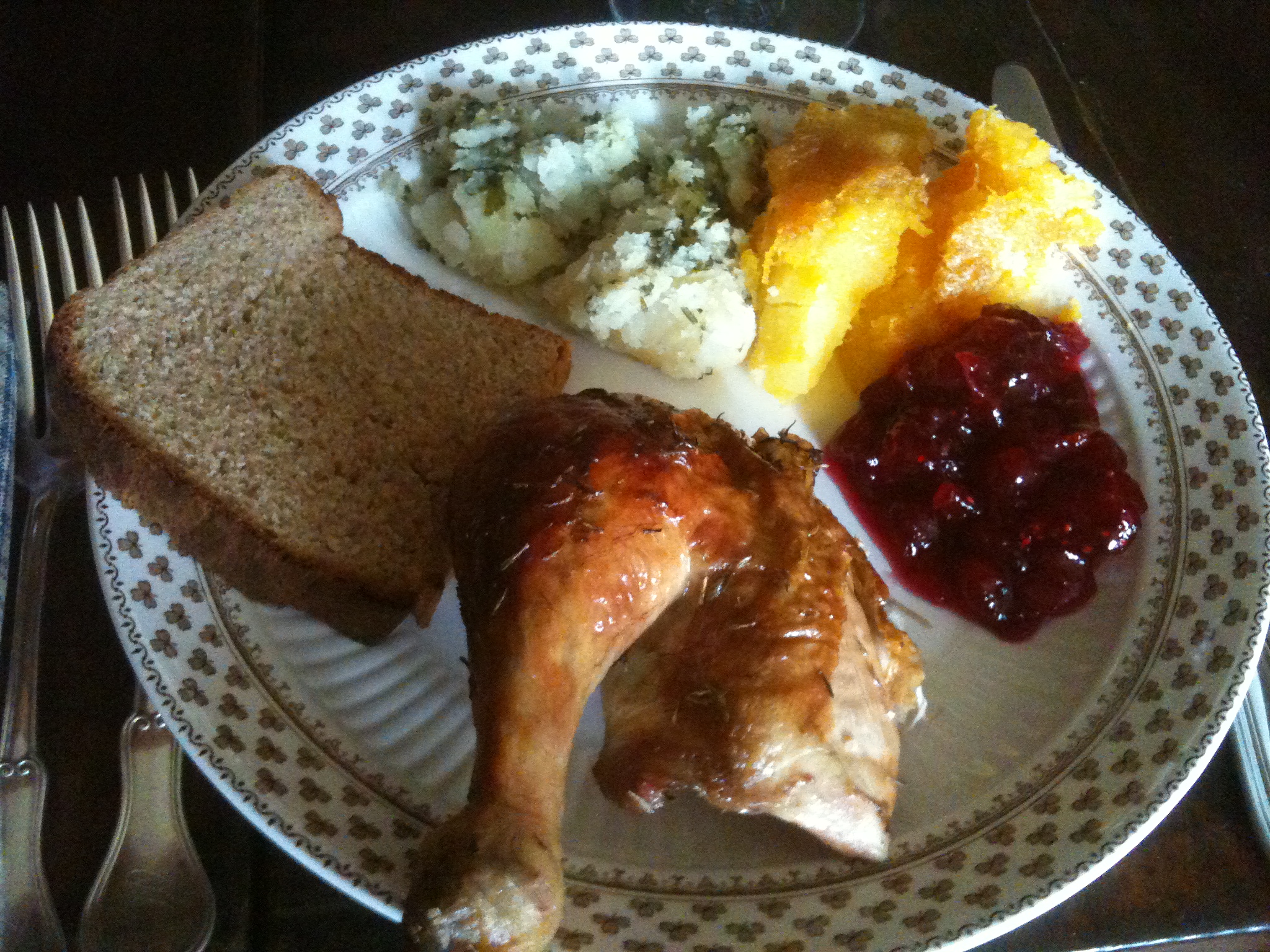
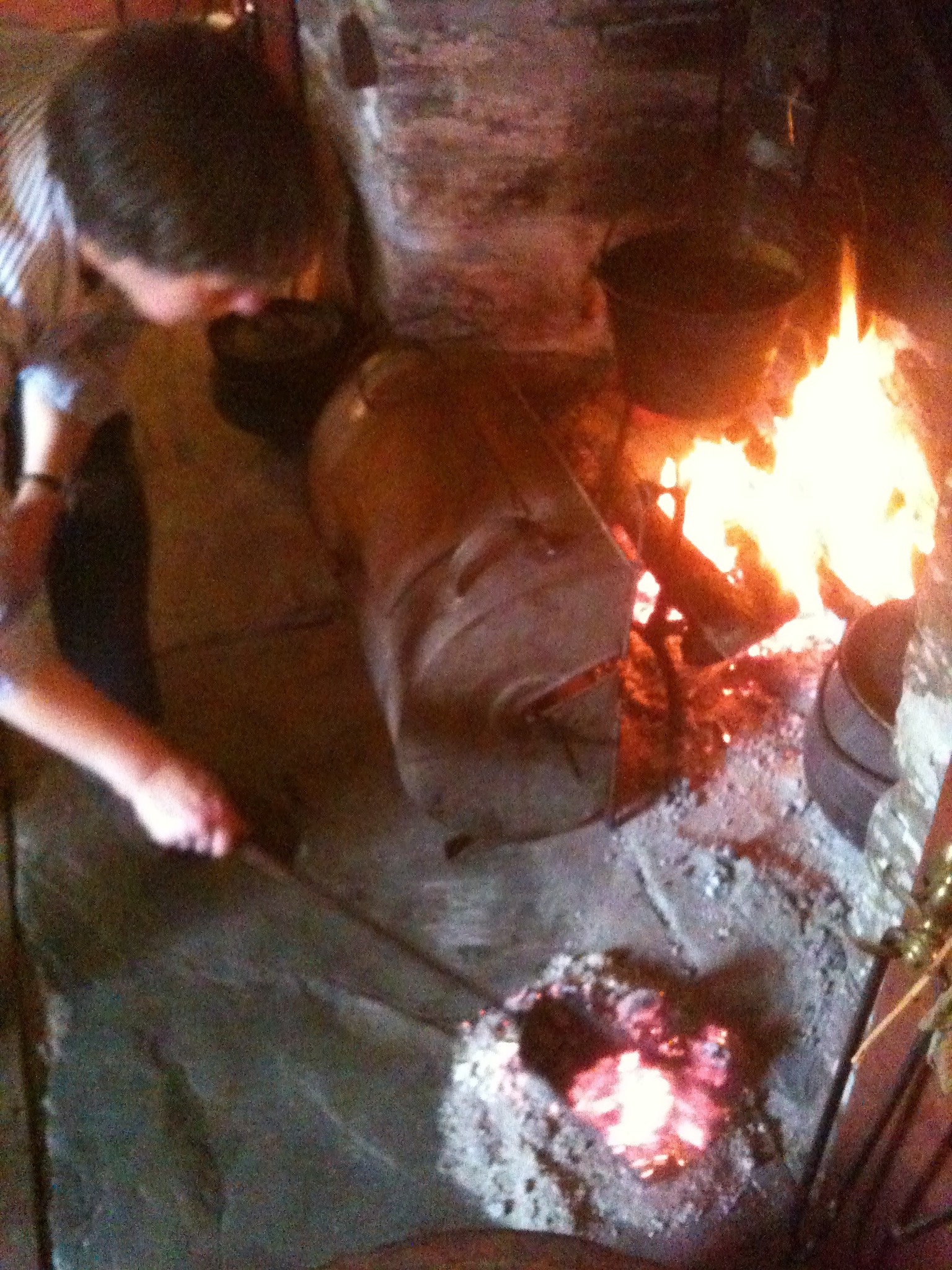
I was in heaven. Immediately upon entering you were warmed by waves emanating from the enormous slate hearth which dominated the room. Sally had started the fire two hours earlier to get it up to the temperatures we’d be needing to cook the meal for the day: roast chicken, potatoes with parsley, mashed Hubbard squash, cranberries, bread and apple pie for dessert. We seven students and Sally spent the next five hours accomplishing this task.

Many Hands

Now I am a little obsessed with this time period… if PBS ever does “Frontier House” again I will politely beat people out of the way with a stick to volunteer. Why do I love this stuff so much, I wonder? After all, we are talking about the age when the average lifespan for a woman was, like, twelve or something. And of course, we must remember Sally would make it all quite painless for us: we didn’t have to stoke the fire at 7am… we didn’t have to wash the cast iron pans and dishes for eight afterwards in a tub of lukewarm water. She had a real bathroom for us and none of us was in danger of dying from appendicitis, childbirth or from an infected scab on the knee. We had it sooooo easy.

Instead, we got to do the fun part: we cooked two chickens in a reflecting oven before the fire, turning the spit every fifteen minutes. We boiled pots full of vegetables that hung from “S” hooks off of a crane that swung into place over the flames. We started a soft-wood fire in the bake oven and filled it with red coals until it was ready to bake our two loaves of bread. Lastly, after assembling a lovely apple pie, we laid it carefully in a cast iron pot, placed it on a “burner” of hot coals right on the hearth, and then shoveled coals on the lid- after a time those coals would be removed and replaced with fresh. It was really starting to smell good in there.

And you can imagine it tasted good too. Not gourmet, not fancy recipe good, but good. Wholesome. Filling. Real.

I loved that we used pot lid lifters and tin ladles and yellowware bowls. There was no Teflon, no plastic, no mixers or microwaves. In fact, there was only one modern toxin I could see: sugar.

When Sugar Was Expensive

Of course, you must’ve already guessed there was sugar in the cranberries and in the apple pie. For good measure Sally’s recipe also had us drizzle maple syrup onto the top of the mashed squash. After some thought I had decided ahead of time not to request any recipe changes- it was authenticity we were going for here, after all. The cranberries tasted almost painfully sweet to me, but the squash and the pie were very mildly sweet, even to my recently more sensitive tongue. Sally later told me that one class she had actually left the sugar out of the pie by mistake and nobody even noticed- it was just as good.

Back in those days sugar was a lot harder to come by, and boiling your own maple syrup was a task that took up a considerable portion of one’s Spring energies. As we waited for the chicken and bread loaves to finish baking, Sally read to us snippets from the diaries of Major James Wilson, who built the house in 1786, and lived there for the rest of his life with his wife and eight children. A few entries described the gargantuan undertaking of making maple syrup: sterilizing the sap buckets, soaking the wood barrels in the nearby stream, gathering the sap bucket by bucket, and finally building the arch for the long evaporating process, not in a saphouse like today, but actually out in the open air of the woods. If only sugar was that hard to come by nowadays.

So, I got to live out my Laura Ingalls fantasy, at least for a morning. Too bad my 1870s-era house isn’t quite old enough to have had a cooking hearth of it’s own- Sally tells me that they likely used a cast iron stove. Hmmmmm- I wonder what that would be like?

You can see how I get into trouble.

A Morning's Work

A Year Of No Sugar: Post 82

Do you remember that movie The Incredible Shrinking Woman, starring Lily Tomlin? I saw it when it came out- I must’ve been about twelve. The movie’s premise is that suburban housewife Pat Kramer (Tomlin) gets exposed to some experimental chemicals and consequently begins to shrink: she shrinks to her children’s size, and later she is living in her children’s dollhouse. Kramer ultimately shrinks to microscopic size, landing in a puddle of household chemicals, which- luckily!- cause her to begin to grow again.

The last scene of the movie is of Kramer, at her normal size, looking down to see her shoe splitting open. Kramer and the audience realize at the same moment… now, she is continuing to grow.

AAAAAAAAAAAAA!!!!!

This movie scared the crap out of me as a kid.

Thirty years later, instead of watching Lily Tomlin get chased by mad scientists, I can scare myself silly by simply reading about actual chemicals in our environment to which we are exposed each and every day: Phthalates, Bisphenol A (BPA), Triclosan, Mercury, Teflon, Brominated Flame Retardants (PCBs, PBBs, PDBEs) and Pesticides (DDT and 2,4-D).

Recently I finished Slow Death by Rubber Duck, which is all about the chemical soup in which we collectively marinate as a society. But authors Rick Smith and Bruce Lourie go one better than just writing about the omnipresence of these chemicals in our everyday environment- they also chose to experiment on themselves. Over the course of a few days they exposed themselves to “normal” levels of common everyday chemicals to see what levels of them would later be traceable in their blood and urine (such as eating a tuna fish sandwich or sitting on a stain-resistant couch). The implications of what they found are perhaps even more scary than the prospect of shrinking to the size of a molecule on your own kitchen floor.

“But, wait a minute” you say, “what does this all have to do with sugar?”

Well, I’ll tell you. While reading Rubber Duck, it struck me that there are many points of similarity between the runaway proliferation of chemicals and that of sugar, namely:

  1. They’re both everywhere
  2. They’re both cheap
  3. They’re both linked to convenience
  4. They’re both hugely profitable industries
  5. They’re both perpetuated by a culture of denial and status quo

and of course…

  1. The more you try to avoid or eliminate them, the more insidious you realize their infiltrations to our everyday life have become.

It begs the question: do we have to go live under a rock to escape the health hazards of modern life? I mean, I’m starting to feel a little surrounded here. Sometimes it seems to me that the price of being a member of contemporary society is, knowingly or not, to put our very lives on a roulette wheel.

After reading Rubber Duck, my husband and I were inspired to get rid of our Teflon pans and replace them with a non-Teflon alternative. At the nearby kitchen store we were sold some pricey “Swiss Diamond” pans which were promoted to us by the salesperson as a great non-stick alternative to Teflon.

Later I wondered why, however, the literature that came with the pans was very careful to avoid saying the pans were Teflon-free. Wouldn’t that be a selling point? Something was fishy in Denmark… or perhaps Sweden.

After some online research the truth came out: Teflon by any other name… is still Teflon. PFOA is what they use to bond to the diamond in the Swiss Diamond pans. Which is… Teflon. Under its non-trademark name.

So here’s my question: why is it that we, non-chemistry majors most of us, are required to sleuth out that “PFOA” is the same thing as Teflon, and that “fragrance” is code for pthalates, that juice is just as bad for you as soda and that sugar is what is making people fat, not fat? Whenever I find out one of these things for the first time, my first reaction is always the same: why didn’t somebody tell me this sooner?? Why don’t more people know this? There are plenty of people being paid very well to argue that the status quo is fine, but is there really no one out there looking out for us? Who is our lobbyist?

In the end, even though the fake-No-Teflon pans had been used, we explained the situation and the kitchen store nicely allowed us to return them for store credit. This we promptly used to buy a large cast iron pan, the kind great-grandma would’ve used. It’s huge, requires some special cleaning instructions (No soap! Special scrub-brush! Dry immediately to avoid rust!) and is incredibly heavy. It isn’t what most people would consider “convenient” in our no-muss, no-fuss, flame-retardant, lavender-scented and oh-so-sweet world. But you know what? I’m starting to think that convenience is in the eye of the beholder.

Just ask Pat Kramer.