All posts by Eve Ogden Schaub

Unknown's avatar

About Eve Ogden Schaub

Serial memoirist Eve O. Schaub lives with her family in Vermont and enjoys performing experiments on them so she can write about it. Author of Year of No Sugar (2014) and Year of No Clutter (2017) and most recently Year of No GARBAGE (2023). Find her on Twitter @Eveschaub IG or eveschaub.com.

A Year Of No Sugar: Post 47

The other day as we were driving home from school we somehow got on the subject of why our daughter Greta hasn’t written in her “No Sugar Project” journal lately. After a spate of great interest and productivity in the beginning, her writing book has been all but abandoned of late on her nightstand. I asked her: how come?

“Well, there’s nothing to write about,” she explained. “It’s like, it’s just normal now.”

There you have it folks. An eleven-year-old says not eating added sugar AT ALL with the exception of a once-per-month treat, can be normal. Let the record show that it took in the neighborhood of four months.

I know what you’re thinking- sure, anything can be normal if you do it long enough. You could wear balloon animal hats every night to dinner and after four months you wouldn’t even be hungry until a latex poodle was firmly situated across your brow.

That is true. However, I can identify with what Greta describes; after lots of flailing, I feel we’ve finally entered a groove of sorts now. We now know which products to buy at the supermarket and we head straight for them, do not pass go, do not collect two hundred dollars worth of sugar. We now know which special things we have to go further afield for and when we do, we stock up: Nature’s Market in Manchester is our connection for GoRaw ginger cookies and granola bars, and Applewood Farms organic sandwich meats. BJ’s Wholesale Club- which is a hike and a whole-morning venture- has freeze-dried fruit chips that are one of the few fruit snacks I have found not sweetened with fruit juice. These have been such a big hit with the kids that we dole them out like special treats. They also sell four pound boxes of a center-cut bacon that is the only commercial brand I’ve found without sweeteners. For something we use a lot of, such as tomato sauce or yellow mustard, after zeroing in brands that contain no sugar, we buy it in bulk and store excess on shelves in the pantry.

We’ve also been fortunate to be in a buying club of sorts- or rather to be buying buddies with- a nearby family who orders bulk organic produce every other week or so. Thus our refrigerator is regularly on the verge of exploding from the amount of broccoli heads and navel oranges I attempt to stuff into it. I can’t tell you how much of a difference this makes in my mind-set: knowing we have so much produce on-hand means I don’t think twice before popping a Fuji apple into everyone’s lunchbox or before carving up a few grapefruit for breakfast. I know it’ll be good, (reliably better than anything we can buy at the regular store) I know it’s organic, AND on top of everything else we’re paying bulk rates and saving money. If you see me and ask me about it- you won’t be able to shut me up about how awesome this is. You’ve been warned.

(Of course, I’ve had to learn our family’s own pace when it comes to produce consumption. Exhibit A: the fifty-pound box of potatoes that seemed like such a good idea until they started aggressively trying to plant themselves in the linoleum of my kitchen floor.)

I’ve also learned to become a bread-hoarder of epic proportions. Bread is an especially tough one: even organic, health food store brands like Vermont Bread Company usually have cane sugar or honey in them. We’re lucky to have a wonderful baker in our community- hello Jed!- who produces fresh baguettes and Pain au Levain under the name “Rupert Rising Bread,” all with fewer ingredients than you can count on your hand- and no sugar. Problem solved, right?
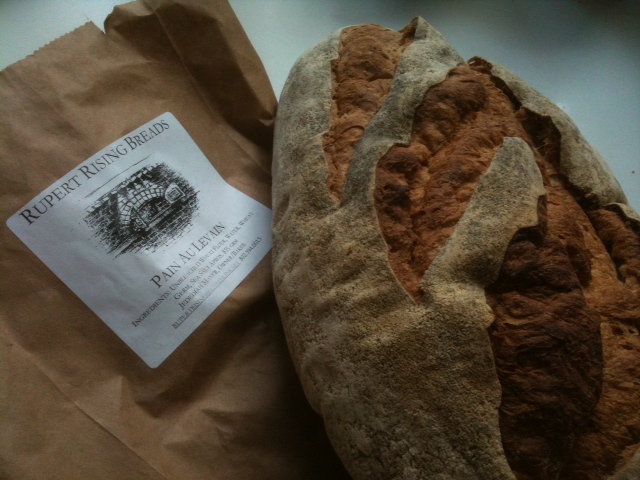
The thing is, everyone knows Jed’s bread is that good, and consequently it sells out from the general store practically before he shows up with it a few times per week. Now, I know I should figure out which days those are, put it in my calendar, and show up mere moments after delivery time in order to secure my continued supply of fresh, local, staff-of-life. Unfortunately, I have about 247 other things to do first, including mailing my mother’s hand-knit Mother’s Day socks a week late (hi Mom!) and writing my blog in which I can complain about how I have no time to go buy bread. So instead, I buy it when I see it, which isn’t nearly often enough.

So, I buy bread and freeze it, I make bread when I can get to it, and sometimes we just have to get along with Triscuits and that’s all there is to it.

Then again, rather than toast for breakfast we could have some nice steamed broccoli heads garnished with navel oranges instead- after all, we certainly have enough of them, and it would give Greta something new to write about. As long as everyone has their poodle-hats handy, I think it should be just fine.

A Year Of No Sugar: Post 46

What if we could find something that tasted like sugar- but without the toxic effects to our bodies of fructose? How much would that change our lives? All our experiments this year have been moving in that general direction: not only are we weaning ourselves down from a taste for sweetness on the one hand, but we’ve been working on sweet alternatives on the other. Ideally, happiness and healthiness meet somewhere in the middle, get married, and live happily ever after.

Thus our many experiments with banana and date sweetened cookies, banana and coconut pancakes, and most recently yogurt and banana popsicles. Recently, however, I’ve begun to wonder just how many bananas a person could reasonably eat. Also, I’m getting a little tired of all my cookies— carob chip, peanut butter, raisin— all tasting pretty much like bananas and dates.

So imagine my surprise when my husband Steve came home a few weeks ago with a (get ready) chocolate bar!! Gasp! Avert thine eyes!

But no! he says, we can eat this.

Huh? I thought I had seen it all in my desperation to comb the internet for sweet substitutes that our Year of No Sugar would accommodate. I have yet to try brown rice syrup, but other than that we haven’t found much beyond cutting up fruit, putting it into our recipes and hoping the other ingredients don’t notice.

But this was a bar of what looked an awful lot like my long lost friend chocolate. “Chocoperfection” was the name, with the tag line, “Sugar Free… Naturally!” How could this possibly be okay? Steve’s massage therapist, our friend Ellen, had given him one upon hearing of our project. “I,” she said ominously, “am about to change your life.”

We eyed the gold wrapper. We read the ingredients. We reread the ingredients. There were two I wasn’t familiar with: “oligofructose” and “erythritol.” Hmmmm. Sounded suspiciously fakey- and we don’t do artificial sweeteners, (although according to my husband Diet Dr. Pepper drives a car with diplomatic license plates, and therefore doesn’t count.)

So I looked it up. Turns out, oligofructose is extracted from fruits or vegetables- in this case from chicory root. It is touted as being not only not bad, but in fact health promoting on account of the extremely high amount of dietary fiber (one Chocoperfection bar brings with it an astounding 52 % of recommended dietary fiber) as well as prebiotic effects- which is to say it is believed to stimulate the growth of “good” bacteria in the colon.

Erythritol is a “sugar alcohol,” which doesn’t sound like a good thing. After all, sugar alcohols such as “xylitol” and “maltitol” are known to be associated with laxative properties and “gastric distress.” Ew! However, erythritol is unique; unlike other sugar alcohols it is absorbed in the small intestine and then excreted. Translation? No tummy troubles.

Upshot: together, oligofructose and erythritol have a pretty good thing going. They supplement one another’s sweetness and counteract one another’s aftertaste. What’s the down side? Well, aside from making my digestive area a little gurgly and- ahem- wind-filled (heLLOO fiber!) the number one complaint would have to be it’s expense: one tiny 1.8 oz bar goes for between three and four dollars- that’s nearly a dollar a bite.

But nutritionally? Well, let’s review: what are the complaints about sugar (fructose)? It gets metabolized as fatty acids. This, in turn, creates cardiovascular disease, fatty liver disease, stroke, insulin resistance/diabetes, not to mention promoting the growth of cancerous cells. Basically, every problem known to man except hemorrhoids and hammer toes.

Well- from everything I can discern, oligofructose and erythritol don’t turn to fat in your bloodstream, don’t raise blood sugar levels and don’t even cause hammer toes. Instead, there is a boatload of fiber, which by definition means it isn’t even being processed until it gets to the colon, at which point it ferments into gases and… well, we’re back in the windy city, so to speak. Best of all? Drumroll please… the “chocolate” bar? Is pretty darn good. I mean, good.

Well, at least the “Almond Dark Chocolate” is. “Milk Chocolate,” which we also tried, has a hard-to-place weird taste. (Other flavors offered that we did not try are “Dark” and “Dark Raspberry.”) You can’t buy these bars anywhere around here so, in the interest of pure, selfless, scientific research, we ordered a small box of almond dark chocolate bars and a small bag of granulated “sugar” (!!) to try in cooking.

Unfortunately, the “sugar” doesn’t work as perfectly as one might hope- the texture is a little crunchy/dry/grainy in baked goods (we tried one batch of somewhat pasty peanut butter cookies), and there is a more distinct aftertaste than in the bars. Then again, maybe it’s not so unfortunate. Ever since we tried the “Chocoperfection” bars I’ve felt kinda… weird about the whole idea. Isn’t this cheating? I think.

I wondered, is this an “artificial” sweetener because it isn’t sucrose/fructose, or is it a natural sweetener because it comes from chicory root? If the point is to avoid fructose, as well as artificial sweeteners that have known negative effects on the body, then we were doing that! If the point is to avoid extracted fructose, as well as any stuff that simulates fructose, then we weren’t doing that! Help!

I felt so conflicted and confused that I e-mailed my question to Dr. Lustig, and waited breathlessly for- at last!- a definitive answer. What he graciously sent me, instead, was this:

“As to non-nutritive sweeteners, there are pharmacokinetics (what your body does to a drug) and pharmacodynamics (what a drug does to your body). We have the former (that’s how they got FDA approval), but none of the latter. So I can’t recommend any of them. But stay tuned, this information may be coming in the future.”

Hmm. Well, that’s essentially where I had ended up before: I don’t know. The thing I have to remember is that Dr. Lustig is a doctor and I’m a writer: he’s offering a doctor answer to what might be, for me, a writer question.

Meanwhile, non-doctor David Gillespie has this to say in his book Sweet Poison:

“No amount of rat studies will reassure me that industrial chemicals that have been in our food supply for less than a few decades are definitively safe… It took almost 100 years of mass consumption before researchers started questioning whether sugar was dangerous. Can we really know if sucralose or aspartame are safe after just a few decades?”

Hmm again. I think I’m getting closer to an answer. Gillespie isn’t taking about oligofructose, per se, but as Lustig points out, all these new sweetening options are big question marks at this point. And question marks, Gillespie reminds us, don’t have a terrific track record when it comes to our bodies’ health.

But back to ethics: it just still feels like cheating to me. Steve is a big “Chocoperfection” fan and much less conflicted about the whole thing than I am. His argument is that even with our “special” chocolate bars, spending a year avoiding all added sugar is still really, really hard. Which is true. And yet… don’t you just have to go with your gut, so to speak?

So we slowly, s-l-o-w-l-y finished off the “special” chocolate bars and for the time being have decided not to order more. The bag of “sugar” languishes in the closet. Sigh.

Banana, anyone?

A Year of No Sugar: Post 45

You know, it’s not every day that I broach the subject of our “family project” with a complete stranger only to have them respond, “Oh, me too!” but that’s exactly what happened to me the other day on the train.

We were traveling down to New York City for the purpose of celebrating our daughter Greta’s eleventh birthday and I ended up sitting next to and striking up a conversation with a lovely woman named Lori who didn’t respond at all the way people do when I start to tell them that our family isn’t eating sugar for a year.

Her eyes didn’t get wide with disbelief or narrow with suspicion; she didn’t pretend to get it and then ask lots of predictable questions like “oh, but you can have honey, right? Because that’s natural?” or shrug it all off with a “Oh I couldn’t ever do that! Never!” Instead, we ended up having a lengthy conversation comparing notes on cookies made with fruit, and debating the pros and cons of different kinds of sugar alcohols. It was uncanny: Lori had even made a big batch of oatmeal raisin cookies before she left for her trip, just like I had, except she used applesauce instead of dates for sweetening.

Turns out Lori had gained a lot of weight- some seventy-five pounds- following a sad event in her life three years ago and her recent abstinence from sugar is an effort to counteract that. She seemed most intrigued by our two girls’ participation in our Year of No Sugar, and seemed heartened by it.

“If they can do it- than I definitely think I can do it!” she said, adding that she would think of our family whenever her resolve was feeling wobbly.

I found the exchange entirely humbling. Us? Inspiring? I am happy to engage in a little false modesty here and there, but really, truly, no kidding at all, I find this concept hard to wrap my mind around. I just don’t feel that self-assuredness, that supreme radiating confidence that I see in some other writer’s similar projects (hello, Barbara Kingsolver!). For one thing, I’m no biochemistry teacher: I am going to win no awards for my precise-but-comprehensible explanations of what fructose does in (and to) your body.

For another, if you read this blog at all you’ll know that the amount of time I spend avoiding sugar is roughly equal to the amount of time I spend worrying about it: questioning why I’m doing it, trying to delineate the parameters of it, and rationalizing the fact that I am pulling the rest of the family through it with me, kicking and screaming included.

This is not to mention the ample brain-space devoted to grappling with logistics of groceries and restaurants, negotiating my husband’s wayward tendencies (hello Diet Dr. Pepper!), and worrying about my children’s future therapy bills. Some days, all I can see are the imperfections: the sugar-containing chewable vitamins, the necessity of relying on the word of a harried waitress, the discomfort of having to skip community events that involve food. Some days, the “project” that I have so cheerfully imposed on our family, feels more like a long tunnel that I am stubbornly trying to lead us all through, blindfolded. I volunteered for this, right?

And then something like the New York Times Magazine article “Is Sugar Toxic?” (April 17, 2011) comes out and validates the fact that just maybe, I might not be crazy after all. Or I get a wonderful supportive comment on one of my posts. Or I meet a woman on the train. So when Lori says she finds our family inspiring, I would have to say: the feeling is entirely mutual.