Be sure to follow me on instagram!
Year Of No Garbage Tip Of The Week
Be sure to follow me on instagram!

Be sure to follow me on instagram!
I’m doing it wrong. I’m doing it wrong all the time, and I know it, and it’s kind of killing me.
This is the thought I’ve been having a lot, because lately our house seems to be in particular chaos. There’s just STUFF EVERYWHERE.. It’s an awfully good thing I didn’t try to do Year of No Garbage at the same time as Year of No Clutter, because if I’ve learned anything in the last two weeks, it’s that an experiment in being Zero-waste is essentially a machine for clutter.

As I’ve written about before, clutter is the result of unknowns and unmade decisions, so it does make sense: all the I-don’t-knows and the what-about-this’s are stacking up. I’ll look it up! Has become my new favorite phrase, but always uttered while I’m in the middle of something else, so what I mean is: I’ll look it up later.
Right now I have a bowl of wine corks on my kitchen counter, right next to a small pile of wax pieces from a block of cheddar cheese. On the floor I have a clothespin holding a festoon of Mylar-lined items such as potato chip bags awaiting further investigation (note to self- call Terracycle). Next to that is a supermarket shopping bag filled with other plastic bags that I think can also be dropped off at the supermarket bag recycling bin: plastic bags from bread, from paper towels, from dried mango slices, from dry cleaning. I think this because I read it online- which is always foolproof, right?

Next to that I have a large, clear, plastic container holding all manner of serious question marks. What about the penny-sized plastic spout that pops out of the top of the olive oil container? What about the plastic tag welded to the rubber band that came on the organic scallions? What about the broken hair elastic? What about the postage stamp-sized SILICA GEL PACK? And foil lids from the tops of bottles- are they really FOIL? I bend them and they don’t feel like foil, they feel like shiny paper… not to mention the fact that the great recyclers in the sky apparently frown on our attempts to recycle The Small Stuff- the plastic caps and bits of foil that, according to folklore, jam up the mysterious machines.
Have I mentioned that these are only the piles in my kitchen?
Sometimes I feel like a Recycling Detective trying to ferret out the truth from among a million different myths. Every person I talk to “knows” something different, and it certainly doesn’t help that the rules have been in constant flux ever since I encountered them for the first time as a college student years ago. This was in Ithaca New York, well-known for being even more crunchy than your average college town, and it was in my senior year that I encountered the city’s shiny new curbside recycling program. Who had ever heard of such a thing? Up until then my efforts to save the earth had consisted mostly of me wearing long flowery dresses; I was excited to be in my first “real” house and in the forefront of green technology.

Immediately I was frustrated by the fact that after rinsing and separating all my items and placing them carefully by the curb in a series of baskets and cardboard boxes, about half the items would not get taken by the trash collectors.
In retrospect I find it kind of amazing that the trash people had the time to sort through my proposed recycling as if it were my senior thesis. But what was I doing wrong? “Oh, that’s because you can’t put in any container that could stack with another container.” One of my more eco-savvy friends said. “Like yogurt containers or sour cream- it has to have a smaller top opening so things don’t get stuck inside one another.”

I don’t even know if she was right. It just felt like I was failing some kind of earth-loving test, to which no one had given me the textbook. I clearly recall thinking, Seriously? If they want people to recycle they can’t make it this hard to figure out.
And here I am having that very same thought thirty years later.
Going into this I knew I’d have trouble. I knew I’d want to be No Garbage perfectly right away, which is pretty much impossible. But then I remind myself that that’s the whole darned point: if it were easy there wouldn’t be much to write about. I imagine it’s likely that humans have always had some concept of garbage, but never have we had so incredibly much of it: for the first time in history we’ve made disposability a way of life. Undoing that will take some time. And thought. And uncertainty. And doing it wrong. So I’m working on being okay with that.
If you don’t hear from me for a few days though, it means I’ve been eaten by the piles.
We are one week in to our No Garbage Year and our family has officially caught our first break. And that’s good because lately I’ve been feeling like I say “oh shit” about every ten minutes. This learning curve is so steep I’m getting a nosebleed.
Three foods have quickly surfaced as being the most troublesome, but the good news is that they’re just small things. You know, things like meat, bread and cheese. I know what you’re thinking: well, duh. Of course meat, what with all the concerns about contamination. Heck, we can’t seem to keep our meat disease-free as it is, even though we wrap it in enough single-use packaging to kill a goat.
But bread? I’m not even talking about sandwich bread, which clearly comes wrapped for protection from the apocalypse, but even the “let’s pretend we have a real bakery in the supermarket!” bread that comes in the homey brown paper bag, because those bags all have shiny little windows, presumably so the consumer can see the lovely bread without having to touch it with their dirty consumer hands.

And we all have dirty consumer hands. Don’t get me wrong. For the health advances made possible by modern packaging science I am eternally grateful- truly. In fact, when I posted a frustrated picture of my favorite peanut butter jar yesterday with a heretofore unnoticed-by-me plastic ribbon around the lid my friend John rightly commented that those plastic bands are there to keep people from putting poison in my peanut butter.
I mean, really. How DARE Teddie Peanut Butter try to save my life!?! The NERVE.
But seriously, (and at the risk of sounding like a broken record repeating the mantra of my previous projects) the problem of how to exist in a less damaging way upon the earth, while deeply important, is nevertheless a first world problem. If you are facing starvation or fleeing oppression, you aren’t going to care about whether your rice comes in a dolphin-friendly bag. You’re just not.
In short, trying to figure out how to live with less or zero garbage, while a legitimate problem, is a problem we are lucky to have. So if I’m whining about the annoying plastic wrap on my favorite peanut butter, I just want to be extremely clear I realize how fortunate I am that, on any given Thursday, this is the biggest of my problems.
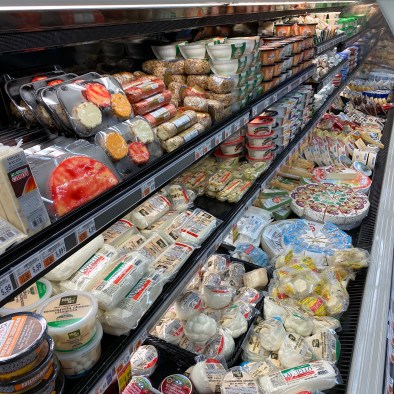
But back to cheese. This one I honestly did not see coming. Just try finding a cheese- any cheese- in your local supermarket that doesn’t incorporate any plastic wrapping. I’ll wait.
SEE WHAT I MEAN? It’s crazy. It’s as if cling wrap had to be developed first, just to pave the way for the invention of cheese.
Listen. I was a vegetarian of one kind or another for twenty years. If necessary, I can do little or no meat. And I have been known to make some pretty decent homemade bread when pressed (cough cough Year of No Sugar). But cheese? I adore cheese. At this point in my life, I’m pretty sure my body is made up of about 95% cheese. I may or may not be tearing up right now at the very thought of a cheese-less year.

Which brings me to our big break. Before abandoning all hope and barricading myself in the basement with a tear-stained copy of Cheeses of the World, it occurred to me to check in with our dear friends Patty and Robin who own Al Ducci’s, an Italian specialty food shop in Manchester, Vermont. Patty assured me they’d be happy to cut from any wheel of cheese in the big glass case and… wrap it in paper for me. (Cue the Hallelujah Chorus.)
AND, as it turns out, they ALSO sell several types of homemade bread made on site that comes in plain brown paper bags… with no plastic windows. (Cue even louder Hallelujah Chorus.)
Sure, the ladies working the counter looked a little confused when I asked for Parmesan cut from the wheel even though they already had about twenty different wedges in the case pre-sliced and wrapped in Saran Wrap. I settled for Romano instead. Heck- Parmesan, Romano, Velveeta- WHO CARED? I was getting cheese, people. (Cue the Hallelujah Chorus, hip hop/extreme dance club version.)
I know, I know. This is expensive cheese. Which brings us to the ever-recurring conversation of whether living more lightly on the earth is a luxury only available to The Fancy People. This was a recurring theme with No Sugar as well: sure, you can spend hours reading ingredient lists, cook homemade food and buy more expensive products that have better ingredients, but most people can’t. Most people don’t have that luxury.
Well, yes. Money and time are ever-present problems in our culture and exist in myriad ways as barriers to changing the way we do things. But things can change and change has to start with people showing up and asking for it. Organic produce, bulk shopping, coops, health food stores and farmers markets, while still not mainstream, are both now more popular and much more accessible than ever before. Acknowledging that everyone may not be able to spend the time or money necessary to go Zero Waste, doesn’t let us all off the hook. We’re still on the hook. And it’s a big hook. Planet-sized to be precise. But we can all start somewhere.
After all, thinking about something differently is free.
 Eve O. Schaub