Tag Archives: no sugar family

A Year Of No Sugar: Post 83

Sally Makes a "Burner"

Lately, I’ve gotten the feeling that I’m going back in time… cleaning our cast iron pan, gathering the eggs from our chickens, buying our milk from the local farm in half-gallon mason jars, selecting apples out of wooden bins at the Farmer’s Market, ordering bread from our local general store. Our freezer is full of meat: half a cow and half a pig locally raised and slaughtered. I buy butter by the 36 pound case and flour by the 50 pound bag. The other day I realized I needed something from the actual supermarket and I felt kind of… disappointed.

It’s not entirely intentional, it just seems to be the natural evolution of things when you try to get away from processed foods (read: added sugar.) Want good bread? If you aren’t prepared to make it in the quantity your family will consume, you order it from Jed in Rupert who makes the area’s best no sugar bread with only four ingredients. Want organic meat? Unless you want to remortgage your house to buy it at the Farmer’s Market, or pick over the sad, non-existant selection at our local supermarkets, you find a guy who knows a cow, and a reputable slaughterhouse. And so on.

As if to complete the effect, last Saturday I had an adventure I’d been waiting for since October. For a birthday present my husband arranged something I’ve always wanted to do: a hearth cooking workshop. So early Saturday morning I, and six friends, converged on the home of Sally Brillon in Hebron, New York.

As we walked up the path in the crisp morning air I looked around at the ancient outbuildings- remnants of the many different jobs having a family farm used to entail. Standing on the rough flagstone step, we knocked on the saltbox door and entered another world.

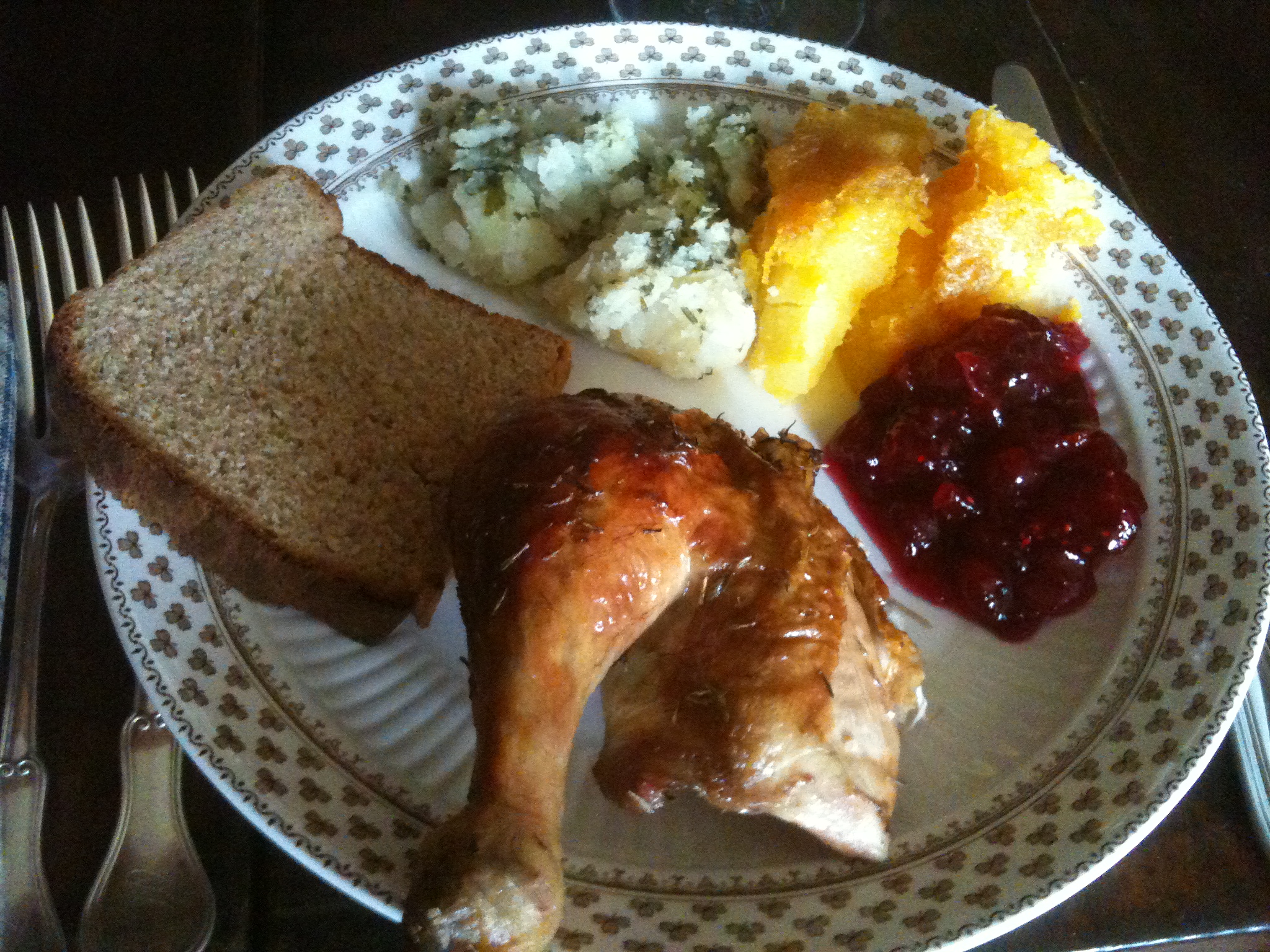
I was in heaven. Immediately upon entering you were warmed by waves emanating from the enormous slate hearth which dominated the room. Sally had started the fire two hours earlier to get it up to the temperatures we’d be needing to cook the meal for the day: roast chicken, potatoes with parsley, mashed Hubbard squash, cranberries, bread and apple pie for dessert. We seven students and Sally spent the next five hours accomplishing this task.
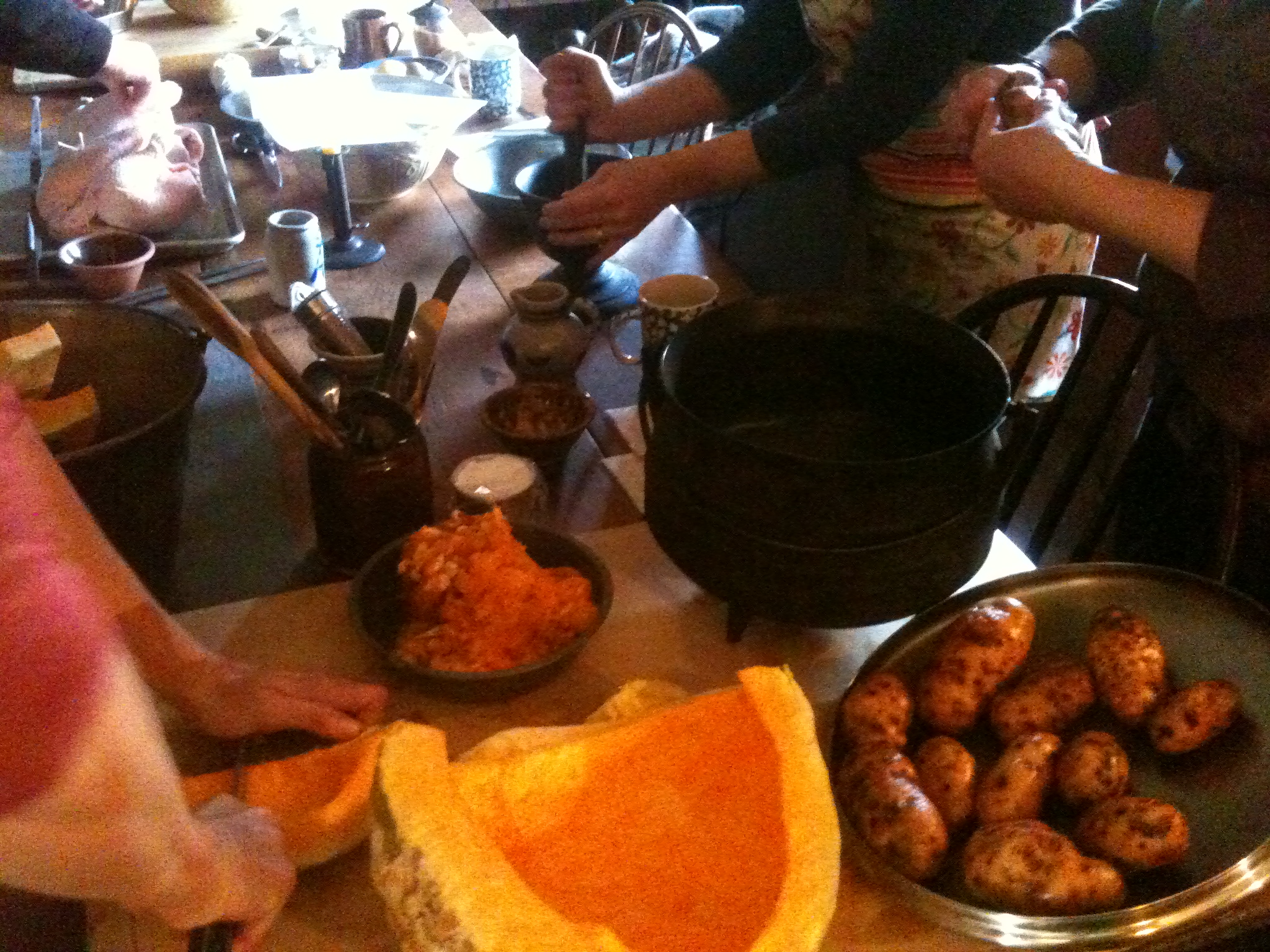
Many Hands

Now I am a little obsessed with this time period… if PBS ever does “Frontier House” again I will politely beat people out of the way with a stick to volunteer. Why do I love this stuff so much, I wonder? After all, we are talking about the age when the average lifespan for a woman was, like, twelve or something. And of course, we must remember Sally would make it all quite painless for us: we didn’t have to stoke the fire at 7am… we didn’t have to wash the cast iron pans and dishes for eight afterwards in a tub of lukewarm water. She had a real bathroom for us and none of us was in danger of dying from appendicitis, childbirth or from an infected scab on the knee. We had it sooooo easy.

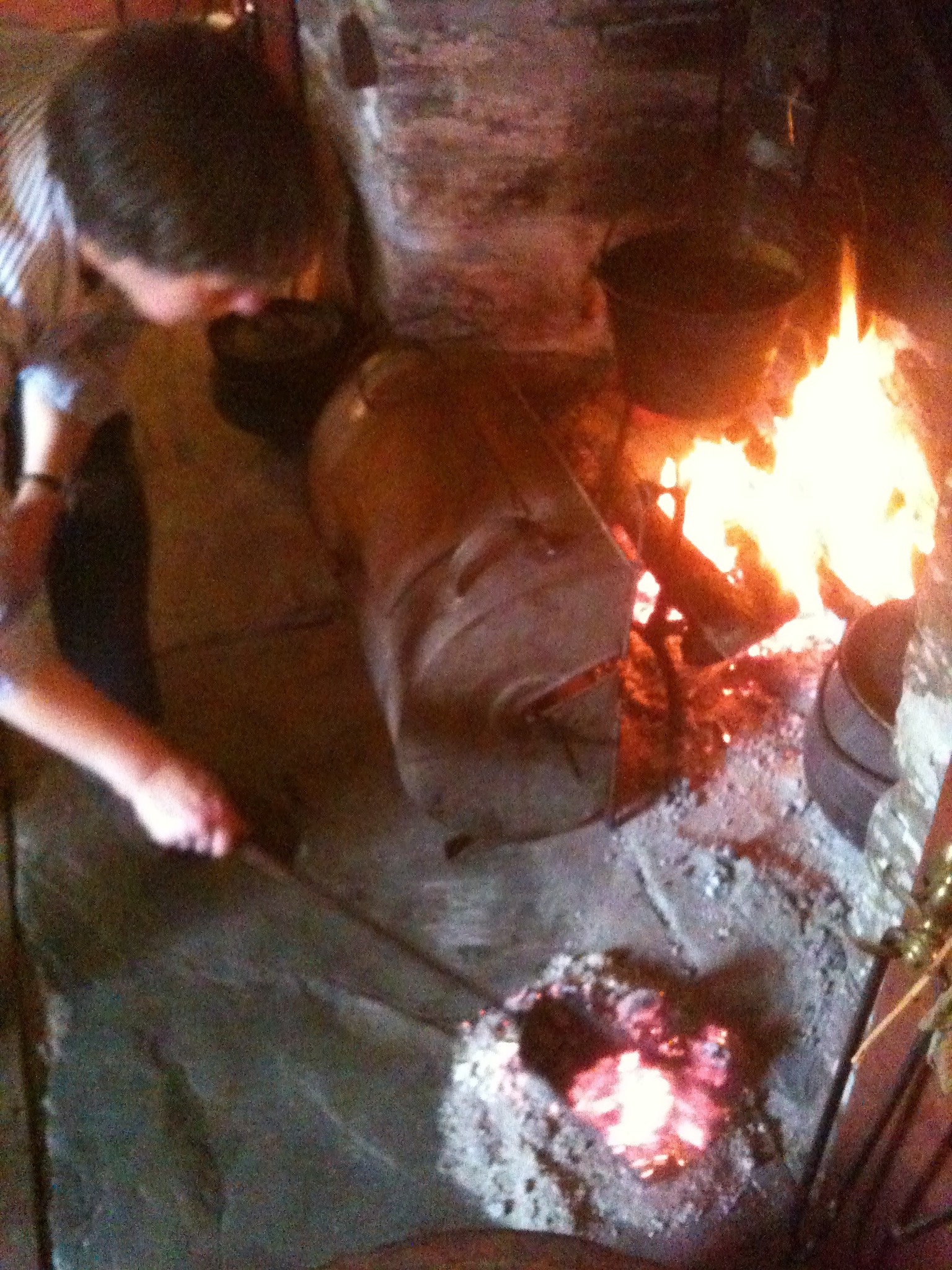
Instead, we got to do the fun part: we cooked two chickens in a reflecting oven before the fire, turning the spit every fifteen minutes. We boiled pots full of vegetables that hung from “S” hooks off of a crane that swung into place over the flames. We started a soft-wood fire in the bake oven and filled it with red coals until it was ready to bake our two loaves of bread. Lastly, after assembling a lovely apple pie, we laid it carefully in a cast iron pot, placed it on a “burner” of hot coals right on the hearth, and then shoveled coals on the lid- after a time those coals would be removed and replaced with fresh. It was really starting to smell good in there.

And you can imagine it tasted good too. Not gourmet, not fancy recipe good, but good. Wholesome. Filling. Real.

I loved that we used pot lid lifters and tin ladles and yellowware bowls. There was no Teflon, no plastic, no mixers or microwaves. In fact, there was only one modern toxin I could see: sugar.

When Sugar Was Expensive

Of course, you must’ve already guessed there was sugar in the cranberries and in the apple pie. For good measure Sally’s recipe also had us drizzle maple syrup onto the top of the mashed squash. After some thought I had decided ahead of time not to request any recipe changes- it was authenticity we were going for here, after all. The cranberries tasted almost painfully sweet to me, but the squash and the pie were very mildly sweet, even to my recently more sensitive tongue. Sally later told me that one class she had actually left the sugar out of the pie by mistake and nobody even noticed- it was just as good.

Back in those days sugar was a lot harder to come by, and boiling your own maple syrup was a task that took up a considerable portion of one’s Spring energies. As we waited for the chicken and bread loaves to finish baking, Sally read to us snippets from the diaries of Major James Wilson, who built the house in 1786, and lived there for the rest of his life with his wife and eight children. A few entries described the gargantuan undertaking of making maple syrup: sterilizing the sap buckets, soaking the wood barrels in the nearby stream, gathering the sap bucket by bucket, and finally building the arch for the long evaporating process, not in a saphouse like today, but actually out in the open air of the woods. If only sugar was that hard to come by nowadays.

So, I got to live out my Laura Ingalls fantasy, at least for a morning. Too bad my 1870s-era house isn’t quite old enough to have had a cooking hearth of it’s own- Sally tells me that they likely used a cast iron stove. Hmmmmm- I wonder what that would be like?

You can see how I get into trouble.
A Morning's Work

A Year Of No Sugar: Post 48

Recently, I finished reading David Gillespie’s Sweet Poison: Why Sugar Makes Us Fat, and it’s a good thing too- my highlighters are all running out of ink. Pretty much my whole book is saturated now in pretty shades of florescent pink, orange and yellow, depending on which pen I was near in the house when I sat down to read.

In it Gillespie weaves the story of his own personal journey to escape the effects of fructose with his research on the history of sugar, the biochemistry of fructose, and the attempts in the last century to understand the connections between Western diet and Western disease. If all this sounds dry or clinical, it isn’t. Honestly, I was sucked in from page one, and there weren’t even any vampires or anything.

As I’ve mentioned before, biochemistry isn’t exactly my bag. I can make it through Dr. Robert Lustig’s “The Bitter Truth”- even that brief hardcore science-y bit, but that doesn’t mean I can turn around and replicate the argument. In fact, prior to watching “The Bitter Truth” on YouTube I was pretty much on the opposite side of the spectrum. I was one of the many people whose reaction to the idea of giving up sugar was: “What?” and “Oh sure, why not just give up all the fun in life? I mean really.” I was an avid dessert baker, devoted canner of jams (talk about sugar!), and all-around lover of sweets. Not junk, of course, but wonderful treats made with caring, love, and the occasional french pastry chef.

Nonetheless, I always suspected there had to be an answer out there to the problem of Western disease that was eluding us in plain sight- like Waldo. There had to be an “Aha!” out there somewhere. Once I watched Dr, Lustig explain it, it was as if a lightbulb had been turned on in my head. Fructose was the “Aha!”

Reading Gillespie has been like that again. Sweet Poison turns on a second lightbulb, one that fills in the details where before there had been shadow. A non-doctor, he has a knack for translating all the various medical findings and research into accurate but comprehensible lay-person-speak. He is also, incidentally, very funny, which can be helpful when you’re hanging in there talking about phosphofructokinase 1 and the islets of Langerhans. Here are a few of my favorite passages (all emphases are mine):

“There is one substance that does not stimulate the release of any of the ‘enough to eat’ hormones. That substance is fructose… We can eat as much fructose as we can shove down our throats and never feel full for long. Every gram of the fructose we eat is directly converted to fat. There is no mystery to the obesity epidemic when you know these simple facts. It is impossible not to get fat on a diet infused with fructose.”

“If you look at BMI calculations over time you quickly realize that the obesity epidemic is very real and is a very recent phenomenon… In 1910, just over one in five US adults was overweight and fewer than one in five of those people was obese (one in 25 for the whole population). Less than a century later, two out of every three US adults are overweight and half of those people are now obese (one-third of the whole population). In less than 100 years, the chances of a given US adult being overweight have gone from very unlikely to highly probable, and the trend is accelerating.

“If obesity was a disease like bird flu, we’d be bunkered down with a shotgun and three years’ supply of baked beans in the garage. But nobody actually dies from obesity itself. You never hear of anyone being pronounced dead from being fat. No, people die from other diseases that may or may not be related to being fat, like cardiovascular disease (heart attack and stroke), kidney failure or various cancers. Obesity is a symptom, not a disease.”

“A lot of the people conducting experiments on rats had been criticized for giving the animals unrealistically high doses of fructose. ‘Of course the rat would die. Look how much fructose you gave it,’ would be the cry. ‘No person actually eats that much fructose.’ These figures tell a different story. Every man, woman and child in the United States (and Australia) is eating that much fructose and more. The USDA rats were actually on lower fructose diets than most of the people feeding them.”

“(Prior to omitting fructose) I was just as trapped in the dieting-with-no-visible-results treadmill as I had ever been. Free access to the biggest medical library in the world (the web), however, allowed me to read my way to a conclusion that, now that I see it, seems blindingly obvious. Fructose was killing me and everyone else as surely as if arsenic was being poured into the water supply.”

Gillespie plays connect-the-dots between fructose consumption, the resultant circulating fatty acids in the bloodstream and all the nasty consequences thereafter: heart attack, stroke, type II diabetes, non-alcoholic fatty liver disease (NAFLD), as well as some of the most prevalent and deadly cancers today: colorectal, prostate, pancreatic. He even goes through and explains exactly how tooth decay works: fed specifically by sucrose, or table sugar, a manmade combination of fructose and glucose. Turns out, the bacteria that causes tooth decay thrives not on large amounts of sucrose, but rather a steady consistent supply of it over time. Well, hell-o-o-o, soda!

He explains why low fat diets don’t work, and why the Atkins diet will work but why no one can stay on it for very long. He explains why exercise- while good for you in other ways- won’t help you lose weight. He explains how he gradually stepped away from fructose, in particular a soda habit, by first switching to diet soda, then seltzer, and finally simply water, and describes the consequent palate change that took place over the course of a few weeks. He lists five deceptively simple rules to live by, including: “Party foods are for parties,” and “There is no such thing as good sugar.”

What Lustig and Gillespie are trying to tell us is not to never have dessert again, but to understand that “dessert” is a phenomenon that our bodies are not evolved to understand or process effectively, much less the onslaught of non-dessert sugar that is, in the Western diet, omnipresent and getting worse. We have to understand this dietary “loophole” in our digestive system and act accordingly.

“The results are in,” Gillespie writes, “If you feed humans fructose for the first 40 years of their lives you get an obesity epidemic, and massive health system costs associated with treating cardiovascular disease, type II diabetes, oral health, cancer and miscellaneous other problems. It’s time to stop.”

Amen.

Special thanks to the Year of No Sugar reader who recommended this book!

All quotations above are from Sweet Poison: Why Sugar Makes Us Fat. For more information on David Gillespie visit his website: http://sweetpoison.com.au/

A Year of No Sugar – Post 1

It’s New Year’s Day: the day I begin my self-imposed “Year of No Sugar.” I started it off auspiciously, of course, by having breakfast at Rathbun’s Maple Sugar House. Great idea, right? As if struck by a bolt of invisible lightning I stopped dead still, spoon poised mid-air with sudden realization before pausing, sighing, and dumping the sparkling white crystals into my coffee mug swirled with cream. Clearly, I’m still working out the details.

Anyway, I thought, tonight I’m making my “goodbye sugar” dish- Buttermilk Pie ( 1 cup sugar)- to serve for our celebratory New Years Day dessert.

That’s the problem, of course. Too many celebrations, too few ways to celebrate. Having a birthday? Have some sugar! Christmas? Valentine’s Day? New Years? Company? Dinner? A snack? Are you, in fact, breathing? Have some sugar, sugar, sugar! Like so many things, it’s one of those items we take for granted, assuming we take in so much less of it that we actually do. As I’ve been mentally trying to prepare for this upcoming year, I’ve become acutely, increasingly aware of the ubiquity not just of high-fructose corn syrup (which is bloody everywhere) but indeed of sugar itself. Cane sugar, fructose, maple syrup, honey… have some sugar with your sugar, why don’t you? For most Americans, by the time they’ve gotten to the dessert, they’ve already had a dessert’s worth of sugar in their meal… they just don’t realize it.

So tonight we have our sayonara pie and start being good. Or not. After all- this is MY brilliant idea and I have still to completely convince the other members of the household, ages 40, 10 and 5. Wish me luck. Lots of it.

••••

Information About The No Sugar Project