Tag Archives: family project

The Garbage Blob That Ate My Kitchen *or* How to Set Up Your Home Recycle Absolutely Everything Center

Periodic freak-outs seem to be a part of my process. Since the beginning of our Year of No Garbage, the corner of my kitchen has served as the hub of all things not single-stream recyclable or compostable. Call it my “wishful recycling” pile. In the early days back in January it was downright adorable: little glass jars holding tiny piles of colorful bits and pieces. A piece of twine! Some yarn! A handful of wine corks!

January- Recycling is kind of like collecting!
May- Recycling is kind of like hoarding!

Fast forward to May. And not just May, but May after seven weeks of quarantine. The corner of my kitchen had morphed from Martha-Stewart-photo-shoot-ready into an pile of indeterminate proportions, possibly escaped from a low-budget horror film entitled THE GARBAGE BLOB THAT ATE MY KITCHEN.

Here’s my strategy when things like this develop: Ignore. Ignore. Ignore. Ignore. Ignore. Igno-SUDDENLY FREAK OUT. I am very good at this. So when my husband walks in and sees me sitting hip-deep in a pile of what most people would call garbage, carefully separating tangled thread from a wad of I VOTED! stickers and the disembodied wire from a long-lost spiral notebook, he knows not to assume I’ve lost my marbles any more than usual.

This is what happened the other day when the wishful recycling blob suddenly destabilized and started cascading onto my kitchen floor. Once I had to wade through plastic bags and random pieces of cellophane to get to the stove, something was bound to give.

Fortunately my daughter Ilsa was there to help. The two of us pulled everything out, and began sorting up a storm. Because I’ve decided I don’t believe in such a thing as non-recyclables, and yet there are still so many items that are awaiting official answers as to where and how they can be recycled, I knew I needed to abandon the dainty little system I had begun with in favor of something a bit more rugged. Out with the adorable mason jars, in with the large, practical bins.

Next, we had to figure out what, precisely, the categories would be- I had five big bins and one small one. What warranted its own bin? What could do with something smaller? This is, of course, something I would have ideally set in place at the beginning of our project, but back then I had no idea what the categories would be, or how much of each one we were likely to collect; now on our fifth month, this pile was now the big, ugly answer to that question. In the end, Ilsa and I came up with a system that I am unreasonably proud of and here are the six major categories:
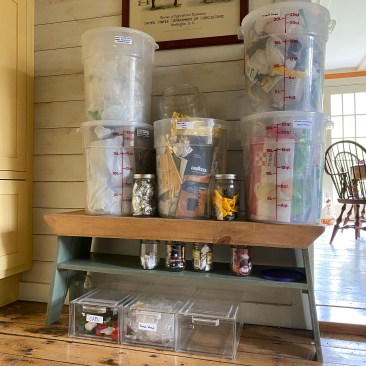
The New System
  1. Polyethylene #2 and 4: This is what I wrote about in my blog in January, this is the flexible, stretchy plastic also known as “plastic film.”

Includes:

plastic supermarket bags

produce bags (both the kind that come in rolls at the store and the kind apples and oranges come in)

plastic overwrap from things like paper towels, toilet paper and water bottle cases

dry cleaning bags

Ziploc bags

bubble wrap and bubble mailers

deflated air pillows and plastic mailing envelopes

newspaper bags

cereal box liners (unless they tear like paper)


SOLUTION: Recyclable at the supermarket bag recycling bin, once that opens up again.

Difficulty level: Easy


  1. Multilayer/ Multi-film Plastic: This is what I wrote about in my blog in April, plastics that are co-extruded (read: scientifically smooshed together) and therefore use several different kinds of plastic. This makes storing food wonderfully easy and recycling impossible very hard.

Includes:

pouches used for vacuum sealing, such as for meat

plastic bags used for frozen vegetables


SOLUTION: Working on it.

Difficulty level: Tough.

Help! My mom is crazy!
  1. Packages Using Foil: These are also multi-layer packages, but in this case they sandwich foil with paper and/or plastic.

Includes:

snack bags

chip bags

coffee bags

candy and granola/breakfast bar wrappers


SOLUTION: Working on it.

Difficulty level: Tough.

No one tell Marie Kondo about this
  1. Crinkly Plastics and Cellophane: Any flexible plastic that is shiny, and makes crinkly noises. Unlike polyethylene, it does not stretch when you pull it.

Includes: Those heat seal shrink wrappers that come banded on the top of so many products. Also, packaging for practically every product you can think of. If it doesn’t fit in any other above categories it is probably this.


SOLUTION: Working on it.

Difficulty Level: You’re killing me here.


  1. Wine Corks: Because apparently I’m a wino. I blame the pandemic. Also I blame wine.

Includes:

Um. Wine corks.

Wine cork necklace? Wine cork Christmas tree garland? I’m just brainstorming here

SOLUTION: Start a business making wine cork keychains? Check Pinterest? Note to self: buy a glue gun. Also, I read you can soak them in alcohol and use them as fire-starters, so my inner pyromaniac finds that promising.

Difficulty Level: Easy to Moderate

  1. I Don’t Know!!: This is where I put the fun stuff.

Includes:

deflated birthday balloons

broken glass

two pieces of styrofoam

a burned out lightbulb

plastic produce netting

hard plastic with no identifying numbers

used up ball point pens

old mascara containers

empty mailing tape dispenser

irredeemably bent coat hanger

a plastic pickle holder that looks like a parasol for a leprechaun


SOLUTION: I swear to God I’m working on it.

Difficulty Level: Ninja.
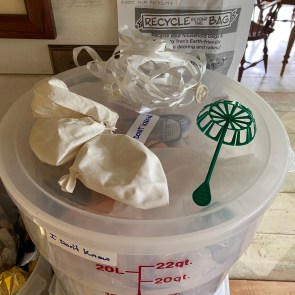
You never know when a leprechaun parasol may come in handy


On smaller shelves underneath the large bin area, I also have eight smaller containers for things that don’t come up as much/ don’t require much room. They are labeled: Tin Foil, Wax, Silica Gel Packs, Batteries, Stickers, Plastic Doohickies, Caps, Plastic Wrap.
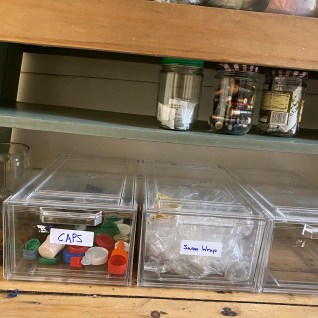
You can tell I’m proud because I’m taking so many photos

I know what you’re thinking. “Eve? Haven’t you just, you know, washed and dried and KEPT all your garbage instead of sending it to the landfill? I mean, what is the point of all this sorting if there is no solution for these things?”

I know you’re probably thinking that, because I think it myself about once a day. But then I realize that all of this stuff, ALL of it could fit into one 96 gallon trash container. That’s the same trash container that until only recently we used to put out, full to bursting, every single week. If I make my calculations right, at 18 weeks in, to date we’ve avoided sending 1728 gallons of garbage to the landfill.

A whole year of filling up our trash container, by the way, amounts to 4992 gallons. So even if, at the end of the year, we end up with say, two containers of I couldn’t solve this– 192 gallons- I can still feel pretty good about the other 4800 gallons we saved from the landfill, primarily because we decided to start paying attention.

Just to be super geeky, I tried to figure out what weight is represented by those 4800 gallons of trash. Would it equal a small elephant? A grand piano? Unfortunately, because gallon is a measurement of volume, not weight, that’s a very tricky thing to figure out. Online I found wildly different estimates as to how much an average gallon of household trash is supposed to weigh. Is it a half a pound? Or four pounds? Depends who you ask.

But what we do know is that the average American throws out 4 pounds of trash per day, or 1460 pounds per year, which is to say 3/4 of a ton. In a household of four people that would equate to about 3 tons per year.

That’s like throwing away a full-grown rhinoceros. Crazy, right? It’s enough to make a person freak out.

But I promise not to freak out again. I’m done. For now.

Happy… Earth Day?

Well, hell. This is not the Earth Day I was expecting.

Not that I’ve ever been exactly sure how I was supposed to celebrate Earth Day… but surely this can’t be it.

Last week they brought BACK the plastic bags at my supermarket whose ban I was so delighted to witness only a few short weeks ago. There’s talk there of prohibiting reusable bags altogether. And bottle and can or plastic film recycling are out of the question: the doors are locked. No more bringing my own containers anywhere. No more buying anything in bulk.

Suddenly I find myself much more worried about getting in and out of the store with the efficiency of a Navy Seal than about whether a product has a non-recyclable plastic ring around the lid. (Get in! Get out! Go home! Stay there!)

Although these changes are deeply dismaying, they’re for the most part hard to argue with. Do we need to be as careful as we can possibly manage to avoid the spread of disease? Of course. Saving lives trumps bringing my plastic bags back to the supermarket.

However, while we’re busy being distracted or panicked, sometimes it’s hard to know when the measures stop making sense anymore. Unfortunately the pandemic presents a golden opportunity to justify anti-environmental behavior under the guise of necessity. Exhibit A: The Environmental Protection Agency has suspended enforcement of environmental laws. That’s right! No more pesky monitoring, lab analysis or reporting. In the United States there are now effectively no penalties for breaking pollution rules. And Coronavirus necessitates this because… if we can’t pollute our own country the germs win?

But don’t worry. “The EPA expects all regulated entities to continue to manage and operate their facilities in a manner that is safe and that protects the public and the environment.” Translation: big corporations are now operating under the honor system. I’m sure everything will be fine.

It’s complicated on the local level too. Sure, everyone agrees waste removal is an essential service, but whether or not recycling is also essential has been left up to the local governments to decide. Cue the chaos. Here in Vermont— Vermont mind you— there’s a proposal to landfill recycling and postpone a ban on landfilling food scraps. Even if these steps are truly necessary, once the crisis has passed, how long will it be before those hard-won environmental gains are re-established? There’s just no telling.

Saving the earth seems to be discontinued until further notice.

It’s a weird time. There’s so much depression, boredom, isolation and fear but at the same time there are moments of unexpected beauty. Polluted skylines the world over are clearing because the world is standing still. The polluted canals of Venice are crystal clear. Wild boar are wandering the streets of Barcelona and a herd of wild deer cavort on Indian streets. We watch from our windows, take videos with our phones. We are a captive audience, literally and figuratively. In our absence, what will nature do to surprise us next?

What can we find to celebrate in such a Through-the-Looking-Glass Earth Day, the 50th anniversary of the first Earth day, no less? I read an article on the World Economic Forum that had a good answer. It argued that what the pandemic offers us is the chance to see the huge difference humans can make when they make individual change.

“Our collective ability to address the damage we’ve done to nature has seemed impossible. Until now… The virus is raging, but we all can help stop it. When’s the last time you felt you could freeze a glacier, or actually help extinguish a forest fire? What we do here – and what we learn – could save lives and help us all endure and thrive as individuals, as communities, as a species.”

Meanwhile, our family is limping our way along in our Year of No Garbage turned Year of Keeping All Our Nice, Clean, Washed Garbage In A Pile In The Kitchen. Today, while cooking, I held up a piece of plastic food packaging and shook my head, and sighed. Was I disappointed at it, or me?

Ilsa laughed.

Today, on the 50th anniversary of Earth Day, I’m asking myself a simple but deeply important question: on the other side of The Great Pause, what will we do with what we’ve learned?

Lunch at Our Table

Lately, a surprising amount of my energy is devoted to the task of not being terrified. I’m a person who suffers from obsessive anxiety, so even pre-Corona virus I was really, really good at washing my hands. Like, I already sang the alphabet song.

Now I sing Wagner’s Ring cycle.

Luckily, for me, I have enough other things to keep my circular thought patterns at bay: the task of keeping a houseful of teenagers and young adults fed, for example. Ever since my daughter’s acting conservatory closed two weeks ago, we’ve had six under our roof, which is double our usual number, including Greta, her actor boyfriend, and her dear friend who is also studying acting.

I was delighted to have them all here, refugees from the panic that has become New York City. I was delighted too, that I could cook for them, because that always makes me feel that I am caring for people. It gives me purpose, makes me feel that I’m literally making the people around me more happy and healthy by feeding them nutritious, homemade food.

The only problem is that I’ve never cooked for the Brady Bunch before, and I keep wondering where the heck Alice is. Between the fact that I make pretty much everything from scratch, and was doing all the dishes? Three meals a day? With no “Hey! Let’s go out tonight and give Mom a break!” in sight?

It has knocked me for a serious loop. I was going to bed exhausted, planning meals in my head, and waking up exhausted, planning meals in my head. Why, you may be wondering, didn’t I ask for help? I don’t know. Part of it is sheer stubbornness. Another part of it is probably my unconscious, deciding that it was better to be on the brink of exhaustion than to think about the scary things that are going on in the world right now.

Thank goodness, things on the Eve Exhaustion Front have now significantly improved. I finally started accepting help when it was offered (imagine that!) and even asking for it upon occasion. We set up a calendar of chores so everyone in the house is now contributing every day. And Greta’s friend made the decision to fly home to her parents, which made us sad to lose her company, but in sheer practical terms also meant one less mouth to feed.

That’s a phrase that strikes me as very old-fashioned: “one less mouth to feed.” It reminds me of stories about the Depression, and the Little Rascals short films that took place in orphanages (“Don’t drink the milk!” “Why?” “It’s spoiled!”). I think about the American Girl historical fiction movies with their young characters living through World Wars and the Depression and their fictional family members who died or disappeared and all anyone could do was bring you a casserole.

What does any of this have to do with No Garbage? In my mind it’s all connected. In fact, weirdly enough, all three of my family adventure-projects seems bound up together for me in living through this current crisis: sugar, clutter, waste. All of these themes have to do with how we live our lives, and- perhaps you’ve noticed?- currently how we live our lives has been thoroughly upended.

For example: my younger daughter, Ilsa, needed a quiet place to park her laptop and attend “school” every morning, and our under-used upstairs room seemed the obvious choice. But, truth be told, this “Hell Room” (the room I spent the entirety of my Year of No Clutter clearing out) has been backsliding into Hellishness for some time now. So I had some work to do.

Interestingly, I discovered some newfound decluttering energy, and Ilsa and I cleared a neat space for her with little trouble. I think it was easier than my past efforts because I had a practical problem to solve, quickly, and thinking practically changes me: it makes me not think quite as much about tomorrow and some future self, but about what we need now, today. I liked the change. So much so that I’ve continued to clean and organize the rest of the room since: if I can manage to clear it out still further it could also become another good space for other things… reading, relaxing, being. I was surprised to realize that all it took was actually needing the space, to make me more effective and efficient.

Meanwhile, in the kitchen we are running a tighter, more efficient ship as well. Yes, No Sugar taught me to cook things from scratch, and yes, No Clutter has been teaching me about planning and thinking ahead to avoid packaging. But this new normal has been bringing home cooking and planning in our house to a new level, and it’s pretty much all lunch’s fault.

Once upon a time, the midday meal in our house had been a “winging it” affair, an amalgam of leftovers, “just in case” foods (“Don’t we have a frozen burrito left in there somewhere?”) and school lunches. Now? Now we have meals. Planned ones. Only. Every day I make sure we have a hot, sit-down meal to feed five people three separate times. This is because social distancing makes our grocery shopping no longer casual- “oh I’ll pick up some milk on the way home”- but instead infrequent, targeted and specific. It is also because we are feeding more people, and therefore the only way I can be sure there’s actually enough food for everyone to eat. It’s a lot of work, for sure, and sometimes I get very overwhelmed, but it’s no different than our ancestors have done for centuries.

As it turns out— and I’m as surprised as anyone about this— living No Sugar, No Clutter and No Garbage all lead to the same place: being thoughtful and devoting the time. When people are nostalgic for the “good old days” they’re not pining for beef shortages and the Whooping Cough, I’m pretty sure what they’re captivated by, when it comes down to it, is the pace. Even the Little Rascals sat down for breakfast together. Being thoughtful about your space, your resources, your food, where the objects of our life come from and where they all go; devoting the time to put those ideals into practice… getting objects to people who will love and use them, recycling and reusing, cooking as much as possible from scratch. These all sound like old-fashioned ideals that many will tell you just aren’t possible in modern society, but all they require is being thoughtful and devoting time.

How do we want to live? What kind of people do we want to be? If we try to find a silver lining in this crisis it could be that it is forcing so many of us to stop running headlong through life, believing we don’t have time for things. Life is time. If we are alive we have time, and don’t let anyone tell you it isn’t up to you how to spend it. What we, as a culture, need to do is stop ceding control of that time, those decisions about how we spend it, to someone or something else- our culture, our job, our technology, our expectations, or someone else’s.

Right now my daughter Greta is downstairs baking bread for lunch today. She won’t use sugar, create clutter or make any garbage in the process. Today we’ve done the best we can do, and that’s good enough. I know I was born with a truly exceptional ability to worry about the future, and that’s what comes easily. The harder part is reminding myself instead that today is what we have and often- often- that’s pretty darned good. The harder part is reminding myself to just be grateful for a family lunch at our table, and a still-warm loaf of bread.

—-

Homemade bread nourishes you twice: it’s relaxing to make it and delicious to eat it.

Here’s my favorite bread recipe, what Greta made today. If you make it let me know how it turns out!:

Oatmeal Sandwich Bread

  • 1 cup old fashioned oats
  • 3 cups boiling water
  • 1 1/2 Tbsp active dry yeast
  • 2 teaspoons kosher salt
  • 2 Tbsp olive oil
  • 1/2 cup barley malt syrup or brown rice syrup (in a pinch you can even use dark corn syrup, which is glucose not fructose)
  • 2 cups whole wheat flour
  • 5 cups all-purpose flour

In the bowl of a mixer, put a cup of oats. Pour boiling water over oats and let sit one hour.

At one hour, sprinkle the yeast, salt, and olive oil on top. Add the barley malt syrup and mix with dough hook. Stir in whole wheat flour. Stir in 2 cups of all-purpose flour. Then stir in 2 more cups of all-purpose flour, 1/2 cup at a time, mixing in between each addition.

Turn dough out onto a foured surface for kneading. Use the final cup of flour to add to dough whenever it gets sticky. Knead for five minutes, until dough has absorbed most of the final cup of flour and feels smooth. Place in a bowl and allow to rise for one hour.

Butter two loaf pans and heat oven to 350 degrees. After the hour has passed, turn dough onto counter, cut in half, and place each half in a bread pan. Allow to rise another 30 minutes.

Bake at 350 for 33 minutes. Remove bread from oven and allow to sit for five minutes before turning loaves out and letting cool on a rack.