Category Archives: Year Of No Garbage

Are “Compostable” Products a Fraud, Or What?

Have you ever received a product in “compostable” packaging and felt good about it? Me too! But recently I realized, maybe I shouldn’t.

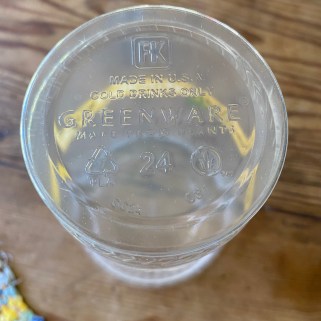
I got to thinking about compostables while on a food run the other day with my daughter Ilsa: we were picking up a dozen bagels from a local shop and she asked for a smoothie to go. When we checked to be sure the cup was recyclable  it appeared to be even better than recyclable. It was something called “Greenware,” and a cheerful message across the bottom of the cup read: “yay! i’m compostable so don’t trash me already”!

What a friendly cup!

Nice! Compostable Plastic! It was a cup that looked like plastic, felt like plastic, but, as I discovered after we got home and I looked it up, was actually made from “Ingeo,” the trademark name for a “PLA resin derived from plants.” “PLA” stands for polylactic acid which comes from corn, sugarcane or beets.

Ilsa was impressed, but then said: Waitaminit. If it is possible to make compostable disposables, why don’t all take away places use them? I explained that eco-friendly products made with natural, renewable materials like bamboo are usually more expensive, so using them is something the company has to believe provides “added value” to their brand for customers. Which is to say, it’s a reason to patronize their shop as opposed to somewhere else.

And for sure, we are those customers if anyone is: Ilsa and I are precisely that demographic who are willing and able to go out of our way, and pay a few cents more, to “do the right thing.” I feel very fortunate to have that option of choice.

But how often do we make an assumption that something labeled “GREEN!” is automatically the “right thing”?

After the smoothie had been drunk and I had washed the transparent cup, I wondered: does this very, VERY sturdy looking thing really go in our compost bin? It just didn’t feel right throwing something so… so plastic-resembling in with all our squishy banana peels and grainy coffee grounds.

Searching for reassurance I looked it up, and that’s when I was surprised. Greenware “compostable cups” are not compostable… in a backyard compost. Their website explains: “These products are compostable in actively managed municipal or industrial facilities, which may not be available in your area. Not suitable for backyard composting. (emphasis mine)”

There are other brands out there of similar products: Ecotainer is another one I’ve encountered; in the UK there’s Vegware. All the websites contain the same message: Compostable? Yes! But hold on! Don’t try this at home.
(It reminded me a lot of the recent existential debate I had over plastic wrap: Recyclable? Yes! Will anyone recycle it? No! So if in reality no one will recycle it… can one really call it “recyclable”?)

So let me make sure I understand this. I’m supposed to get my one-use, takeaway cup, and as the name indicates, I take it away. And then when I’m done I… bring it to the nearest industrial composting facility? Oh sure, I think there’s one of those at the mall in between the Hallmark Store and the movie theater.

To be fair, yes, in-store they have a bin for compostables, which presumably goes to the mythical industrial composting facility. If you consumed the drink in-store (presumably during a non-COVID-19 time when people did such wild and crazy things) then this all might make sense. But in this scenario surely it’s even better to have the vendor provide a real glass cup that gets washed and reused.

Alas, the point of the take away cup is to Take. It. Away. Am I really supposed to drive the thirty minutes back to town to return my compostable cup? And if I did wouldn’t I get pulled over by the Irony Police?

It gets worse. Although the cup is labeled with a recycling code number (#7), the Greenware website also explains it is not really a normal #7 plastic made of things such as acrylic, polycarbonate or nylon, so it should not be put with single stream recycling, lest it contaminate actual plastic recyclables. What do they recommend instead?

If a commercial composting facility is not available, please dispose responsibly in a trash receptacle.

So it goes to… the landfill. Where, despite the fact that it is made from plants, means it never degrades. And Greenware knows this. Again from Greenware’s website:

The sealed anaerobic environment of a common landfill severely limits the ability for compostable materials to break down. Oxygen and microbial activity are necessary for the breakdown of all compostable items and unfortunately is not present in most landfills.

To recap: You’ve come home with this awesome good feeling about being kind to the planet with your better choices. Yet, when you discard your feel-good cup, you end up either contaminating recycling or adding to the landfill.

It’s enough to make a regular recyclable plastic cup look downright sustainable by comparison.

If you think all this is confusing or misleading to customers, it turns out we aren’t the only ones. I called up the shop where the cup had come from and asked the employee who answered if I could put the Greenware smoothie cup into my home compost pile. She said, “I don’t know… I think you can.”

Now, just to be clear, I love my bagel shop. And right now, in particular, I applaud them for being open, heroically feeding hungry, pandemic-panicked patrons, not to mention answering weird, random questions from some crazy lady on the phone. But if the very people who work at the shop can’t tell you about the cup, I ask you: what good is it?
Is it me or are all the objects getting unnervingly friendly?

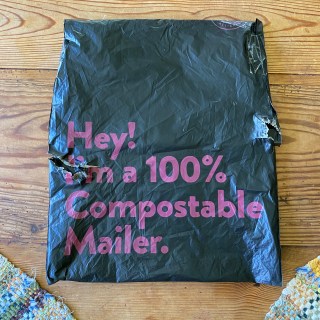
Then another development: yesterday a package arrived at our house in a flexible mailer that had a familiarly cheerful message emblazoned upon it: Hey! I’m a 100% Compostable Mailer.

As you can imagine, I was suspicious. First of all: why are all these inanimate objects talking to me? Second: why are they all so friendly? Third: Compostable?! Yeah, right.

But as it turns out these mailers— made by a company called Noissue— really, truly are what they say they are. Again- they look like plastic, feel like plastic, but when you are done with them you can throw them right into the backyard compost bin. In six months there will be no trace of them- I learned from the Noissue website that there is a technical term for this capability: home compostable.

Green-washing is a very real thing. Just because something presents itself as an earth-friendly alternative, doesn’t mean it actually is one. Sometimes I wonder if we aren’t all just so busy feeling good about trying to be better to the planet, we don’t stop to realize we might actually be being worse to the planet instead?

At the risk of sounding like a broken record, it shouldn’t require a host of Google searches to get to the heart of whether a product is what it claims to be, but until we get better regulation and public awareness around such issues, the onus will still be on the consumer to ferret this stuff out on their own. We could all benefit from clearer, legally defined terminology that recognizes that between “industrial compostable” and “home compostable” there is a BIG difference.

So, are compostable products a fraud? Noissue is clearly the real deal and kudos to them for walking the walk. As for products like Greenware, Ecotainer and Vegware, I’d like to think that they are well intentioned. But the problem is that using these products alone isn’t enough, because using them improperly can be worse than not using them at all. Informing the consumer and the vendor about what a product can and can’t do is key, and obviously that isn’t happening enough. In cities that offer curbside compost pick-up, these products probably make more sense than they do elsewhere. But there are an awful lot of places that don’t fit that description. Maybe you live in one. I do.

Until the pandemic recedes and we get back to being able to bring in our own reusable containers for take-out, I’d rather choose a recyclable plastic container over products that are only compostable in an industrial setting. At least then I know it’s part of a circular economy, and not destined for a landfill.

Then I’d know I’m doing something real, with intention, and not just accepting the veneer of sustainability as fact. Sometimes, when you peek beneath the surface, that shiny green veneer? Turns out to have been just a mirage after all.

The Garbage Blob That Ate My Kitchen *or* How to Set Up Your Home Recycle Absolutely Everything Center

Periodic freak-outs seem to be a part of my process. Since the beginning of our Year of No Garbage, the corner of my kitchen has served as the hub of all things not single-stream recyclable or compostable. Call it my “wishful recycling” pile. In the early days back in January it was downright adorable: little glass jars holding tiny piles of colorful bits and pieces. A piece of twine! Some yarn! A handful of wine corks!

January- Recycling is kind of like collecting!
May- Recycling is kind of like hoarding!

Fast forward to May. And not just May, but May after seven weeks of quarantine. The corner of my kitchen had morphed from Martha-Stewart-photo-shoot-ready into an pile of indeterminate proportions, possibly escaped from a low-budget horror film entitled THE GARBAGE BLOB THAT ATE MY KITCHEN.

Here’s my strategy when things like this develop: Ignore. Ignore. Ignore. Ignore. Ignore. Igno-SUDDENLY FREAK OUT. I am very good at this. So when my husband walks in and sees me sitting hip-deep in a pile of what most people would call garbage, carefully separating tangled thread from a wad of I VOTED! stickers and the disembodied wire from a long-lost spiral notebook, he knows not to assume I’ve lost my marbles any more than usual.

This is what happened the other day when the wishful recycling blob suddenly destabilized and started cascading onto my kitchen floor. Once I had to wade through plastic bags and random pieces of cellophane to get to the stove, something was bound to give.

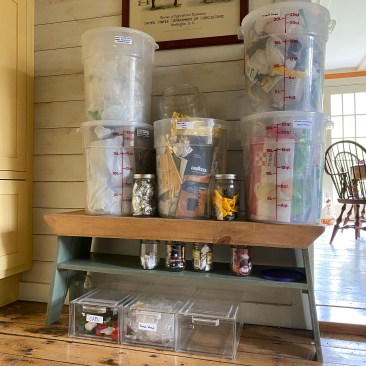
Fortunately my daughter Ilsa was there to help. The two of us pulled everything out, and began sorting up a storm. Because I’ve decided I don’t believe in such a thing as non-recyclables, and yet there are still so many items that are awaiting official answers as to where and how they can be recycled, I knew I needed to abandon the dainty little system I had begun with in favor of something a bit more rugged. Out with the adorable mason jars, in with the large, practical bins.

Next, we had to figure out what, precisely, the categories would be- I had five big bins and one small one. What warranted its own bin? What could do with something smaller? This is, of course, something I would have ideally set in place at the beginning of our project, but back then I had no idea what the categories would be, or how much of each one we were likely to collect; now on our fifth month, this pile was now the big, ugly answer to that question. In the end, Ilsa and I came up with a system that I am unreasonably proud of and here are the six major categories:

The New System
  1. Polyethylene #2 and 4: This is what I wrote about in my blog in January, this is the flexible, stretchy plastic also known as “plastic film.”

Includes:

plastic supermarket bags

produce bags (both the kind that come in rolls at the store and the kind apples and oranges come in)

plastic overwrap from things like paper towels, toilet paper and water bottle cases

dry cleaning bags

Ziploc bags

bubble wrap and bubble mailers

deflated air pillows and plastic mailing envelopes

newspaper bags

cereal box liners (unless they tear like paper)


SOLUTION: Recyclable at the supermarket bag recycling bin, once that opens up again.

Difficulty level: Easy


  1. Multilayer/ Multi-film Plastic: This is what I wrote about in my blog in April, plastics that are co-extruded (read: scientifically smooshed together) and therefore use several different kinds of plastic. This makes storing food wonderfully easy and recycling impossible very hard.

Includes:

pouches used for vacuum sealing, such as for meat

plastic bags used for frozen vegetables


SOLUTION: Working on it.

Difficulty level: Tough.

Help! My mom is crazy!
  1. Packages Using Foil: These are also multi-layer packages, but in this case they sandwich foil with paper and/or plastic.

Includes:

snack bags

chip bags

coffee bags

candy and granola/breakfast bar wrappers


SOLUTION: Working on it.

Difficulty level: Tough.

No one tell Marie Kondo about this
  1. Crinkly Plastics and Cellophane: Any flexible plastic that is shiny, and makes crinkly noises. Unlike polyethylene, it does not stretch when you pull it.

Includes: Those heat seal shrink wrappers that come banded on the top of so many products. Also, packaging for practically every product you can think of. If it doesn’t fit in any other above categories it is probably this.


SOLUTION: Working on it.

Difficulty Level: You’re killing me here.


  1. Wine Corks: Because apparently I’m a wino. I blame the pandemic. Also I blame wine.

Includes:

Um. Wine corks.

Wine cork necklace? Wine cork Christmas tree garland? I’m just brainstorming here

SOLUTION: Start a business making wine cork keychains? Check Pinterest? Note to self: buy a glue gun. Also, I read you can soak them in alcohol and use them as fire-starters, so my inner pyromaniac finds that promising.

Difficulty Level: Easy to Moderate

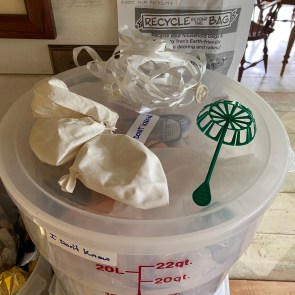
  1. I Don’t Know!!: This is where I put the fun stuff.

Includes:

deflated birthday balloons

broken glass

two pieces of styrofoam

a burned out lightbulb

plastic produce netting

hard plastic with no identifying numbers

used up ball point pens

old mascara containers

empty mailing tape dispenser

irredeemably bent coat hanger

a plastic pickle holder that looks like a parasol for a leprechaun


SOLUTION: I swear to God I’m working on it.

Difficulty Level: Ninja.

You never know when a leprechaun parasol may come in handy


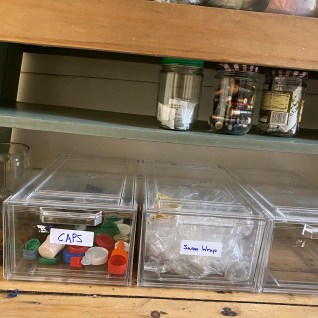
On smaller shelves underneath the large bin area, I also have eight smaller containers for things that don’t come up as much/ don’t require much room. They are labeled: Tin Foil, Wax, Silica Gel Packs, Batteries, Stickers, Plastic Doohickies, Caps, Plastic Wrap.

You can tell I’m proud because I’m taking so many photos

I know what you’re thinking. “Eve? Haven’t you just, you know, washed and dried and KEPT all your garbage instead of sending it to the landfill? I mean, what is the point of all this sorting if there is no solution for these things?”

I know you’re probably thinking that, because I think it myself about once a day. But then I realize that all of this stuff, ALL of it could fit into one 96 gallon trash container. That’s the same trash container that until only recently we used to put out, full to bursting, every single week. If I make my calculations right, at 18 weeks in, to date we’ve avoided sending 1728 gallons of garbage to the landfill.

A whole year of filling up our trash container, by the way, amounts to 4992 gallons. So even if, at the end of the year, we end up with say, two containers of I couldn’t solve this– 192 gallons- I can still feel pretty good about the other 4800 gallons we saved from the landfill, primarily because we decided to start paying attention.

Just to be super geeky, I tried to figure out what weight is represented by those 4800 gallons of trash. Would it equal a small elephant? A grand piano? Unfortunately, because gallon is a measurement of volume, not weight, that’s a very tricky thing to figure out. Online I found wildly different estimates as to how much an average gallon of household trash is supposed to weigh. Is it a half a pound? Or four pounds? Depends who you ask.

But what we do know is that the average American throws out 4 pounds of trash per day, or 1460 pounds per year, which is to say 3/4 of a ton. In a household of four people that would equate to about 3 tons per year.

That’s like throwing away a full-grown rhinoceros. Crazy, right? It’s enough to make a person freak out.

But I promise not to freak out again. I’m done. For now.

IS Plastic Wrap Recyclable?

Plastic wrap is a tough one. Also known as “cling wrap” or “plastic film­,” it presents maybe the toughest of all zero-waste conundrums.

Only those who are trying to avoid it can fully appreciate how everywhere it is. Whole aisles of meats, entire walls of cheeses, all sealed off from the world in tidy little packets! Even organic produce is safely- if ironically- secured with it to little biodegradable trays! It’s hard to imagine how magical this stuff must have seemed to consumers way back in the 1940s when it was first marketed, back when glass, metal and paper were the primary materials for storing food, and flies laying eggs on the buffet table was a subject of much debate.

Fresh! Easy! Lightweight! Cheap! I suppose it makes sense that the supermarket has a longstanding love affair with clean, clear, oh-so-sanitary plastic wrap. Even before the current pandemic severely limited my shopping/food packaging choices, the stuff just kept popping up in my house like a deranged Whack-a-Mole. Surprise!

Friend: I brought you some lovely cheese, Eve!

Me: CRAP.

Also Me: I mean, thank you it’s lovely!

Me to myself: CRAP. Guess I’ll put this next to the plastic wrap I found in the freezer and the plastic wrap a friend brought me leftovers in, and the plastic wrap that fell out of the freaking sky on my head.

Note to self: Gotta find out what is the DEAL with plastic wrap.

Since our Year of No Garbage began, whenever plastic food wrap has reared its ugly head in my kitchen, I have carefully washed it in the sink, the same way I do tin foil: flattening it against the sink bottom and wiping with my dish sponge in one-directional strokes. I have draped it delicately over the dishes in the drainer to dry. At some point, though, I began thinking to myself: how is this thin, flexible plastic any different than, say, the thin flexible plastic of supermarket bags? It felt the same. It has the same industry terminology: “plastic film.” If food wrap is the same plastic as supermarket bags, wouldn’t it stand to reason that you could- after cleaning and drying it- recycle it in the plastic bag recycling bin at the supermarket?

So I googled it. When one googles “is plastic wrap recyclable?” the resounding answer one invariably gets is: NO NO NO DON’T EVEN THINK ABOUT IT NO.

But why? Most online sources give no reason at all, but a few say it’s because plastic food wraps are made of #3 plastic: PVC or PVdC (polyvinyl chloride or polyvinylidene chloride).

The thing is, this is not entirely true. When you dig a little deeper you find that, due to a growing awareness of the toxicity of chlorine in PVC and PVdC many plastic wrap films are no longer made with these materials, notably including Saran Premium Wrap, which changed its formula in 2004.

So what are they made of? Well, when you get an actual person on the phone at these companies, you find out that two of the leading food wraps, Glad Clingwrap and Saran Premium Wrap, are currently both made with… polyethylene.

And because I am now a certified Recycling Nerd Extraordinaire, this is when I start to get excited. Because polyethylene, you may recall, is exactly what makes up all those plastic film products that are suitable for recycling into outdoor decking by the good people at Trex. Dry cleaning bags, bread bags, plastic overwrap from toilet paper and paper towel, produce bags, Ziploc bags, bubble wrap… as I wrote about back in January, all of these things are made with polyethylene (plastics #2 and #4) and can all go into the plastic film recycling bin at the supermarket.

Could it be that Saran Wrap and Glad Wrap could go in that recycling bin too?

I sent an email to my friend Stephanie Hicks at Trex to confirm my hypothesis. I was disappointed to get her response: “Hi Eve… Glad Wrap and Saran Wrap are not plastic films that Trex accepts.  It’s my understanding that they (sic) chemical do not behave the same as typical PE film.  Please do not include.” This struck me as odd, because both of the company representatives I spoke with confirmed that their plastic wraps were 100% polyethylene- I mean, there are no other chemicals hiding in there. So what made this polyethylene film different than any than other polyethylene films?

When I pressed for more info from Stephanie at Trex this is what I got: “Saran wrap is PE (polyethylene) but it’s a modified form of PE and performs different that (sic) traditional PE.   It does not melt like traditional PE.”

Wait- was that true? More phone calls.

This time I spoke to Public Affairs representative at SC Johnson, the makers of Saran Wrap. That’s when I got a response that blew my recycling mind. Here’s a quote from the official statement they sent me:

We can confirm that clean and dry Saran Wrap® is recyclable at most major US retailers similar to Ziploc® bags by dropping off in the bins located in stores that collect plastic bags and films. 

On the phone, Megan, a customer service representative at Glad Products told me the same thing about their Glad Wrap: “It’s 100 % recyclable.”

Wow! Great news! But hold on. One thing I’ve been learning this year is to be more skeptical about things companies say. What does “recyclable” really mean, anyway? The term “recyclable” is meaningless if no facilities actually exist to accept it, right?

Dear Loyal Consumer: We are delighted to inform you that our product is 100 %, guaranteed, fully recyclable. On Pluto. Thanks for your inquiry!

Was I just back to square one? After all, even though the manufacturers say their product fits the parameters like those used at Trex, remember Trex said: Glad Wrap and Saran Wrap are not plastic films that Trex accepts. 

But why? I was starting to sound like an annoying four year old, yet I still couldn’t help but wonder. Is it just because recyclers are afraid customers won’t wash and dry the stuff properly? Or are they afraid customers will put in non-polyethylene films that look identical, but are chemically very different? (Stretch-Tite, for example, is still made with PVC.) And if so, would this contaminate the recycling process? And how?

At this point I’d just like to pause and say: it should not be this hard. It should not be hard to know what chemicals are being used in the packaging of our foods, and it should not be hard to recycle our food packaging. I can’t say it enough: Trex and other polyethylene recyclers are doing a wonderful, fantastic thing by turning plastics that were heretofore unrecyclable into new products. They are to be deeply commended and I mean that.

But. Why did I feel like I was getting the runaround?

Plastic wrap as far as the eye can see in the cheese aisle

Were they just hoping I’d give up and go away? Because if so, they were truly not understanding the level of Lady Macbeth obsessiveness I’m operating on.

So I gave Trex one last try, emailing Stephanie again, asking: What is the modification that makes 100% polyethylene plastic food wraps unrecyclable with other 100% polyethylene plastic films? And at last I was able to get a more specific answer:

It is true that saran wrap plastic films are 100% PE, but are XPE – cross linked polyethylene.  Trex process does not handle well XPE as it doesn’t move through the process of melting and material flow the way that non XPE does.  Our whole business, machinery, and technology are designed to use a consistent or homogenized material source and XPE causes major chemical shifts. 

Apparently, XPE can gunk up the whole recycling process, creating clogs in the line and irregularities in the new product.

After all this rigamarole with dueling representatives I kind of felt like it was time to get an outside viewpoint on the recyclability of plastic wrap. So I had a phone call with a lovely woman named Emily Tipaldo, at MORE Recycling, a consulting company that specializes in facilitating recycling and sustainability.

According to Emily the other concerns I had suspected are, all by themselves, enough to put the kibosh on the whole endeavor, even before you get to the issue of the polyethylene being cross-linked. “(Many recyclers are) probably worried about contamination,” she explained. “Most people probably won’t take the time to wash and dry the film properly.” Which can not only contaminate the recycling, but also invite pests.

Add to that the fact that, while Saran Wrap and Glad are polyethylene, others are not.

“It’s confusing enough for people trying to recycle right,” she said, without people trying to keep track of whether the plastic came from Saran, Glad or Stretch-Tite. And once the plastic is out of the box, they’re indistinguishable: there’s no way to determine whether a food wrap is PVC or HDPE just by look or feel.

And, most importantly, she confirmed once and for all: “XPE is not currently compatible with the PE recycling stream.”

So just like in The Mysterious Case of the Meat Plastic Vacuum Pouches, I had at last gotten to the bottom of a difficult recycling question, only to find a not very satisfying answer: yes… but really no. Yes, some manufacturers are saying plastic food wraps are “recyclable,” but are they really? In reality, pretty much no one wants to recycle them, because it just too hard: too complicated, too arduous for consumers, too messy, too confusing. The industry is simply not set up to do this.

Not yet.

Please, please. Don’t ever do this.


Or this.


So what’s the takeaway? I’d say more pressure needs to be put on corporations to take responsibility for what happens to their packaging after it is purchased by the consumer. I was delighted to find a company like MORE Recycling whose mission is in part to help companies make that transition from a linear to a circular economy. We need much, much more of this.

Here’s a crazy idea: how about all companies adopt a common set of packaging options that is guaranteed to be recyclable or compostable in all fifty states. Anything falling outside these parameters shouldn’t be allowed to be made or sold. We need a standardized system that is clear, consistent and easy to use— by everyone.

Let’s work on that.

In the meantime, the easiest, most sensible thing we can do as consumers is to avoid food-wrapping plastic films. Don’t buy them for your kitchen— instead use beeswax wrap or glass Tupperware such as Pyrex— and as much as possible try not to buy products that come wrapped in them. Until we can go back to bringing our own containers to the store for cheese and meat, that’s the best we can do.

Even though it’s not a very satisfying answer, I’m glad now to have the real story about plastic wrap… cross-linking warts, and all. Because as long as we are willing to take the word of industry who tries to brush us off with: you wouldn’t understand it, lady, because: science, we can’t effectively argue for change.

And change is clearly what needs to come next.