Category Archives: Year Of No Garbage

The Chicken Who Lived

I know the world is ending, but first I’d like to talk about something that happened at our house this week: one of our baby chickens was attacked by a raccoon and lost a good part of her face.

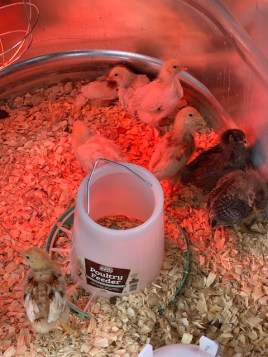
We’ve been raising baby chicks for the first time this year. We bought nine of them when they were a day and a half old, at which point they resemble little balls of fluff with legs; for the first several weeks, before it got warm enough for them to be outside, they lived in a metal tub in our dining room. There they ate and drank and were somewhat smelly and argued over who got to play with the loose feather someone found. So, you know, pretty much what we do in our dining room.
Although we’ve never raised from chicks before, we’ve kept chickens for the last ten years, so we know the deal: chickens live short, unpredictable lives, and it’s best not to get overly attached. Like, you stop letting the kids name them. We’ve had chickens carried off by fox, raccoon, hawk, and even a bobcat once. We’ve had three brand new pullets decimated in the night by a predator who left only a few gristly feathers and a foot behind. We’ve had them die of strange diseases that make their heads list mysteriously to one side, or stand in one spot all day without moving or eating.

The chicken-keepers mantra: Chickens don’t recover. They die.

So when we discovered our little half-grown chick bloody and missing key body parts (a large swath of feathers and her beak), we knew the odds of her surviving were Definitely. Not. Good. I felt woefully under skilled as we tried to clean her up and ascertain the damage. Looking at the place where her beak was supposed to be, I couldn’t make any sense of it. Splintered shards were sticking out everywhere- was that beak? Was there any beak left? What about her tongue? Or was that a piece of hay? I felt a strange mixture of anxiousness and defeat at the same time. How can I help if I don’t even know what I’m looking at?

I feel this way a lot lately, and not just about chickens. This morning I asked my husband, as he scrolled the news on his phone, “So, what’s happening in the world? Or, should not I even ask?”

I mean, here we are in the throes of the first major pandemic in a hundred years.

We’re destroying the planet.

And there’s rioting and looting in the streets of our major cities.

Have I left anything out?

When the state of the world is this chaotic and unpredictable, it’s hard to know how to feel. Is the pandemic ending now? Or is the worst yet to come? Is it too late for the planet, the polar bears and the rainforests? Or can something still be done? Why are innocent people being killed in the streets by the very folks sworn to protect us all?

How can I help if I don’t even know what I’m looking at?

Frying pan: meet fire.

Just in case I wasn’t feeling bad enough, a friend forwarded me an Op-Ed from the New York Post, making the argument that New York City should stop recycling. Yes. With all that’s wrong in the world why not just throw some gasoline on the fire?

The worst part is that the author of the article, a senior fellow from a conservative think-tank, makes a decent argument. Remember how in 2017 China stopped accepting recyclables from the United States? Have you ever wondered what happens to all that recycling now? Well New York City has been paying a small fortune for private companies to take it. According to the editorial’s figures, the city spends around $390 million to get paper, metal, glass and plastic into the hands of recyclers and consequently could save about 87% of that amount, or $340 million, if all of it just went straight to landfill.

That sounds like a lot of money. But is it? The annual budget of the city of New York is about $86 billion. Which would mean that landfilling recyclables would save New York City less than one-half of one percent of its budget. A fraction of a fraction, but still… $340 million is $340 million. Fortunately, when Mayor Bill de Blasio announced his proposed upcoming budget on April 16th, which included many slashed programs, eliminating recycling was not one of them.

But the fact remains, one of the biggest obstacles to recycling is cost. If people have to choose between, say, food and shelter and recycling? Obviously it’s no contest. Likewise New York City or any other municipality.

Tom Szaky, the founder of the innovative recycling business Terracycle, has an interesting take on this subject of recycling and cost. Recently I watched a keynote address he gave at Planet Forward, an annual student journalism conference, which is available for viewing on YouTube. In it he introduces a novel concept: there is no such thing as not recyclable.

Rather, Szaky says, it’s a matter of simple economics: if you can find someone to pay for it, then you can recycle it. No exceptions. Terracycle has proven this with a team of in-house scientists who have found ways to recycle everything from cigarette butts to dirty diapers.

But who wants to pay for this recycling when the end product is more expensive than buying new? In his presentation he offers an interesting solution: change the story.

“People want purpose,” he tells the roomful of communications majors. He gives an example: a shampoo bottle Terracycle developed with Proctor and Gamble that uses 25% recycled “beach plastic” in the packaging. He relates an anecdote in which one P&G associate is jokingly mad at Terracycle for having greater success with a 25% recycled plastic bottle than they had had previously with a 100% recycled bottle.

Why are people more interested in a 25% recycled bottle than a 100% recycled bottle? Szaky’s point here, I think, is that the story of beach plastic recycling, which conjures up powerful images of turtles with plastic straws lodged in their nostrils, is compelling to the consumer, in a way that the generalized idea of “recycling” cannot be.

“That’s one of the biggest challenges in sustainability communication I think.” Szaky elaborates. “It’s 99% ‘the world is ending’ and at the end it’s like ‘well, turn your light-bulb off when you leave your home.’ And it’s like well, those aren’t balanced concepts. And then I might as well (say) fuck it and just party because the world is gonna end and I can’t do anything about it right? We need to empower this positivity, the inspiration that there is a way to solve it. ‘Cause there is.”

How do you get people to change their behavior? To clean and sort their recyclables? To spend more money for recycled packaging? To demand their government officials continue to invest in curbside recycling? You need a powerful story they can relate to. Cleaning up ocean plastic so that sea turtles don’t have to have straws in their nostrils is one such story.

Speaking of nostrils, or lack thereof, we ended up taking our chicken to the vet. And believe me, finding a vet who sees chickens is not an easy thing to do. (See the chicken-keepers mantra, above.) We were about 85% sure he would tell us to put her down.

But he didn’t. He said “I’ve seen chickens worse off than this, that recovered.” That was all we needed to hear. Yes, it’s financially bonkers- how many farmers do you know who would pay vet bills for $4 chick, who may very well die in the end anyway? But we’re not farmers. Keeping chickens for us is about enjoying them and their eggs, not about making financial sense. Don’t get me wrong, we’re not going for the six-million dollar chicken here, but if we can manage to save her— the vet has described gluing on a new prosthetic beak— we’d really, really like to.

The Chicken Who Survived Being a Metaphor

A lot of it comes down to just paying her some extra attention, keeping her separate (she’s back in the tub in the dining room), and feeding her a couple of times a day with a dropper. She’s been through a lot, as have we all lately, and she looks a little bit like Sylvester Stallone at the end of the film Rocky. For one thing, in a world where so much is going wrong, it’s one tiny good we can do.

For another, well, we’re invested in her now. You see, she’s got a story.
Top Ten Facts You Need to Know About Terracycle NOW!

You know what makes me crazy? List articles. You know the ones: Top Ten Things You Could Be Recycling NOW! Or: Recycling! Ten Ways You’re Doing it ALL WRONG!!

The reason I don’t like these articles is because they often purport to give you good advice about important issues, like recycling, but actually end up just skimming the surface in a way that isn’t at all helpful. We feel good about reading the article, but don’t end up with enough information to effectively change anything.

What does using Terracycle really entail?

Exhibit A: in the article 10 Household Products You Never Knew You Could Recycle on Food 52, the author breezes past the thorny issue of what to do with used toothbrushes and toothpaste tubes with the advice to “mail toothbrushes to alternate recycling systems like Terracycle” adding, “Terracycle’s got you covered”!

Great! I’ll use Terracycle! we think.

But… what does that actually mean? Like… can I just write Terracycle’s address on an envelope and mail them my old toothpaste tube?

  • FACT #1: No, you can’t just mail them your old toothpaste tube. The actual deal, as you will see, is far more complicated.

To begin with:

  • FACT #2: You have to pay for Terracycle’s services. Unless you have a school group or business that is locally collecting for Terracycle as a fundraiser or promotion, it is a fee-based program.

On top of this:

  • FACT #3: It is not all that easy to figure their system out. I myself have visited Terracycle’s website about a dozen times since the Year of No Garbage project began. Every time I visit I am determined to figure out how I, as a reasonably intelligent ordinary person, can use it. And every time I’ve been utterly defeated.

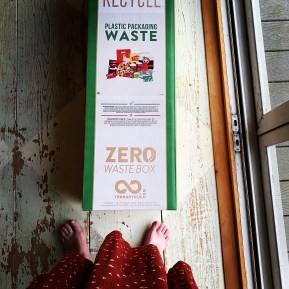
This much is clear: for the pay programs, you order a “Zero Waste” box for a fee, which includes the postage for mailing it back when it is full; they recycle the contents. So the next logical question is how much does it cost?

  • FACT #4: The fee varies a LOT depending on what goes in the box, and this is where it starts to get complicated.
  • FACT #5: There are 79 different types of Zero Waste Box, at least by my count. This includes boxes devoted entirely to subcategories like 3D Printing materials, toy action figures, and (my personal favorite) used chewing gum. I know. I’m not sure I want to know what they do with that.

On top of this:

  • FACT #6: The Zero Waste boxes come in three sizes, the middle one of which is about the size of a kitchen garbage can… which is pretty big for someone who is just looking to recycle some empty toothpaste tubes.

    Besides these three, there are 76 more categories to consider

Between the categories and the sizes, so far you have at least 237 boxes to choose from. Stymied yet? Well, they do have a “one size fits all” option.

  • FACT #7: The “All in One” box is the easiest solution, but it is also the most expensive: the medium box in this category costs $287.

Hmm. Still trying to recycle my empty Tom’s toothpaste container here, and $287 feels a little steep. How about the “Personal Care Accessories” Box? The smallest box measures 11″ x 11″ x 20″ and costs $115. To recycle a few toothpaste tubes?

But wait! In the list of acceptable items for the Personal Care box, nowhere does it mention toothpaste tubes or toothbrushes! Back to the drawing board.

In the search bar I type “toothpaste.”

Sorry, we could not find a program matching your request. 

ARGH.

I flip over to “Free Recycling Programs.” Maybe I could start one of those in our community, like at the local school or library? Then everyone could recycle their toothpaste tubes! For free!

  • FACT #8: All the “free” recycling programs sound like advertising: “Febreze Aerosol Recycling” “Gillette Razor Recycling,” and so on. So does that mean you can only recycle those brands in these boxes? It’s not entirely clear, but it turns out it doesn’t matter, because:
  • FACT #9: The free boxes seem impossible to get. When I go through the effort to register and make separate requests for three different kinds of free recycling boxes, I get a message for each one saying I’ve been placed on a “waitlist for this program.” That was several months ago.

Back to the drawing board. A search for “dental” brings up boxes for Disposable Gloves, Garage Waste and Pet Products.

I’m swimming in a sea of random objects. Vitamin bottles! Cassette tapes! Shoes! It’s all so frustrating and tantalizing at the same time. I’m so very glad Terracycle is recycling these things, but so very frustrated I can’t figure out how to use their system in a way that makes any sense. It’s like I am looking through a glass door at a wonderful world of recyclability, but the door is locked and I can’t get in.

From sheer number of categories, to the huge boxes, to the bureaucratic layout, the Terracycle website feels designed for industry, not ordinary people. Which it may be, but I’m awfully glad that it is open to ordinary people. Despite the fact that I’m giving Terracycle some crap here, I’d nevertheless like to point out that:

  • FACT #10: What they’re trying to do is groundbreaking and kind of heroic. Yes, I wish it was much, much more user friendly. But as far as I can tell they seem to be the only game in town trying to recycle everything, and I think that counts for a whole heck of a lot.

The last time I checked out the Terracycle website was last week. I was seeking a solution to the burgeoning containers of plastic building up ominously in my kitchen-recycling corner. My husband Steve has started to say things like “Soooo, after the project’s all over, if this stuff is still here? We can throw it away then, right?”

Well, yeah, but that wasn’t the idea, of course. The idea was to find actual solutions. It was time at last to bite the bullet and just try ordering something from Terracycle and see how it all turned out. I selected a Zero Waste box called “Plastic Packaging.” I had both phone and email exchanges with Terracycle customer service, to be reassured this particular box was appropriate for what is building up in my recycling corner the most: crinkly cellophane plastics and co-extruded multi-layer plastics (such as packaging for meat and frozen vegetables). Then I checked on the one last thing that had been bothering me.

Did I really have to remove all paper labels?

A customer service representative wrote back: With regards to paper labels, we do ask that they are removed before you place them in your Zero Waste Box. I know these can be a bit tricky at times so please know that we sincerely appreciate your efforts in removing them!

Ugh. Well… What choice did I have? Buying the “All in One” box for at more than twice the price? No… I’d worry about the labels later.

I was finally ready.

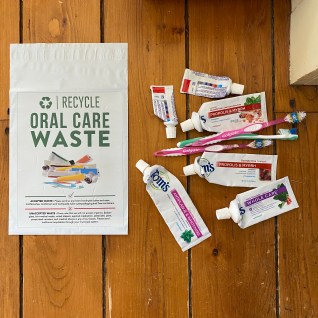
I ordered a medium size box for $134. At some point during the ordering process I stumbled across an envelope marked “Oral Care Waste”!! At last a solution for my toothpaste tubes!!! It was $42, for a size slightly smaller than a manila envelope but I was so grateful to at last find it, I added it to my cart without hesitation.

The elusive Oral Care Waste envelope

I’m not quite sure how to feel about this pay-to-play recycling. Of course, there’s always the problem of what-is-the-carbon-footprint-of-all-this-package-mailing? There’s the wondering what really happens to the stuff once it gets to the good people of Terracycle? There’s the hope that this really doing good things, but the lurking fear that I may just be paying Terracycle to assuage my first-world-problem guilt.

But cost is clearly the most obvious deal breaker. What! PAY to throw things away?? Although, many, if not most of us do that all the time. Currently we pay $57 per month for combined garbage removal and single-stream recycling. So, if I manage to get six months otherwise-unrecyclable plastic stuffed into that Terracycle box and recycled by paying $134, and a year requires two boxes, that would work out to just over $22 per month. Now, whether or not one thinks that price is: A. possible and B. worth it is another question entirely.

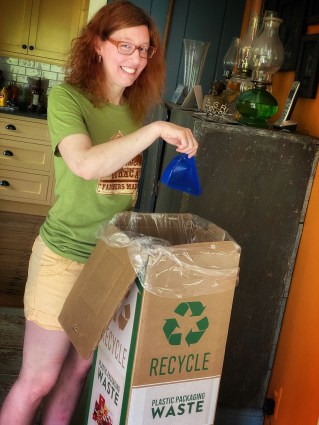
Vanna White fears me


In cases like this, Steve likes to quote the movie National Treasure: Harvey Keitel’s FBI agent is confronting main character Nicholas Cage who asks if he really has to go to prison, even though he’s the good guy. Keitel says, “Someone’s got to go to prison.” What he means is someone, somewhere always has to take responsibility, to pay the bill. If the companies who make these almost-impossible-to-recycle products aren’t going to do it, we have to. Or the government does. Or the environment does. Someone does.

A lot of Zero Wasters advocate for eliminating the plastics and other unrecyclables by not buying the products that use them, and they have an excellent point. But it’s a point that only goes so far. During this period of quarantine, like most people, I’ve not had as many choices in food packaging or shopping as I’d like. Plus, I’m well aware that there are an awful lot of people out there who just aren’t going to willingly give up their shrink-wrapped cheese and their vacuum-sealed hamburger meat. Not for the polar bears, even.

If we’re realistic, we need more than just the committed Zero-Wasters. We need people like my mom and my dad, who are seventy five and definitely not about to start making toothpaste out of baking soda and tree bark or whatever in order to avoid using plastic toothpaste tubes. But they might do a Terracycle envelope. Maybe. We need a whole roster of solutions at our disposal, reaching larger groups of people, in order to get on the side of the environment and eliminate the concept of “garbage.”

Would it be preferable to make non-recyclables illegal? Or force companies to provide reasonable recycling opportunities for their product packaging? Yes.

But until we get there, there is something appealing to me about being able to do something besides shrug my shoulders and keep adding to the landfill. Whether or not Terracycle really makes sense in the grand scheme of things is a question to which I’m still trying to find the answer.

Meanwhile. Anyone know a ridiculously easy way to remove paper labels?

—–

Postscript:

Okay, I’m pretty blown away by how much has fit into my Terracycle box so far. My ENTIRE five-month supply of cellophane/crinkly plastic went in, about half of the multi-layer plastic went in (the other half has the dreaded paper labels I have yet to figure out) and literally two-thirds of my large I Don’t Know box. This feels like the first major breakthrough since I discovered all the things that can go into the supermarket plastic bag recycling. So far I’m pretty impressed, and the box isn’t even full yet.

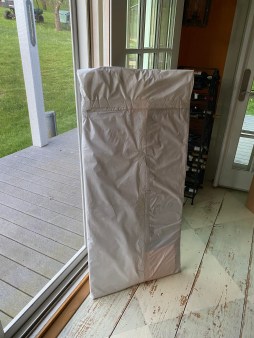
Don’t tell the irony police that your Terracycle box shows up in a big plastic package.

Things I discovered can ALSO go into the Plastic Packaging box, that before now were giving me agita in the non-recyclable pile:

-plastic blister packaging

-hard plastic with no recycling numbers

-mailing tape containers

-plastic ribbons

-those little plastic tags they sneak onto the rubber bands around vegetables

-styrofoam

-heat activated shrink-wrap seals (those bands around the cap or lid of products)


EXCITING, right? Stay tuned for more adventures in Extreme Recycling, and let me know your thoughts in the comments!

Lovely Vintage Things

Note from Eve: This week features a post written by my daughter Greta. If you read Year of No Sugar you met her at age 11; now at age 20 she is an aspiring young actress studying at the Stella Adler Studio of Acting in New York City. Since school closed for the pandemic in March she and her boyfriend Steven, also an actor, have been staying with us here at our home in Vermont, but even before that she had been living Year of No Garbage along with us, navigating the project in an urban setting.

Greta has been fascinated with the 1940s since early high school. Online, she has discovered an entire vintage community who shares her passion for the styles and culture of this period (but, Greta is quick to point out, not the prejudices or politics). For her 17th birthday we celebrated with a “VE- Day” Party that featured Big Band music, a Victory Garden and signs pointing to the nearest Anderson air raid shelter. The other day Greta was waxing poetic about how neatly her interest in this time period fits with Year of No Garbage and I said Why don’t you write about it? So here she is.

Greta in a 1940s bed jacket and “curler cozy” she knit from a vintage pattern. Special occasion? It’s Tuesday.

Wilkommen! Bienvenue! Welcome! Okay, to be fair, as a musical theater actress that was a really exciting way for me to open this piece.

But now you are wondering why I am here on my very, very exquisitely talented mum’s platform and I must reveal all: I love vintage! (And by vintage, I mean old stuff from a particular time period.) I particularly love 1940s vintage but I do dabble in 1930s as well. And for the Year of No Garbage this has turned into a strange asset.

Today when I go to the store to buy items for my apartment, everything seems meant to last about five minutes before you go buy yourself a new one. In ye-old days of the 1930-40s, as you probably know, plastic was yet to be widely used, excepting of course such early forms as Bakelite and Lucite. (And from those have come some truly lovely purses and bracelets that are getting very pricey to acquire. But I digress.)

You know what I like? Pyrex. Take a moment and think about Pyrex: it’s one of the most time-tested kitchen items we have today, but it hasn’t changed much since it was introduced in the early 1900s: you can buy it old, you can buy it new. It’s still the same Pyrex. (No, Pyrex is not sponsoring me, however if anyone out there has any they don’t want? Please call me.) Made of borosilicate glass, it is so sturdy it is often used in the sciences because heat won’t warp it or cause a “laundry effect” (shrinking or expanding). Once upon a time if you forgot a bowl at a potluck— without the masking tape with your surname firmly stuck to the bottom— it was possibly a life-altering event. I mean, Mrs. Maisel went back for her Pyrex, and look what happened to her! (Spoiler alert: it changed her life.) Today, however, we’re conditioned not to expect things to last.

But Pyrex lasts.

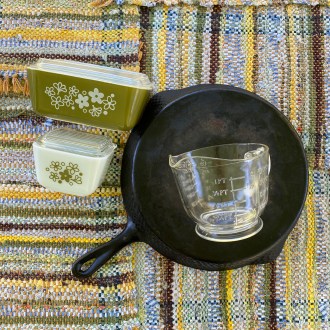
My Mom’s favorite kitchenware includes Pyrex from my great-grandmother and cast iron from my great, GREAT grandmother

Because of this, to vintage-fans in the know, kitchen items made 80 years ago are still being used and coveted. Not only vintage casserole dishes and mixing bowls, but other things too: cast iron pans, food mills, potato mashers, and baking molds are among the practical vintage items still in use in kitchens today. Could you say that most of the things we produce today will still be around in 80 years? In good working order?

And this brings me to clothing. I do so love being a girl! So many dresses, so little time. I love them, I care for them, I worry about them, and no matter how many I have, I always need more. If you’re gentle you could say I’m a collector, but if not you might say I’m obsessed.

If you ever have the breathtakingly lovely experience of wearing vintage clothing you will immediately notice the different fit and shape it gives you. But what I find equally fascinating are the hems and seams and buttons- the way they’ve held up for all this time. They, too, were “made to last.” I’m not referring only to select designer brands, mind you- the presence of ready-to-wear clothes in all the vintage stores I visit attests to the attention and care that was paid to the making of these everyday garments. So again we must ask ourselves: if you were to go to a store today that sells ready-to-wear clothes, do you think those clothes would withstand 80 years of good care and regular use?

Maybe Victory Rolls are also sustainable? Somehow?

Buying vintage is the most rewarding kind of recycling. Rather than buying something new, you’re taking something that has already had a life, and giving it another one.

Don’t get me wrong. I’m not saying I like to get all dolled up like it’s the 1940s in the name of sustainability; in my case the chicken came before the egg. I am drawn to the clothes and the style, but what I find compelling is the promise to stand the test of time, something I think we lack quite often in our fascination with “fast fashion.”

I’m also not saying anyone but me should conflate environmental responsibility with wearing their hair in a snood, nor must everyone enjoy the thrill of realizing your new dress still has its Bakelite buttons or the original matching belt. But I think it’s important to see what value an older piece can have. I often see matching vintage nesting bowls sell online for over $250. Even I think that’s pricey, but the fact that patrons are willing to purchase such things shows how much many of us crave things that are made well and last a lifetime.

My newest find! A 1950s aluminum cookie press

There’s a lot of wonderful stuff out there, in the antique and vintage shops, at the rummage sale and the local charity shop, on eBay and Etsy, stuff that has a life and a history and it isn’t done yet. Why settle for the second best, throwaway production we are given by so many contemporary manufacturers and by doing so accept the responsibility of hurting our planet? Making our objects well and treating them as resilient rather than expendable gives us hope as consumers as well as residents of the planet.

Now if you’re still here after all that? Brava! Brava! Bravissima! (See what I did there? Phantom of the Opera? Anyone?) Just to wrap this up: I’m not saying everything must be perfect and that I have no garbage vices of my own. I like to wear disposable, false lashes when I dress up. I like to order vintage dresses and hats online which, of course, has a carbon footprint. But what is important is that we don’t settle to pay for something that won’t last.

Why should we when there are such lovely things already out there?