I’ve been wondering this, and so have Hamburger and Max. They’ve migrated to YouTube now, so be sure to follow them, like them, and send them secret messages in invisible ink.
Category Archives: Year Of No Garbage
Is Recycling a Right?
I was ready. After months of planning I had finally worked up the courage to cancel my curbside garbage service.
And then all my careful plans got sideswiped.
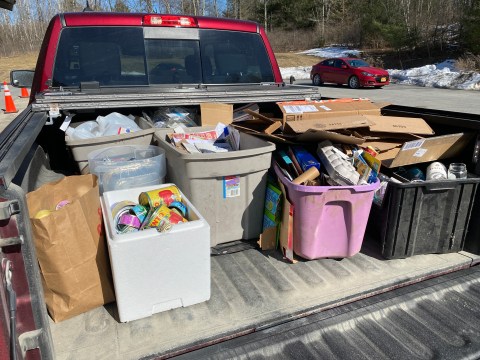
Now I know cancelling my garbage service may not sound like such a big deal, but it was something looming large in my consciousness; after a whole year of thinking about it, I was going to finally MAKE RECYCLING MAKE SENSE. I had it all figured out: by cancelling my garbage service, I would save over $60 per month, or $720 per year. We could take our ordinary recycling, (glass, cardboard, plastics #1 and 2) to the local transfer station, which would recycle it for free. Meanwhile, we’d put difficult-to-recycle plastics (#3-7) in the Terracycle box, which is expensive, but whose cost was now covered by that lovely $720 we were now saving. Perfect! No more fake recycling that quietly dumped our plastics in landfills and impoverished countries; instead everything would go to the best possible place for it to go.
And we could remain a Garbage Free/Zero Waste house.
But fear of change is a powerful de-motivator—I kept finding reasons to put off cancelling our service. I finally got around to calling at the end of January and when I hung up the phone it felt pretty momentous. We were on our own. My husband Steve built me a neat little sorting center in the basement and we began making a regular pilgrimage to the dump. It took more time and effort, but I actually enjoyed the chore of sorting because I felt like I had found a way to make a difference.
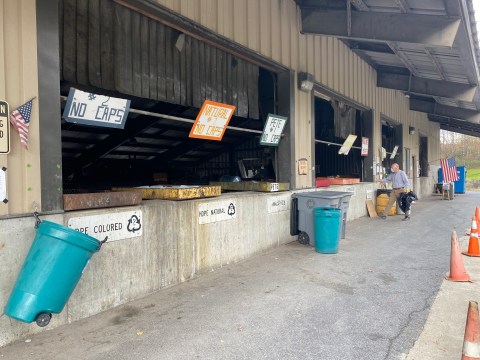
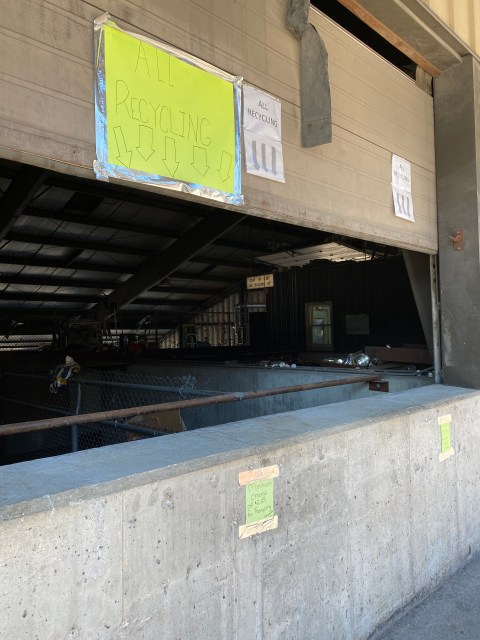
Aaaaaaand then it all came crashing to a halt. As we drove up on our most recent trip to the transfer station, Steve and I were confused: why did it suddenly look so… different? As we drove closer we saw that instead of many different bin categories there was now one giant bin with all arrows pointing directly to it. ALL RECYCLING the signs said.
Oh shit, I thought. Single stream.
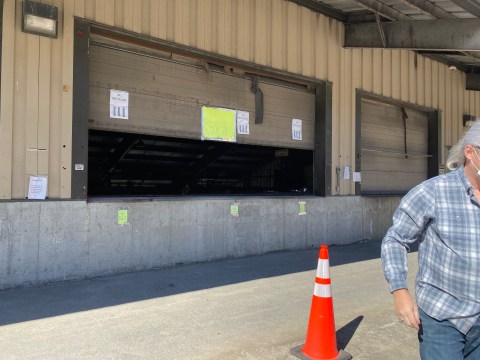
I got out and spoke to the man in attendance and he explained: the facility had recently been purchased by a large garbage service company out of Albany.
My heart sank. It was exactly the company I had cancelled our curbside pick up from.
But it was worse than just the lie of single stream. Because the signs also indicated that recycling was no longer free.
Stymied, we left and took our carload of carefully sorted recycling with us. The whole way home I was silent.
When I stopped being silent, I was incredulous. By law Vermont requires all residents to recycle. Didn’t my town have to provide recycling services? Wasn’t recycling supposed to be free?
So I started making phone calls. I ended up talking to a lovely woman named Pam Clapp who is the administrator for our county’s Solid Waste Alliance.
“It’s kind of a misnomer that recycling is free,” Clapp told me. “It’s not free.” Although the state of Vermont does prohibit companies from charging for recycling, most pick-up services get around this by having “handling fees” for single stream recycling, bundling it with garbage removal.
And even the ban against charging for recycling may soon be lifted, Clapp told me, because keeping recycling streams properly sorted and “clean” is so labor intensive (read: expensive) due to well-meaning “wishful recyclers,” as well as the possibly-less-well-meaning people who throw things like used diapers and dead deer carcasses in with recyclable materials.
“You’re kidding.” I said. “People do that?”
“Oh yes.” she said.
All I knew was that it seemed I was back to square one. Steve was justifiably tired of playing this game of garbage musical chairs and suggested we consider returning to our old curbside service, since it was all the same company anyway. But I knew that would leave no money for buying Terracycle boxes, so we’d no longer be Garbage Free/Zero Waste. Plus it just felt like going backwards.
Let it never be said that I am not ridiculously stubborn.
After some thought I formulated a new, modified plan: we would use the single stream at the transfer station, only putting in those items which I know are likely to get recycled. At $2.25 per trip, even if we go every week the fee to recycle is only $9 per month or $108 per year… still way better than having curbside service, and it still leaves me with $612 to spend on Terracycle boxes.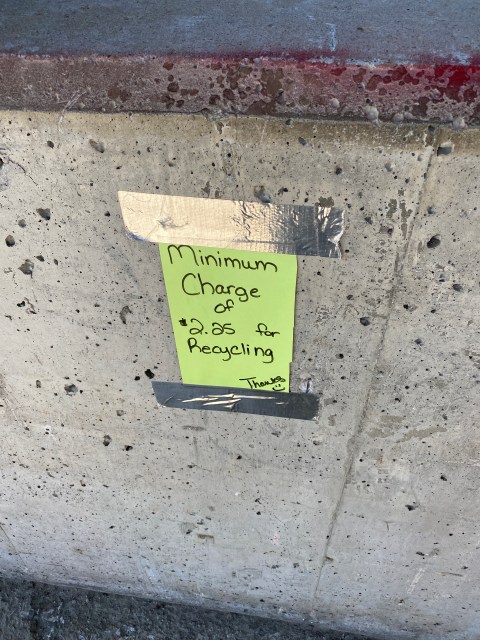
It’s funny though. Everyone I talk to about Terracycle invariably cites how very expensive the service is, but no one talks to me about how expensive curbside garbage service is. I have a theory about this. I think it’s not really the expense of Terracycle that is stopping people, since the numbers tell us that the money is essentially the same. Rather, much of it goes back to those same reasons it took me so long to cancel my garbage service in the first place: fear of change. Taking the time to figure it out and create a new habit. More fear.
But we can’t be afraid to change if we want to fix what we’ve been breaking. And we can’t excuse our inaction by saying we don’t have perfect solutions, because change, even incremental change is what gets us heading down a better path.
So I have my new plan and it’s not perfect, but neither am I. Having access to real, effective recycling may not be a right- yet- but with a little ridiculous stubbornness I have no doubt we can get there.
What’s the Story on WIPES?
For a long time wipes have existed as a fuzzy grey area in the part of my brain devoted to Garbage Knowledge. Antibacterial wipes, make-up removal wipes, baby wipes, “personal” wipes… When you start to look around you find them everywhere, and especially so during a time of pandemic when everyone is in a panic to keep things clean and sanitary.
But what were they?
Were they paper?
Were they plastic?
Were they some combination of the two?
Were they bad for the environment? (Psst! If you have to ask the answer is: Probably.)
And if they were bad, how bad, exactly?
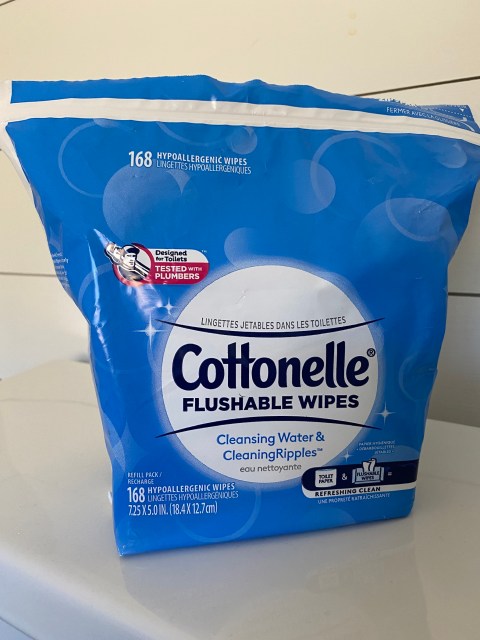
I just didn’t know and so I avoided them as a general rule, with one notable exception: I’ve hung onto “personal” wipes. You know, those fussy, I want to be CLEAN wipes for people who don’t have a bidet in their bathroom. After all, I reasoned, they aren’t garbage: they go away! Flushed right into nothingness! Like magic!
That should’ve been my first clue. Because if I learned anything at all during our Year of No Garbage, it’s that nothing just “goes away.”
I reasoned that “flushable” was in the name of the product- so probably it didn’t contain plastic? Additionally, the package proclaimed: “Designed for Toilets“! and “Tested with Plumbers“! This all sounded good, but what specific information was Kimberly-Clark really giving us here? (“Tested with plumbers”? Like, there were plumbers in the vicinity, having coffee in the next room or something?)These statements were just vague enough that I should have immediately been suspicious.
But I wasn’t.
Then I was doing research on toilet paper, and I stumbled upon the answer to my question: what are wipes? The answer is that virtually all wipes— from Stridex pads and Wet Ones to one-use facial “spa” masks—are made of something called “spunlace.” And it turned out they are also a bit of a hot-button issue in the plumbing community.
This is because spunlace is a fabric made of a combination of materials like polyester, polypropelene, rayon, cotton, and tencel. The fibers are bound together by “hydroentanglement” which is to say a treatment of high-pressure water. Reading more, I found out that because of the plastics involved, not only is spunlace not biodegradable, it is notorious for clogging up sewer systems and wastewater treatment plants all over the world.
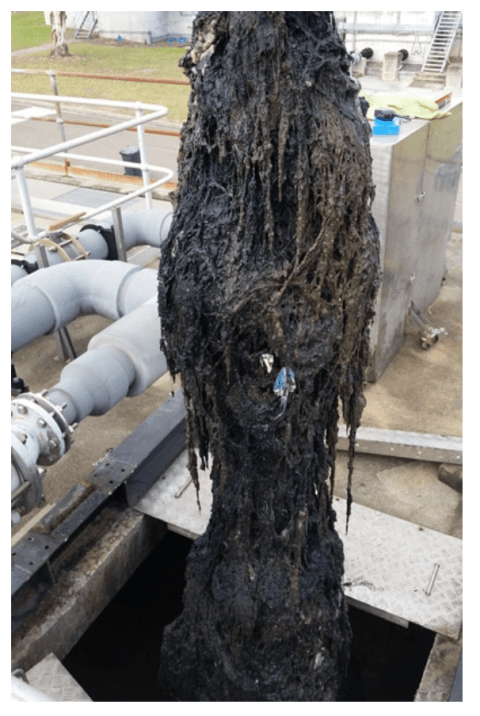
When this happens it can be super bad: have you ever heard about the phenomenon of “fatbergs”? These are rock-like masses composed of things like wipes and congealed grease. When these occur they can cause city sewage systems to overflow with untreated sewage. What happens then? Well the fatberg must be excavated and then… you guessed it. Landfilled or burned.
(You can peruse a nice list of “Notable Fatbergs” on Wikipedia. In 2017, excavated pieces of a 140 ton fatberg on display at the Museum of London apparently became one of the museum’s most popular exhibits. )
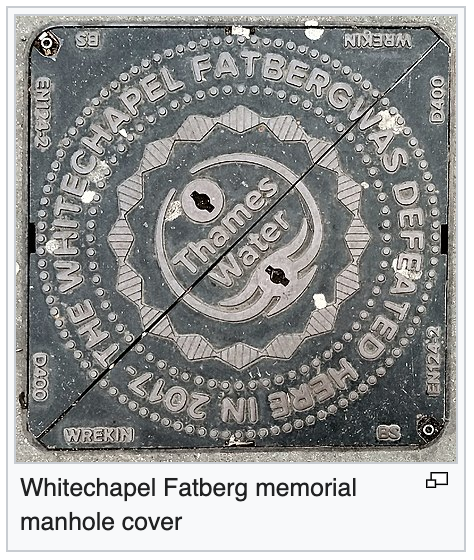
What I never knew about the phenomenon, though, is that fatbergs seem to be directly linked to our increased usage— and flushing— of wipes. The Wet Nap hand wipe was trademarked in 1958 and has grown and morphed into thousands of different wipe products on the market today. The term “fatberg” was coined around 2010, and in 2015 a British sewer company reported that two-thirds of their blockages are now caused by wet wipes.
So the first moral of this story seems to be that no matter how pliable and tissue-like a wipe may seem, any wipe that doesn’t say “flushable” on the packaging should never, EVER be flushed. Cleaning, make-up and baby wipes are all permanent landfill fodder. Don’t buy them.
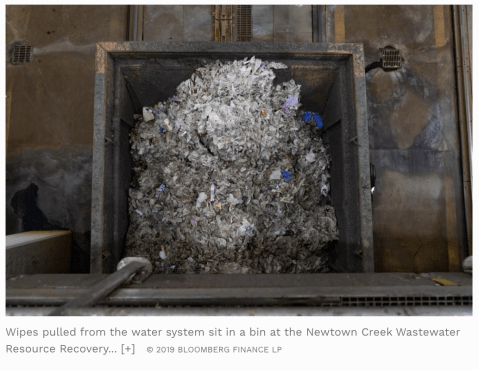
But what about my supposedly “flushable” wipes? It turns out I was right about one thing: any wipe that claims it is flushable can’t contain plastic, which means my Cottonelle’s are different: they are made entirely of paper. However, there is clear disagreement in the plumbing and wastewater community about whether even 100% paper wet wipes break down fast enough to avoid causing problems.
On their website Cottonelle’s defense against such accusations is to tout the fact that their product is “Approved by JEA”!! If you look closer you see that the JEA stands for Florida’s “Jacksonville Electric Authority.”
So one wastewater treatment facility in the entire country endorses this product? One out of the approximately 14,000 wastewater treatment facilities in the U.S.? Maybe we shouldn’t be too impressed by this high power endorsement. I’m more inclined to listen to Consumer Reports, whose test in 2013 determined that all four of the leading wipes (including my beloved Cottonelle) failed to break down in an agitation test. Then in 2019 Forbes reported on an independent study that tested 101 different wipes for disintegration and “flushability”- and-
—wait for it—
…not one of them passed.
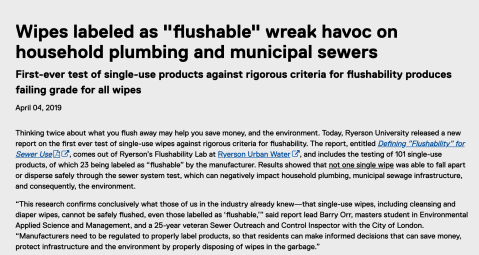
What experts will tell you is that it has yet to be proven that paper-only wipes are any less harmful than spunlace wipes. For folks who are on a public sewer system the wipe just doesn’t have enough time or agitation to disintegrate before it reaches the sewage pump in a matter of minutes. If we are lucky the wipe gets filtered out, and set aside to be either landfilled or burned. If not? Fatberg.
But back to my bathroom. Because we are in the country, we are not on a sewer system, so the process is a little different: whenever someone in my house uses a “flushable” wipe, it gets deposited in the septic tank buried in our yard. While liquids run off and eventually deposit into a leach field, the wipe will fall to the bottom with the sludge.
Maybe it degrades in there. According to my husband, since we only need to pump our tank out every seven to ten years, he thinks it is likely that the paper does get broken down by bacteria and enzymes in the septic system, because it is over a long period of time.
I don’t know. But all this new information has brought me to two conclusions.
First: Unless verified by an objective third party, don’t trust companies’ claims. (You’d think I’d have learned this by now, yes?) In this case, “Flushable“! probably isn’t.
Second: I’ve been avoiding it, but I think it’s finally time to look into a bidet attachment. I’ll avoid the wipe conundrum, as well as the plastic packaging the wipes come in, and I’ll probably save on toilet paper too.
What do you think? Do you have a favorite wet wipe you are loath to give up? Or a bidet attachment you like? Extra points for a good fatberg story.
 Eve O. Schaub