Category Archives: A Year of No Sugar

Making a Difference in Three Minutes

I have a confession to make.

Yes, I am a passionate Sugar Awareness advocate, who has no problem writing, blogging and speaking on the topic. However, historically speaking, I’m just not all that good when it comes to the whole participatory democracy thing. I mean, like everybody, I have issues I care about – besides sugar even! I vote. I watch debates. I pay attention. But whenever I am advised to “call/email your representative today!”- do I? No. Not even once.

I’m not proud of this, mind you. But it’s true: I feel too… shy to call. And, if I’m honest, a bit afraid. Afraid to navigate whatever rat maze they’ll surely have set up for anyone foolish enough to attempt entering the debate. That I won’t know the lingo because I don’t speak Politics. I talk myself out of it: maybe they’ll put someone on the phone to argue with me! Maybe they’ll put me on a list! Maybe I’ll just feel like an idiot.

I hate feeling like an idiot.

So here’s the thing: right now there’s something huge going on in the world of Sugar. You probably don’t know about it, because, despite the fact that Sugar Awareness has been gaining increasing momentum, nevertheless I have seen almost no reporting in the media about the fact that the United States Food and Drug Administration is considering major changes to the way the nutrition facts label talks about sugar.

You know the nutrition facts label- that’s the little box on the side of every food package that lists how much of your Recommended Daily Allowance (RDA) one serving of this product contains; 6 ounces of Dannon Coffee Yogurt, for example, contains 2.5 grams of fat, 10 milligrams of cholesterol, 25 grams of sugar, etc.
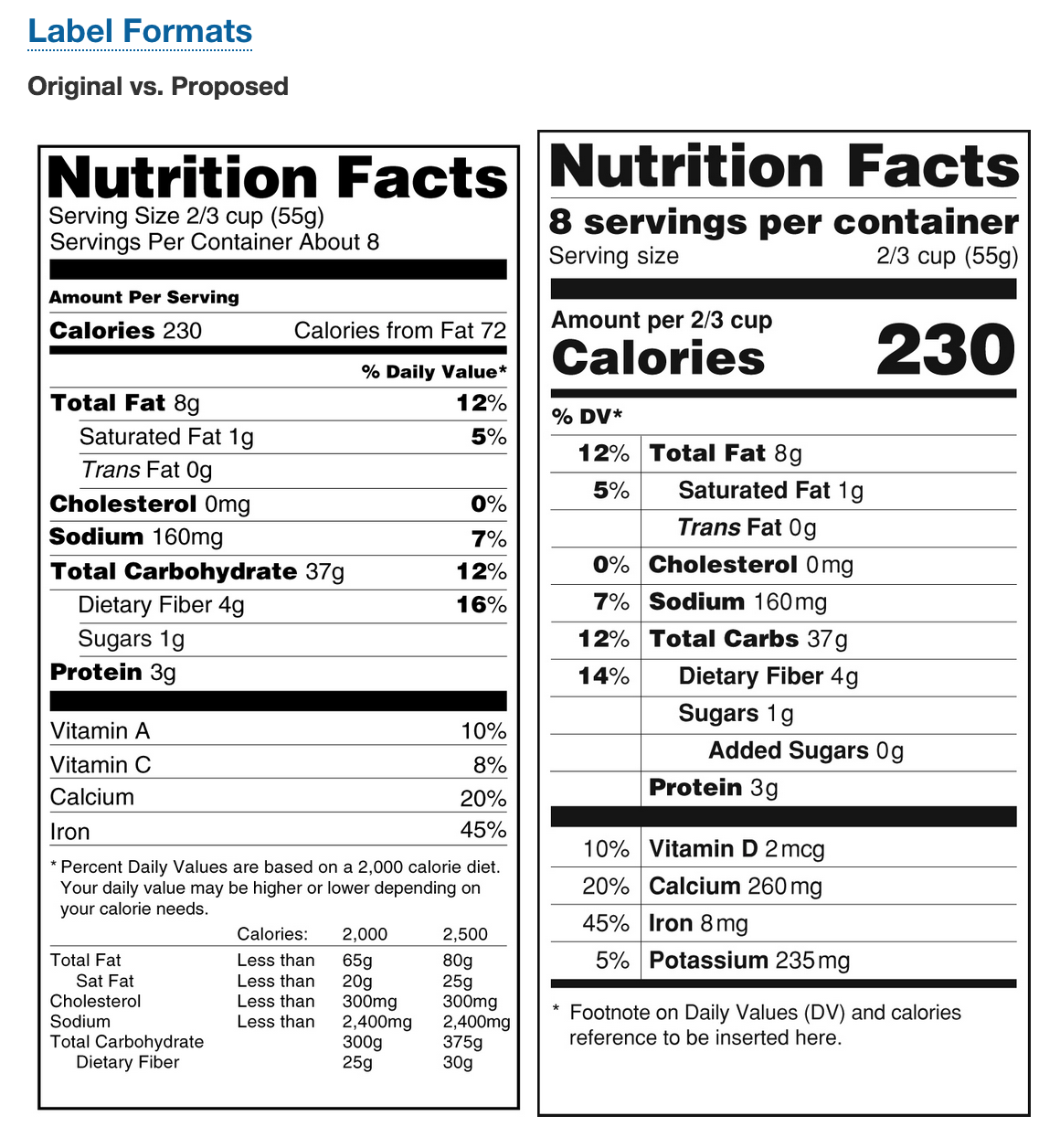
Nutrition Fact label

Very, very few of us really know how to interpret this data. In fact, I’d venture to say that nobody does, except perhaps your nephew’s girlfriend who is studying to be a nutritionist.

So when, for example, the World Health Organization changes its recommendations about how much sugar we should all be consuming on a daily basis (or rather, beyond which amount we should not be consuming)- which it recently did last March, halving it’s previous recommendations, it makes news, but who knows how to interpret it?

The WHO lowered the advised daily limit of sugar from 10 to 5% of total calories. I wrote a whole blog post about this that you can read here- https://eveschaub.com/2015/04/20/the-upshot-or-what-who-wont-tell-you/ but the upshot is this: the average person should not consume more than 6 teaspoons of sugar per day.

Back to our Dannon Coffee Yogurt: our nutrition facts label says 25 grams of sugar per serving. Which presents two problems: the first is the fact that who the heck knows how many teaspoons 25 grams amounts to?

The second problem is the fact that some of these sugars are surely lactose- milk sugars- which are not fructose, and not part of the FDA’s 6 teaspoons per day recommended limit.

So what do we do? Give up, make a joke about how modern eating is too damn difficult, and eat the yogurt. Right?

But, if approved, the FDA’s current proposal will change all that, so pay attention cause this is Super Cool (to food nerds like me) and, more importantly will make our sugar-sleuthing lives orders of magnitude easier:

  1. There will be a new line, underneath the “Sugar” line, which lists separately “Added Sugars” (see illustration).

What this means is that instead of memorizing the over 61 different names for sugar (what I call “The Sugar Alphabet,” which you can find here: https://eveschaub.com/resources/ ) you will have to look no further than this one simple line. If it is added sugar (read: extracted fructose) you will find it here.

Additionally, it will not include those “sugars” that are not fructose (and therefore IMHO not to be unduly fretted over), such as glucose and lactose. Then we will be able to easily see that of the 25g of “sugar” in our Dannon Coffee Yogurt, 13g comes from added sugar and that other 12g comes from lactose. Hooray for clarity!!

But wait, it gets better:

  1. Now, for the first time ever, the Nutrition Facts Label will list a Recommended Daily Allowance for sugar, just as it already does for fat, cholesterol, sodium and so on. Yes!

No more wondering what the heck 25 grams of sugar- or 13g of added sugar- in your Dannon Coffee Yogurt really means. It means, 3 teaspoons. And so, right there on the label it will tell you that your yogurt contains 50% of your Recommended Daily Allowance for Sugar.

Wow. Yep. What this tells us is that we’d be better off treating flavored yogurts such as Dannon Coffee Yogurt as dessert than as a healthy snack. One little alteration to the information facts label can suddenly give us a whole new understanding of our food.

Do you want these changes? Do you want people to be able to know that a can of Coke- all by itself- is nearly twice their Recommended Daily Allowance for sugar? I sure do.

So here’s the hard part: NOW IS THE TIME TO TELL THE FDA THAT WE WANT THIS. Now, that first part- the part about making a new “added sugars” line? The period for public comment on that has ended. (See? I wasn’t kidding when I told you I’m terrible at this.)

But the second proposal- the one to include an RDA for sugar- is open for public comment until October 13, 2015. Seriously, if I- the admittedly democratically-handicapped- can do this, you can definitely do this. I’ve even made a cheat sheet below to make it ridiculously, super easy. If it takes you more than three minutes I will be surprised. Here is what you do:

Step One: Go to this link: http://www.regulations.gov/#!submitComment;D=FDA-2012-N-1210-0537

This is the page for submitting your comment on the proposal to add an RDA for sugar.

Step Two: Click on the comment box. Here is where you type your opinion on this proposed change. If you are like me, and get flummoxed easily at this point, you can copy and paste this:

As an individual consumer, I am very much in favor of the proposed change to the Nutrition Facts Label, specifically that it will now list % daily value for added sugars.

Sugar acts like a toxin- a chronic poison- that over time does substantial damage to the health of the human body. Our society’s ever-escalating consumption of sugar, specifically added sugars, is responsible for, or related to, practically every major modern health epidemic that we suffer from today: from diabetes and obesity, to metabolic syndrome, heart disease, liver disease, hypertension, and even cancer.

Changing the Nutrition Facts Label in this way will give consumers much needed information about the amount of sugar in food products within the established framework of a recommended percent daily value, so they can more easily make informed and healthier choices.

Step Three: Fill in the boxes for first and last name, (or, you can leave it blank in order to be anonymous) and, if you want to, check the box for contact information and fill out with your e-mail and/or zip code. Unless you work for the Sugar Association of America, make sure “I am submitting on behalf of a third party” is unchecked.

Step Four: Under “Category” select “Individual Consumer.” (Then, be amazed at all the Special Interest Groups that are listed here.) Click “Continue.”

Step Five: It will now show you a preview of your comment. Near the bottom of the page it says : “You are filing a document into an official docket. Blah blah blah… may be publicly viewable on the web.”

When you are ready, click “I read and understand the statement above.” And then “Submit Comment.”

Step Six: The next page instructs you to do a little dance, or possibly give yourself a modest high-five because you are very proud of yourself. Okay, well it should. What it actually does is give you a “comment tracking number” so you can go back and see if your comment has been posted on regulations.gov. You can also check a box if you want to be emailed a “receipt” for your comment.

Good luck finding where on earth all those comments go. I tried hunting around the regulations.gov website for sugar proposal comments and came up instead with fascinating discussions on “Importation of French Beans and Runner Beans From the Republic of Kenya” and the “National Sheep Industry Improvement Center.” (Since I’m on a roll, clearly, these will be the next items I comment on.)

But at last I did find the correct page. And to save YOU the trouble here is the link to it here:

http://www.regulations.gov/#!documentDetail;D=FDA-2012-N-1210-0537

Now, I still couldn’t find the comments, but do you know what I did find? On the right hand side there is a box tallying “Comments Received” on this topic. Do you know how many comments had been received on this issue- this deeply important issue as to the clear labeling of added sugars (read: chronic toxins) in our food- as of this writing?

196.

Wow. Seriously, it is a deeply awesome and humbling thing to be able to participate in our democracy. And when you’re talking about 196 comments? Participation is no illusion.

So go do it. Now. I swear it will feel good. And if you have an extra thirty seconds post a comment here saying you did; let’s see how high we can ratchet up that comment-o-meter before October 13th. It might just make a really big difference.
The Upshot Or: What WHO Won’t Tell You

I can’t be sure, but I have this vague idea that once upon a time people ate food. Just food. They didn’t talk about it in terms of calories, or grams, or “free sugars” or “percentages of energy intake.” They talked about it in terms of food.

And to a certain degree I think it would be kind of nice to get back to this idea that food is for eating, not for counting, or measuring, or hiding in the bottom of our sock drawer, or whatever the latest medical advice is. I don’t know if you’ve noticed? But it seems the Era of Nutritional Advice is not exactly doing us a whole heck of a lot of good.

Of course the oft-noted irony is that despite the fact that we are all inundated with recommendations from every conceivable source about what we eat, and how we eat it; we are less healthy than ever. We have epidemics of things our grandparents considered extremely rare- like obesity, diabetes, and heart disease- as well as things we’ve unwittingly invented- like metabolic syndrome. Worst of all, this generation of children is the first on record predicted to live shorter lives than their parents.

In the wake of the World Health Organization’s recent nutritional recommendations I’ve been thinking a lot about the idea of nutritional advice, and where it gets us. When the WHO advises people- as it did a few weeks ago- to try to limit their “free sugars” to “5% of total energy intake,” I know the twelve or thirteen people who actually paid attention to that report probably wanted to claw hysterically at their refrigerator doors and scream: “WHAT DOES THAT EVEN MEAN???”

I’m here to tell you that, as a person who’s spent the last several years thinking about, writing about, and generally obsessing over the impacts of sugar on our health, I don’t know what the recommendation means- not instinctively, anyway. So, besides the physicians and nutritionists, who the heck does?

Practically nobody. Instead, the highly motivated among us (read: fanatical) sit down and try to figure it out with pencil and paper and a few good internet searches. Upon further research we learn that an average adult diet might consist of about 500 grams of food per day. This would mean that 5% of an average “total energy intake” would be 25 grams. Which, if we know that 4 grams equals about one teaspoon of sugar, would translate to roughly 6 teaspoons of sugar per day.

Of course, this is wildly nonspecific— do I eat 500 grams of food per day? Do you? What about Arnold Schwarzenegger?— but unless we want to wander around describing every last mouthful we ingest to a computer app, or invent an implant that will automatically count it all up for us and display the information on our wrist or forehead or something- broad generalizations will have to do.

But here’s some practical info that these generalizations translate into, that the groups like the WHO or the Department of Health and Human Services won’t- can’t– come out and tell you in so many words: effectively the new recommendation means don’t drink soda or juice. Why? Because:

–       a 12 oz can of Coke= 10 tsp sugar

–       a 20 oz bottle of Coke= 16 tsp sugar

–        a 15 oz Naked juice smoothie= 17 tsp sugar

See?  If, as we’ve just figured out, the average adult recommendation is not more than 6 tsp sugar per day, than have one can of soda and already the alarms are going off: you’ve had nearly two days worth of sugar right there, not including anything else you might eat or drink that day. Have a larger soda or a “healthy” juice smoothie? And that alarm becomes a blaring siren: that’s nearly three days worth of sugar.

Hopefully by now people are starting to get the message that there’s a scary amount of sneaky sugar hiding in virtually every product for sale in our supermarkets… in our bread, in our chicken broth, in our mayonnaise… and so on. Two pieces of bread might contain one tsp sugar, a serving of chicken broth might contain ¼ tsp sugar, a tablespoon of mayo less than that. Certainly we need to be mindful of how all these small sources of sugar add up throughout the course of our day. Yet, as you can see, none of these sources can hold a candle to the blast of sugar that your system receives when you drink just one juice or soda.

So if the WHO were to recommend the biggest, simplest, most practical step people could take in the reduction of dietary sugar and improvement of their long-term health? Clearly, it would be to stop drinking soda and juice.

But OhMyGod can you imagine the mess the World Health Organization would be in for if they started telling people not to drink juice or soda anymore? Previous attempts to stem the sugar tide— such as banning the bucket soda or taxing sugar-sweetened beverages— have resulted in such indignant histrionics that you’d think Mountain Dew had been mentioned in the Declaration of Independence. So what would outright telling people just how bad for them their favorite drinks are do? I’m pretty sure all-freaking-heck would break loose. Panic in the streets… mass hysteria… dogs and cats living together…

But it could be worth it. I know it sounds impossible now, but if soda and juice were relegated to the category of Things That Seemed Like a Good Idea at the Time, (along with doctor-recommended cigarettes, parachute pants, and deep fried butter on a stick) maybe it would mean that we could all stop with the calorie/gram/percentage-counting madness— all of which obfuscates more than it clarifies— and instead of having a “dietary energy intake” we could just go back to what I like to call: “eating food.” And be healthier in the bargain.

A crazy idea, but it just might work.

Running the Gauntlet

In case you were wondering, once your family has gone to all the trouble of eating for a year without added sugar, the world does not go away. People still ply your kid with armloads of sugar from every conceivable direction. Bowls of well-intentioned free candy turn up in the strangest places: The hairdresser’s. The bank. The dry cleaner. The Farmer’s Market, for crying out loud.

And just in case that fact had escaped my notice, I’d have become aware of it whenever I wanted to wash one of Ilsa’s jackets or coats, because like a little mouse thinking of winter, she squirrels away the free lollipops and Hershey’s kisses and Lifesavers in her many pockets.

What "Valentines" Now Means
What “Valentines” Now Means

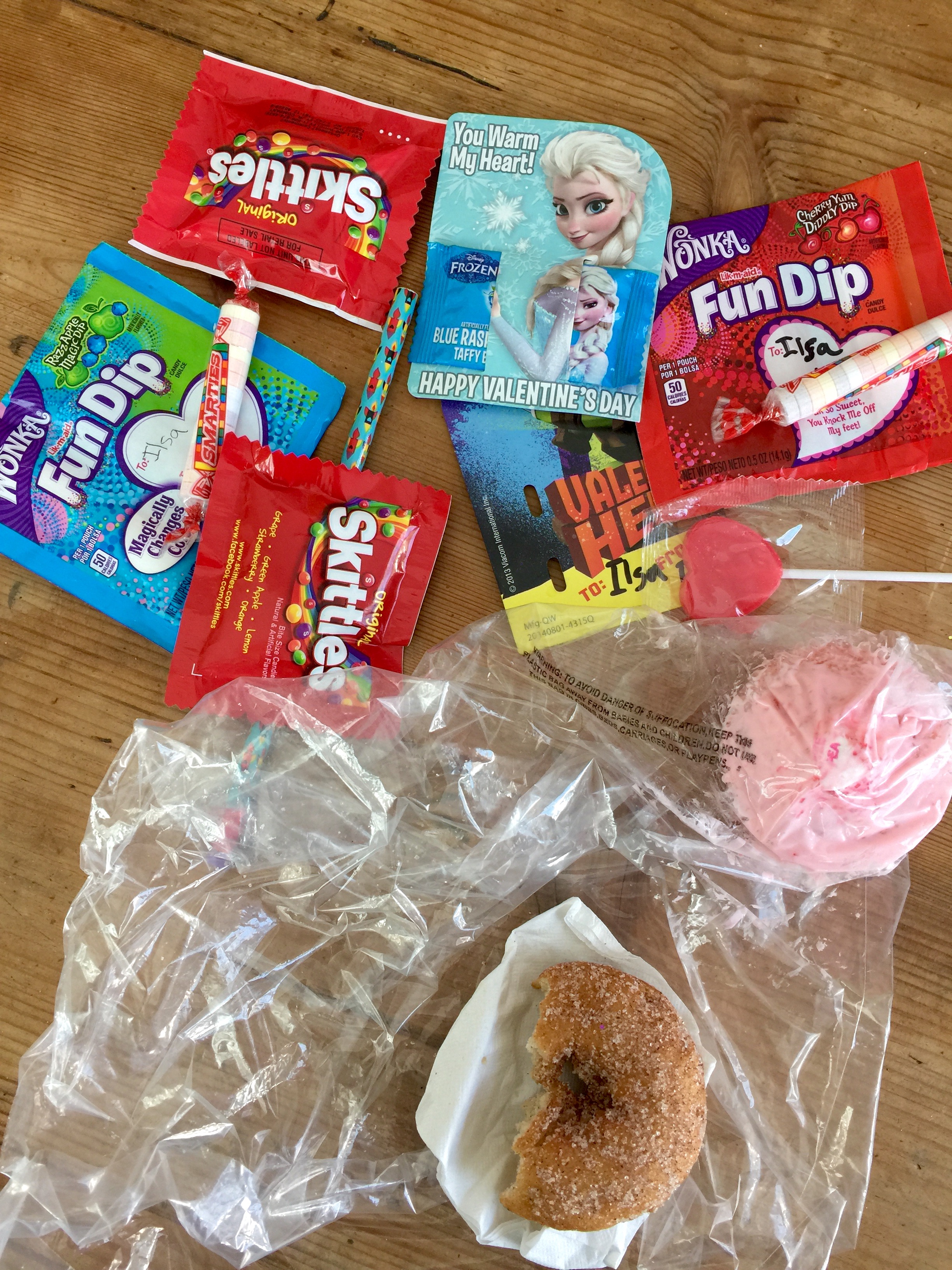
Here’s the funny thing though: they stay in her pocket. And just in case you think I’m suffering from an acute case of Mom Deluding Herself Bigtime, here’s another interesting fact: all that candy masquerading as Valentines that the kids exchanged in school two weeks ago? Ilsa’s not inconsiderable portion thereof is still sitting in our kitchen cupboard, untouched. It’s in good company, because it sits on top of the candy she’s received at various birthday parties and Christmas. At the very bottom of the pile is her large sack of Halloween candy: also largely untouched. This is, mind you, on the very bottom shelf of the cupboard, well within my kids’ reach.

Now, did I say “largely untouched”? Yes. Ilsa and Greta have each had, I’d estimate, about three to four pieces of their Halloween candy since they collected it four months ago. As if to drive the point home still further, one child in Ilsa’s fourth grade class who was absent for Valentine’s Day sent home a handful of candy with Ilsa this week so it has yet to officially make its way to the pile in the cupboard. It consists of: three Starbursts, two pieces of bubblegum and a mini package of Whoppers, which have been sitting on the kitchen counter for the last four days, presumably enjoying their solitude.

Now- I’m not going to lie to you. My kids do try out sugary things once in a while, almost as if they are checking to see if they are still there, and whether their mom will turn inside out or grow horns when they do it. I make a concerted effort not to.

And I think that’s as it should be. The world will continue to do what the world does, and my kids have enough information to make these decisions themselves at this point, if anyone does. They know what I think. And I figure the more I belabor the point now, the more it will backfire.

So instead I just quietly hold firm to the things I am in control of: no matter how many times Ilsa tells me she prefers vanilla, I still buy plain yogurt. Dressing up our oatmeal in the morning means adding raisins. “Dessert” in our packed lunches means an apple or an orange. Drink choices are milk or water. Actual, sugar-containing dessert remains a “once every couple of weeks” occasion, and in modest portions.

When the kids go out into the world- as they are doing increasingly as they are growing older, and further away from our official Year of No Sugar- they will make their own decisions about whether to choose sugar in their food or not. Two recent occurrences give me reason to suspect, however, that all is not lost.

Just the other night Greta (who is now nearly 15) and I were out at an event, and she was offered a tall glass of root beer, which she accepted (after a significant sidelong glance at her mom).

After one sip she remarked “it’s SO SWEET!!” and then “It’s REALLY GOOD!!” She proceeded to drink about half of the tall glass. (Later on, she told me, she went back and finished it mainly because grown-ups were still chatting and she was bored.)

Not long afterwards, she interrupted my conversation with some friends to ask if we could go- she was tired. Really tired. She didn’t look well- didn’t look like her normal cheerful self. Amazingly, I failed to put two and two together until we were in the car and Greta did it for me.

“I think it was the soda,” she said. “Too much sugar.”

As for Ilsa, (who is now ten), last week we were lucky enough to play host to a documentary film crew from the popular Middle Eastern show Khawater. For the interview, the affable host Ahmad AlShugairi had requested we have on hand some examples of different high sugar meals and contrast them with no sugar alternatives. I had a lot of fun with this one- we focused on breakfast and I had the bizarro, upside-down experience of trying to find the sugariest yogurts, cereals and pancake mixes on the shelves at my local supermarket.

Consequently, after the interview was over and the crew had left we had all this crazy sugary stuff lying around- including a bowl of Cheerios Protein cereal- which despite being marketed as a healthy cereal for adults, has more sugar then even the sweetest kid cereals (17 grams of sugar per 1 ¼ cup serving. Compare that to Froot Loops, for example, which are 15 grams of sugar for 1 ¼ cup serving). Ilsa was curious: could she eat the bowl we had poured as a prop?

Hmmm. I reminded her it was veeeery sweet, but told her she could if she wanted to. Just as with Greta’s soda, Ilsa liked the cereal A LOT… at first. About halfway through the bowl she remarked that it was awfully sweet. Maybe she wouldn’t finish it after all. And then she said she didn’t feel all that good.

“Yeah, isn’t it amazing what sugar can do when you aren’t used to it?” I said, hopefully offhandedly.

Fast forward to this morning: Ilsa enjoyed- along with her egg and some orange slices- a bowl of her new favorite cereal: Rice Chex. It has 2 grams of sugar per serving. (I think it makes her feel adventurous to have a cereal with a bit of sugar in it somewhere- but appreciates the fact that it doesn’t give her tummy ache.)

Meanwhile, for the last week the rest of the box of Cheerios Protein sits forlornly in our kitchen, untouched. (I kind of feel bad throwing away food- even sugary food- so I’m procrastinating.) I wonder if it’s lonely, but then again, perhaps it will make friends with the Halloween, Christmas, and Valentines Candy. After all, they have a lot in common.