All posts by Eve Ogden Schaub

Unknown's avatar

About Eve Ogden Schaub

Serial memoirist Eve O. Schaub lives with her family in Vermont and enjoys performing experiments on them so she can write about it. Author of Year of No Sugar (2014) and Year of No Clutter (2017) and most recently Year of No GARBAGE (2023). Find her on Twitter @Eveschaub IG or eveschaub.com.

A Year Of No Sugar: Post 91

It just wouldn’t be Christmas without cookies, would it? As much as hanging our stockings and running out of Scotch tape, cookies have become an intrinsic part of the way our culture celebrates the holiday season. Every family I know has their own unique and highly personalized cookie tradition.
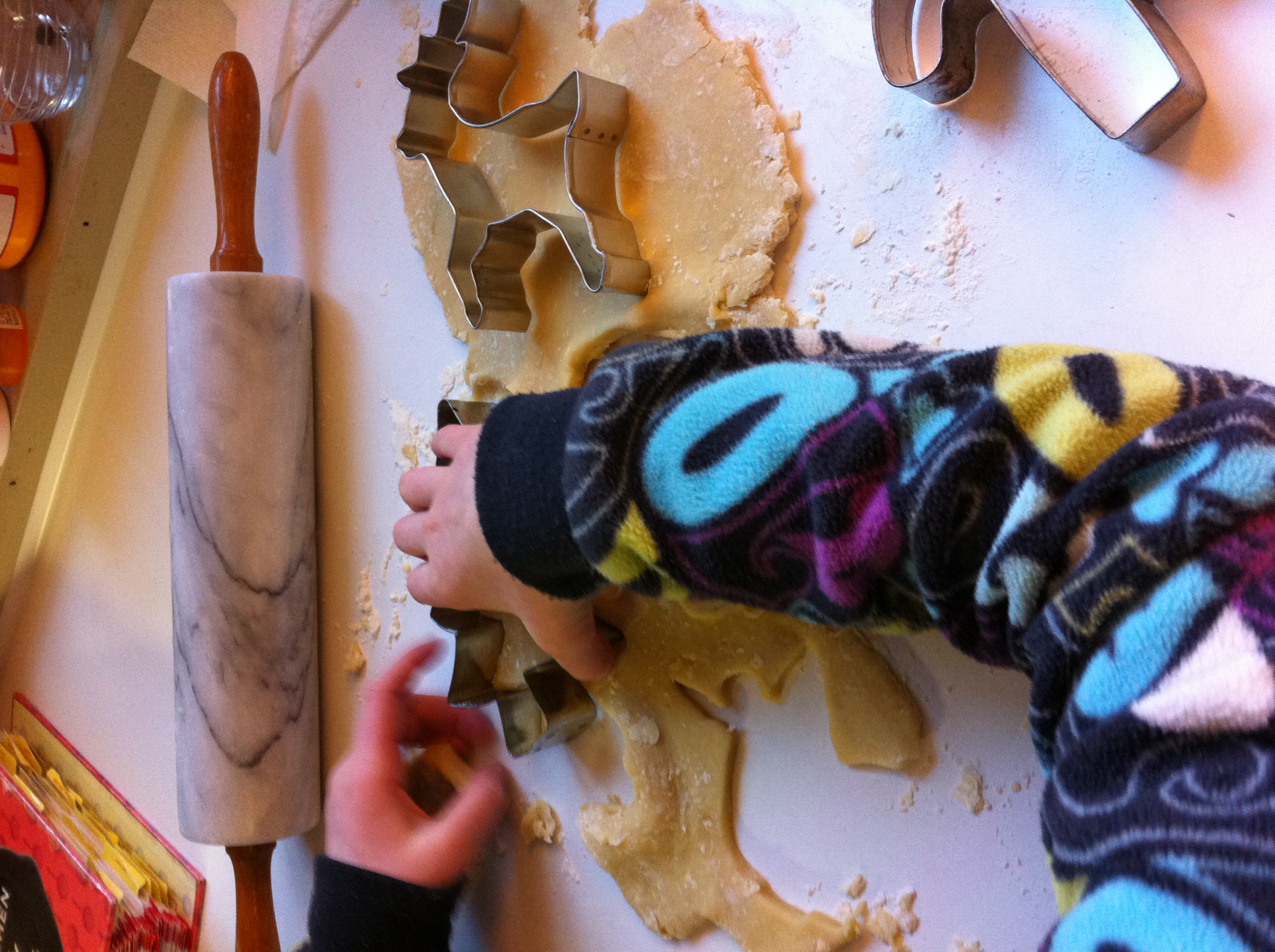
Making Cookies

When I was growing up, it was jelly thumbprints and chocolate chip meringues. Maybe this doesn’t sound very Christmasy to you, but all I have to do is taste that buttery dough with a bit of raspberry jam and I am instantly transported to the Christmases of my childhood. I have since realized that making those two cookies together also represented an ingenious way to not let any eggs go to waste: thumbprints got the yolks, meringues the whites. In my husband’s house it was- and still is- his mother’s amazingly addictive sugar-cookie cut-outs with icing and sprinkles. The famous family story about them involves Sharon making them far in advance one year, in an attempt to get ahead of the holiday mayhem, only to find that the boys had discovered her stash and eaten ALL the cookies in advance- perhaps also to get a jump on the holiday season.

Dextrose Gingerbread

When I grew up, I learned from my cousin Gretchen that our family had a much older cookie tradition that had been brought over from the old country called “Flettin.” Every November, weeks before the holiday season really got underway, the family women would convene and proceed to spend the entire day rolling, cutting, and frying dough. After being sprinkled with a mixture of powdered sugar and cinnamon, the delicate little things would be wrapped in linen and stored in the attic (!!) for several weeks to let them “age,” which presumably made them even more crunchy and crispy. I don’t know about you, but I’m pretty sure in my house the attic mice would do a number on these cookie baskets similar to what my husband and his brother did to his mother’s big green Tupperware bowl.

Nonetheless, in recent years our family has revived the Flettin tradition. It’s more of a production these days, since everyone is coming from all across New England rather than from down the block or across town, but all the planning pays off when we finally arrive at one of our houses and settle in to tie on the apron strings. Even with the dough prepared in advance- a very strange recipe involving lots of sour cream, separated eggs and kneading (who kneads cookie dough?)- it takes pretty much all day. We always set up an assembly line with the Flettin veterans at the fryers and novices and kids on cookie cutting and sugar-sprinkling detail.

The Baking Sheet

For years Gretchen had been threatening to send the story of our Flettin tradition to the King Arthur Flour’s magazine The Baking Sheet– with hopes they would finally resolve some of our long-standing debates: has anyone else ever heard of this recipe? Do we really have to separate and whisk the egg whites, only to knead and pound the dough after their addition? And honestly, was that aging in the attic thing a real step, or yet another clever strategy for getting a head start on the holidays?

Gretchen really did send our story in, and, amazingly, they published it in their 2011 holiday issue. If you find a copy, you can read all about it, see pictures of our family, the cookies, and find out what they thought about our quirky family recipe. We all thought that was pretty cool.

But that’s not really the point, I think. Cause you know what? Flettin are a lot of work, part of our family history and a wonderful Christmas tradition, but psst!… they’re not THAT good. I mean, they’re good. But is that really what we drive several hours for? What we slave over a hot fryer all afternoon for? “Linen in the attic” instructions notwithstanding, in my opinion they always taste best that day, warm from the fryer, freshly sprinkled and eaten while surrounded by family, some of whom you won’t have the opportunity to see again till we do this next year. We don’t have much in the way of family heritage, so Gretchen and I are holding onto Flettin tight: it’s not really about the cookies as much as about the fact that they’re our cookies.

As it turns out, this year the family didn’t manage to get together for a Flettin day, so I didn’t have to confront what it would mean in light of No Sugar- too bad. Instead, I’ve been creating some oxymoronic recipes at home such as No-Sugar Sugar Cookies and Dextrose Gingerbread. They’ve so far gotten good reviews from my helpers and harshest critics- the kids. Thus, despite all our fretting, I have a sneaking suspicion that a No Sugar Christmas will work out just fine. Sugar or no, the most important part of these cookies will be the fact that we baked them, and ate them, together.
A Year Of No Sugar: Post 90

I spend a lot of time making food these days. Pretty much, I divide my time between making food, and writing about food… and if there’s any time leftover I do trivial stuff like pay bills, shower, brush teeth. At times it feels like I’m emerging from being under the surface of a lake full of cultural assumptions about food. My head just above the surface of that water, I am only now opening my eyes and looking around- it’s amazing to me to begin to realize how very much time real food can take, and how good and satisfying that can feel.

For example, last night I was making spaghetti and meatballs, which sounds like a pretty simple thing. Once upon a time, I would’ve bought meatballs and sauce at the supermarket, and such a dinner would’ve taken about half-an-hour. Yesterday, however, it took up a not-insignificant portion of my day: in the morning I made bread- not only for our toast and sandwiches, but also as a meatball ingredient. I poured boiling water over oatmeal and let it sit an hour, then added more ingredients before kneading the dough and setting it in a bowl to rise. An hour later I came back to it, divided it into two loaf pans and let it rise some more. Half an hour after that I put them in the oven, and half an hour after that the bread emerged from the oven smelling like God.

Later in the day, after picking the kids up from school it was time to make the sauce. After putting cans of diced and crushed tomatoes to stew in a pot with oil and garlic, I got out meatball ingredients- defrosted beef, grated Parmesan, measured spices… then mixed all together with a paste made from the cut-up bread slices and water. After the sauce was finished reducing it was time to form the mixture into meatballs and gently place them into the hot oil for frying. Each batch cooks about ten minutes and I fuss over them like a mother hen, trying to ensure they don’t burn on one side or undercook on another- and most of all that they stay in one piece. Meanwhile I put the water on to heat up for the spaghetti.

All this time my six year old Ilsa was “helping” by making a fruit concoction composed of cut-up Clementine and bananas. She had a name for it- I can’t recall it exactly, but something like “Super-happy-loveliness”- and after an extremely long process of peeling and squeezing and sampling and mixing, was inordinately proud of the end result that she put on the dinner table. I knew exactly how she felt.

Is it crazy to feel this way about food? Having a Year of No Sugar is a tremendous part of it- it’s the reason for making my own bread and sauce after all- but that isn’t all of it. It’s more than that.

Recently I read “Into the Wild,” the true story of Chris (Alex) McCandless’ journey to Alaska to attempt to be free from the trappings of society and live off the land, and his eventual death by starvation. Why was I reading this, I wondered, when I still have a stack of “homework” books left dealing with sugar and nutrition? What did this have to do with A Year of No Sugar?

The answer came on page 167. Author – Krakauer relates that Alex had underlined passages in Thoreau’s Walden concerning “the morality of eating.”

“It is hard to provide and cook so simple and clean a diet as will not offend the imagination; but this, I think, is to be fed when we feed the body; they should both sit down at the same table. Yet perhaps this may be done. The fruits eaten temperately need not make us ashamed of our appetites, nor interrupt the worthiest pursuits. But put an extra condiment on your dish, and it will poison you.”

Whoa. I stopped cold when I got to the “extra condiment” part. It jumped off the page at me as if it were printed in neon ink. Sure, he may be speaking metaphorically about that extra condiment being “poison”… but still. Didn’t that sound like he was talking about sugar? I was fascinated by this passage just as Alex was- Alex had written in the margins of his copy: “YES. Consciousness of food. Eat and cook with concentration… Holy Food.”

Fast forward to this morning: I was reading a magazine interview with spiritual philosopher Jacob Needleman, who talks about the practice of “self-remembering” and “Conscious, willful attention to oneself…” So much of what we concern ourselves with in life is meaningless, he argues, whereas what most cultures describe as “God” has to do with what he calls “deep feeling.” I wondered, was Alex looking for that “deep feeling” in the Alaskan wilderness? Is it possible- or am I just crazy here- to relate our search for God or “deep feeling” or whatever you want to call it, to the practice of meaningful sustenance… what Alex called “Holy Food”?

Maybe I’m way out on a limb here, but we’re within spitting distance of meeting our goal of a Year of No Sugar, and I’m feeling philosophical. It somehow makes sense to me to draw big, sweeping analogies between our modern avoidance of real social contact in favor of reasonable facsimiles thereof -Facebook, Twitter, interactive video games- and our modern avoidance of real, fulfilling nourishment in favor of reasonable facsimiles thereof- fast food, processed food, convenience food.

Is modern society based on our collective desire to run away from consciousness/deep feeling/God? Is it possible that a practice of what Alex called “Holy Food” could represent the fledgling beginnings of a way back to… what? Spirituality?

…the imagination… I think, is to be fed when we feed the body; they should both sit down at the same table.

Yes, folks, it’s been nearly a year into this journey and perhaps I’ve finally cracked: I’ve discovered the meaning of life in a bowl of spaghetti and meatballs.

A Year Of No Sugar: Post 89

I’ve managed to get through an entire 88 posts this year so far writing all about my family, what we’ve been eating- and not eating- and pretty much everything else incidental or important that has happened along the way. Is it surprising that religion hasn’t come up yet?

I don’t know. Religion and food have one quintessential thing in common: they are both topics in whose philosophy one can become so ensconced that they dramatically affect everything else in your life. Which is to say, some people treat religion like their food, and some people treat their food like a religion. Perhaps the two were bound to meet- I just didn’t expect that meeting to come in the form of a plastic bag of flyers hanging on my front door.

Inside this bag was a bunch of information about a local church, just a few miles down the road from us, and an invitation to their services and Christmas play, as well as a DVD entitled “The Case for Christ.” “Enjoy meaningful worship and music,” it read in part. Well, that sounds good. It went on to detail community service, celebrating recovery… all positive things.

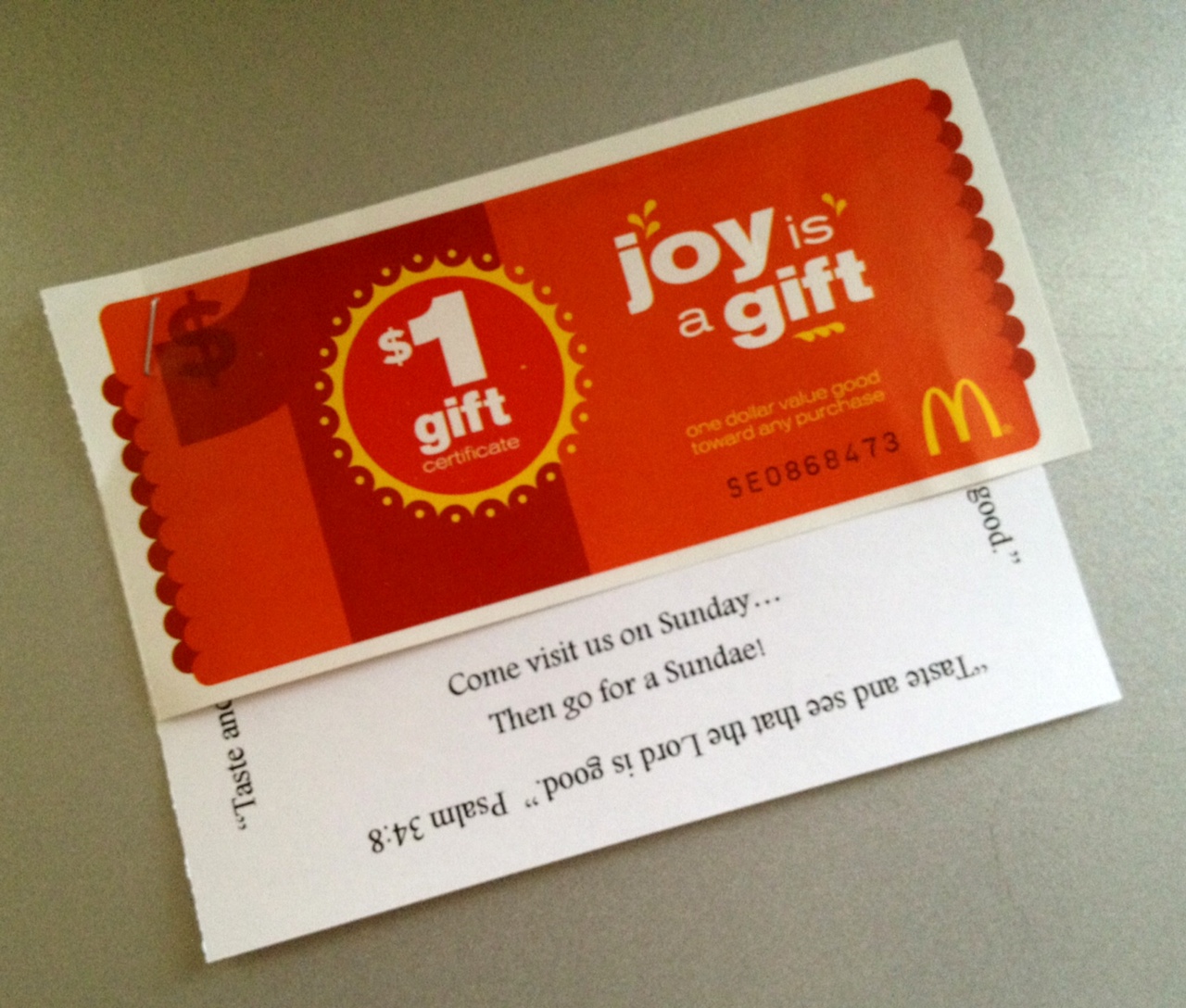
Then I got to the coupon for McDonalds. Stapled to it was a card that read “Come visit us on Sunday… Then go for a Sundae!” and quoted the Psalms “Taste and see that the Lord is good.” I kid you not.

Is McDonald’s proof that God exists? Apparently, some people think so.

McJesus?

I was speechless. The church endorsing fast food? Using junk food desserts as a reward for attending services? When I was a kid we survived the droning sermons and fourteen-off-key-verses of “Oh Thou Who Art Mine Antidisestablishmentartianism” by doodling on the offering envelopes and looking forward to the “fellowship hour” that followed. There, we knew, we could snag more refreshments than we were reasonably allowed while the grown-ups gabbed and drank coffee. That was crap food too, of course: butter cookies from supermarket tins and Kool-aid. So then, was it really so different?

I would argue that what was different was that it was still in the church, designed to get members of the congregation to begin talking to one another, become friends, maybe even form a close-knit community that would support one another… all thanks to some free caffeine. Turning the local McDonalds into the honorary vestibule, to me, isn’t quite the same.

Instead, it comes off more as a cheap bribe. I wonder about the technicalities of this: if you use the coupon without going to church, will you go to Hell? And, if you go collect all your neighbors coupons from their doorknobs before they get home, are you definitely going to Hell?

These are all important questions. Back in Jesus’ day food was a simpler matter: some loaves, some fishes… Sugar as we know it had yet to be invented, likewise McDonalds. Honey is mentioned often, usually as an indication of plentitude, as in “milk and honey.” Back then the food symbol of ultimate sin? An apple.

Apples have since come a long way: a symbol in today’s society of purity, wholesomeness, and nutrition, Snow White’s experience notwithstanding. It does make me wonder though, if the Bible were written today, would Eve have offered Adam a sip of her McFlurry?