All posts by Eve Ogden Schaub

Unknown's avatar

About Eve Ogden Schaub

Serial memoirist Eve O. Schaub lives with her family in Vermont and enjoys performing experiments on them so she can write about it. Author of Year of No Sugar (2014) and Year of No Clutter (2017) and most recently Year of No GARBAGE (2023). Find her on Twitter @Eveschaub IG or eveschaub.com.

Sugar’s Bad Year

I don’t know if you’ve noticed, but there’s been a lot happening in the world of food policy, and because I am a tremendous Food Nerd, I am here to breathlessly point out this quiet but seismic shift. To sum up, if there is a Sugar Anti-Defamation League out there (and I assure you there is) they are having a very, very bad year.

It all began last April, when the World Health Organization recommended that we- everyone- should restrict to between 10 and 5 percent of total daily calories our intake of “free sugars” (translation: added sugars, as opposed to say, the sugar in a piece of whole fruit). http://www.who.int/mediacentre/news/releases/2015/sugar-guideline/en/ This was huge news in the sugar world, not only because it made headlines, and not so much because anyone thinks it will radically shift the way any one person actually chooses their food, but more importantly because of the impact this can have on food policy around the world. What this means, at heart, is that what we consider acceptable food on a global scale is truly, if ever-so-glacially, changing.

In January, the US government followed suit, releasing new federal dietary guidelines telling Americans, officially, and for the first time ever, that they should be limiting their sugar intake to no more than 10 percent of daily calories. http://health.gov/dietaryguidelines/ http://well.blogs.nytimes.com/2016/01/07/new-diet-guidelines-urge-less-sugar-for-all-and-less-meat-for-boys-and-men/?_r=0 Again, this is the kind of thing that will find its biggest ramifications in eventual changes to things like school lunch policy and food stamps.

You can recommend till you’re blue in the face, but what then? Some would add a stick to go with the carrot, which is where soda taxes come in. And there’s good news on that front as well because a study has found that soda taxes work: specifically in Mexico where their recently implemented tax has resulted in the decline of soda purchases anywhere between 6 and 17 percent. http://press.psprings.co.uk/bmj/january/sugartax.pdf

This is excellent news, because the idea of helping solve the obesity crisis via strategic taxation is all the rage, especially in Europe. Did you know Finland, Hungary and France already have their own versions of a sugar-sweetened beverage tax? No? https://www.euractiv.com/section/agriculture-food/news/fat-taxes-do-work-eu-report-finds/ Who’s next? Maybe England. Aided by the lobbying efforts and a public awareness campaign by food celebrity Jamie Oliver, Britain’s parliament is considering a tax on sugary beverages, as well as other measures to reduce childhood obesity. http://www.theguardian.com/politics/2015/oct/22/jamie-oliver-expects-kicking-sugar-tax-sweetened-drinks

These are all good signs, right? To some degree.

Not to be a downer, but I’d have to be in pretty big denial not to notice that there’s still a pretty big sugar-shit-storm raging out there, with no signs of abating any time soon. I’ll give you a for-instance: a few weeks ago I found myself in a hospital cafeteria, surrounded by people who were overwhelmingly choosing to have soda for breakfast. Not high school or college students, mind you, but full-time adults who fold their own socks and everything. It was like a horror movie especially for Pilates instructors and people who work at Whole Foods. All by itself, this observation would’ve been bad enough, but to make matters infinitely worse, do you know who most of these people clearly were? As indicated by their ID badges, scrubs and white coats they were doctors, nurses and other health professionals.

Health professionals. Having soda. For breakfast.

And just yesterday I was sitting in a local cafe at breakfast time, idly watching patrons wander by with trays full of what should’ve been food, but really was sugar in various guises and forms. There was the tall, thin, twenty-something guy who had a 15 ounce Smoothie with which to wash down his enormous slices of chocolate cake and Tiramisu. (I kept silently looking over, hoping a friend was going to at least join him to eat the second dessert, but no such luck.) There was the well-meaning Dad who arrived at a table full of youngsters with a tray containing cupcakes, pastries, and a stack of thick, dinner-plate-sized cookies. Did I mention that this was at 9:30 in the morning?

Really, it would’ve been worth someone’s time to videotape the open-mouthed look of stupefaction on my face. I couldn’t have looked more aghast if these plastic trays had carried the results of someone’s frog dissection from biology class. At any rate, perhaps that would’ve been a healthier breakfast.

I don’t want to tell everyone how to eat, honestly I don’t. I just can’t believe that, if they knew about sugar what I know about sugar, that most people would be making these choices. Sure, we can enjoy a cupcake occasionally, but when it becomes the focal point of breakfast? That’s when we start to get in seriously big trouble.

But let’s go back to the good news, which is actually bigger than all the latest taxes, recommendations, celebrity awareness, and double-blind studies put together: the really good news is that people are talking about this. The sugar conversation is being had. For the first time, companies are adding words like “No Sugar Added” to their labels, because suddenly there is a cultural recognition on some level of why that might be a really good thing.

No longer is sugar the innocuous, cheap, filler ingredient that makes everything better with no consequences. And, if I had to guess, that’s what really keeping the Sugar Anti-Defamation League up at night.

That’s okay. They can always have a nice soda for breakfast.
Making a Difference in Three Minutes

I have a confession to make.

Yes, I am a passionate Sugar Awareness advocate, who has no problem writing, blogging and speaking on the topic. However, historically speaking, I’m just not all that good when it comes to the whole participatory democracy thing. I mean, like everybody, I have issues I care about – besides sugar even! I vote. I watch debates. I pay attention. But whenever I am advised to “call/email your representative today!”- do I? No. Not even once.

I’m not proud of this, mind you. But it’s true: I feel too… shy to call. And, if I’m honest, a bit afraid. Afraid to navigate whatever rat maze they’ll surely have set up for anyone foolish enough to attempt entering the debate. That I won’t know the lingo because I don’t speak Politics. I talk myself out of it: maybe they’ll put someone on the phone to argue with me! Maybe they’ll put me on a list! Maybe I’ll just feel like an idiot.

I hate feeling like an idiot.

So here’s the thing: right now there’s something huge going on in the world of Sugar. You probably don’t know about it, because, despite the fact that Sugar Awareness has been gaining increasing momentum, nevertheless I have seen almost no reporting in the media about the fact that the United States Food and Drug Administration is considering major changes to the way the nutrition facts label talks about sugar.

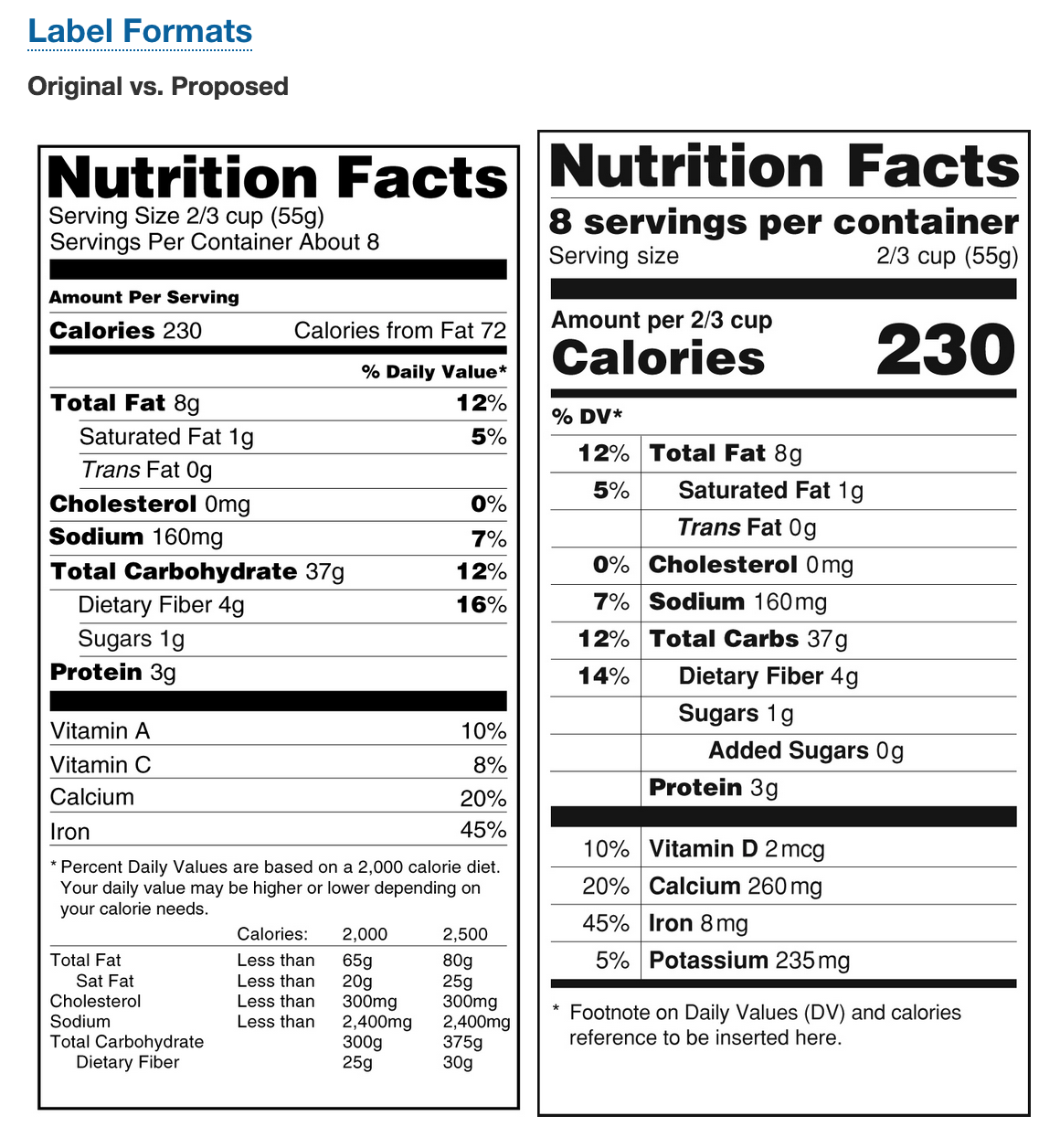
You know the nutrition facts label- that’s the little box on the side of every food package that lists how much of your Recommended Daily Allowance (RDA) one serving of this product contains; 6 ounces of Dannon Coffee Yogurt, for example, contains 2.5 grams of fat, 10 milligrams of cholesterol, 25 grams of sugar, etc.

Nutrition Fact label

Very, very few of us really know how to interpret this data. In fact, I’d venture to say that nobody does, except perhaps your nephew’s girlfriend who is studying to be a nutritionist.

So when, for example, the World Health Organization changes its recommendations about how much sugar we should all be consuming on a daily basis (or rather, beyond which amount we should not be consuming)- which it recently did last March, halving it’s previous recommendations, it makes news, but who knows how to interpret it?

The WHO lowered the advised daily limit of sugar from 10 to 5% of total calories. I wrote a whole blog post about this that you can read here- https://eveschaub.com/2015/04/20/the-upshot-or-what-who-wont-tell-you/ but the upshot is this: the average person should not consume more than 6 teaspoons of sugar per day.

Back to our Dannon Coffee Yogurt: our nutrition facts label says 25 grams of sugar per serving. Which presents two problems: the first is the fact that who the heck knows how many teaspoons 25 grams amounts to?

The second problem is the fact that some of these sugars are surely lactose- milk sugars- which are not fructose, and not part of the FDA’s 6 teaspoons per day recommended limit.

So what do we do? Give up, make a joke about how modern eating is too damn difficult, and eat the yogurt. Right?

But, if approved, the FDA’s current proposal will change all that, so pay attention cause this is Super Cool (to food nerds like me) and, more importantly will make our sugar-sleuthing lives orders of magnitude easier:

  1. There will be a new line, underneath the “Sugar” line, which lists separately “Added Sugars” (see illustration).

What this means is that instead of memorizing the over 61 different names for sugar (what I call “The Sugar Alphabet,” which you can find here: https://eveschaub.com/resources/ ) you will have to look no further than this one simple line. If it is added sugar (read: extracted fructose) you will find it here.

Additionally, it will not include those “sugars” that are not fructose (and therefore IMHO not to be unduly fretted over), such as glucose and lactose. Then we will be able to easily see that of the 25g of “sugar” in our Dannon Coffee Yogurt, 13g comes from added sugar and that other 12g comes from lactose. Hooray for clarity!!

But wait, it gets better:

  1. Now, for the first time ever, the Nutrition Facts Label will list a Recommended Daily Allowance for sugar, just as it already does for fat, cholesterol, sodium and so on. Yes!

No more wondering what the heck 25 grams of sugar- or 13g of added sugar- in your Dannon Coffee Yogurt really means. It means, 3 teaspoons. And so, right there on the label it will tell you that your yogurt contains 50% of your Recommended Daily Allowance for Sugar.

Wow. Yep. What this tells us is that we’d be better off treating flavored yogurts such as Dannon Coffee Yogurt as dessert than as a healthy snack. One little alteration to the information facts label can suddenly give us a whole new understanding of our food.

Do you want these changes? Do you want people to be able to know that a can of Coke- all by itself- is nearly twice their Recommended Daily Allowance for sugar? I sure do.

So here’s the hard part: NOW IS THE TIME TO TELL THE FDA THAT WE WANT THIS. Now, that first part- the part about making a new “added sugars” line? The period for public comment on that has ended. (See? I wasn’t kidding when I told you I’m terrible at this.)

But the second proposal- the one to include an RDA for sugar- is open for public comment until October 13, 2015. Seriously, if I- the admittedly democratically-handicapped- can do this, you can definitely do this. I’ve even made a cheat sheet below to make it ridiculously, super easy. If it takes you more than three minutes I will be surprised. Here is what you do:

Step One: Go to this link: http://www.regulations.gov/#!submitComment;D=FDA-2012-N-1210-0537

This is the page for submitting your comment on the proposal to add an RDA for sugar.

Step Two: Click on the comment box. Here is where you type your opinion on this proposed change. If you are like me, and get flummoxed easily at this point, you can copy and paste this:

As an individual consumer, I am very much in favor of the proposed change to the Nutrition Facts Label, specifically that it will now list % daily value for added sugars.

Sugar acts like a toxin- a chronic poison- that over time does substantial damage to the health of the human body. Our society’s ever-escalating consumption of sugar, specifically added sugars, is responsible for, or related to, practically every major modern health epidemic that we suffer from today: from diabetes and obesity, to metabolic syndrome, heart disease, liver disease, hypertension, and even cancer.

Changing the Nutrition Facts Label in this way will give consumers much needed information about the amount of sugar in food products within the established framework of a recommended percent daily value, so they can more easily make informed and healthier choices.

Step Three: Fill in the boxes for first and last name, (or, you can leave it blank in order to be anonymous) and, if you want to, check the box for contact information and fill out with your e-mail and/or zip code. Unless you work for the Sugar Association of America, make sure “I am submitting on behalf of a third party” is unchecked.

Step Four: Under “Category” select “Individual Consumer.” (Then, be amazed at all the Special Interest Groups that are listed here.) Click “Continue.”

Step Five: It will now show you a preview of your comment. Near the bottom of the page it says : “You are filing a document into an official docket. Blah blah blah… may be publicly viewable on the web.”

When you are ready, click “I read and understand the statement above.” And then “Submit Comment.”

Step Six: The next page instructs you to do a little dance, or possibly give yourself a modest high-five because you are very proud of yourself. Okay, well it should. What it actually does is give you a “comment tracking number” so you can go back and see if your comment has been posted on regulations.gov. You can also check a box if you want to be emailed a “receipt” for your comment.

Good luck finding where on earth all those comments go. I tried hunting around the regulations.gov website for sugar proposal comments and came up instead with fascinating discussions on “Importation of French Beans and Runner Beans From the Republic of Kenya” and the “National Sheep Industry Improvement Center.” (Since I’m on a roll, clearly, these will be the next items I comment on.)

But at last I did find the correct page. And to save YOU the trouble here is the link to it here:

http://www.regulations.gov/#!documentDetail;D=FDA-2012-N-1210-0537

Now, I still couldn’t find the comments, but do you know what I did find? On the right hand side there is a box tallying “Comments Received” on this topic. Do you know how many comments had been received on this issue- this deeply important issue as to the clear labeling of added sugars (read: chronic toxins) in our food- as of this writing?

196.

Wow. Seriously, it is a deeply awesome and humbling thing to be able to participate in our democracy. And when you’re talking about 196 comments? Participation is no illusion.

So go do it. Now. I swear it will feel good. And if you have an extra thirty seconds post a comment here saying you did; let’s see how high we can ratchet up that comment-o-meter before October 13th. It might just make a really big difference.

The Upshot Or: What WHO Won’t Tell You

I can’t be sure, but I have this vague idea that once upon a time people ate food. Just food. They didn’t talk about it in terms of calories, or grams, or “free sugars” or “percentages of energy intake.” They talked about it in terms of food.

And to a certain degree I think it would be kind of nice to get back to this idea that food is for eating, not for counting, or measuring, or hiding in the bottom of our sock drawer, or whatever the latest medical advice is. I don’t know if you’ve noticed? But it seems the Era of Nutritional Advice is not exactly doing us a whole heck of a lot of good.

Of course the oft-noted irony is that despite the fact that we are all inundated with recommendations from every conceivable source about what we eat, and how we eat it; we are less healthy than ever. We have epidemics of things our grandparents considered extremely rare- like obesity, diabetes, and heart disease- as well as things we’ve unwittingly invented- like metabolic syndrome. Worst of all, this generation of children is the first on record predicted to live shorter lives than their parents.

In the wake of the World Health Organization’s recent nutritional recommendations I’ve been thinking a lot about the idea of nutritional advice, and where it gets us. When the WHO advises people- as it did a few weeks ago- to try to limit their “free sugars” to “5% of total energy intake,” I know the twelve or thirteen people who actually paid attention to that report probably wanted to claw hysterically at their refrigerator doors and scream: “WHAT DOES THAT EVEN MEAN???”

I’m here to tell you that, as a person who’s spent the last several years thinking about, writing about, and generally obsessing over the impacts of sugar on our health, I don’t know what the recommendation means- not instinctively, anyway. So, besides the physicians and nutritionists, who the heck does?

Practically nobody. Instead, the highly motivated among us (read: fanatical) sit down and try to figure it out with pencil and paper and a few good internet searches. Upon further research we learn that an average adult diet might consist of about 500 grams of food per day. This would mean that 5% of an average “total energy intake” would be 25 grams. Which, if we know that 4 grams equals about one teaspoon of sugar, would translate to roughly 6 teaspoons of sugar per day.

Of course, this is wildly nonspecific— do I eat 500 grams of food per day? Do you? What about Arnold Schwarzenegger?— but unless we want to wander around describing every last mouthful we ingest to a computer app, or invent an implant that will automatically count it all up for us and display the information on our wrist or forehead or something- broad generalizations will have to do.

But here’s some practical info that these generalizations translate into, that the groups like the WHO or the Department of Health and Human Services won’t- can’t– come out and tell you in so many words: effectively the new recommendation means don’t drink soda or juice. Why? Because:

–       a 12 oz can of Coke= 10 tsp sugar

–       a 20 oz bottle of Coke= 16 tsp sugar

–        a 15 oz Naked juice smoothie= 17 tsp sugar

See?  If, as we’ve just figured out, the average adult recommendation is not more than 6 tsp sugar per day, than have one can of soda and already the alarms are going off: you’ve had nearly two days worth of sugar right there, not including anything else you might eat or drink that day. Have a larger soda or a “healthy” juice smoothie? And that alarm becomes a blaring siren: that’s nearly three days worth of sugar.

Hopefully by now people are starting to get the message that there’s a scary amount of sneaky sugar hiding in virtually every product for sale in our supermarkets… in our bread, in our chicken broth, in our mayonnaise… and so on. Two pieces of bread might contain one tsp sugar, a serving of chicken broth might contain ¼ tsp sugar, a tablespoon of mayo less than that. Certainly we need to be mindful of how all these small sources of sugar add up throughout the course of our day. Yet, as you can see, none of these sources can hold a candle to the blast of sugar that your system receives when you drink just one juice or soda.

So if the WHO were to recommend the biggest, simplest, most practical step people could take in the reduction of dietary sugar and improvement of their long-term health? Clearly, it would be to stop drinking soda and juice.

But OhMyGod can you imagine the mess the World Health Organization would be in for if they started telling people not to drink juice or soda anymore? Previous attempts to stem the sugar tide— such as banning the bucket soda or taxing sugar-sweetened beverages— have resulted in such indignant histrionics that you’d think Mountain Dew had been mentioned in the Declaration of Independence. So what would outright telling people just how bad for them their favorite drinks are do? I’m pretty sure all-freaking-heck would break loose. Panic in the streets… mass hysteria… dogs and cats living together…

But it could be worth it. I know it sounds impossible now, but if soda and juice were relegated to the category of Things That Seemed Like a Good Idea at the Time, (along with doctor-recommended cigarettes, parachute pants, and deep fried butter on a stick) maybe it would mean that we could all stop with the calorie/gram/percentage-counting madness— all of which obfuscates more than it clarifies— and instead of having a “dietary energy intake” we could just go back to what I like to call: “eating food.” And be healthier in the bargain.

A crazy idea, but it just might work.