All posts by Eve Ogden Schaub

Unknown's avatar

About Eve Ogden Schaub

Serial memoirist Eve O. Schaub lives with her family in Vermont and enjoys performing experiments on them so she can write about it. Author of Year of No Sugar (2014) and Year of No Clutter (2017) and most recently Year of No GARBAGE (2023). Find her on Twitter @Eveschaub IG or eveschaub.com.

The Mysterious Milkman and Aseptic Cartons

I can still recall the milk box we had when I was a kid. A cube-shaped metal container sat outside our front door and would fill with fresh, new glass bottles of milk once a week. I never saw the milkman, so it seemed rather like a magic trick: put empty bottles in and- poof– new milk appears! Whenever my parents got home from work, they’d bring them inside.

Our old milk box looked just like this one and now I feel very old.

It kind of boggles my mind now. At the time no one seemed particularly worried about the milk spoiling out there in the non-insulated box… or freezing… or that someone would tamper with the milk. The bottles each had a little round foil cap that peeled off the top when you wanted to open a new one, and it never sealed perfectly again once opened, but no one seemed too concerned about that either.

I know this makes me sound like perhaps I grew up sometime just before the invention of the icebox but this was the seventies, people.

Fast forward to my No Garbage project of today and here I am again thinking about milk. The pile of HELP WHAT DO I DO WITH THIS in my kitchen is ever-so gradually getting smaller, but the empty containers for milk are comparatively large and stacking up, effectively presenting themselves as the next urgent question to answer.

Before this project began I used to recycle milk cartons, thinking: paper. But soon after beginning the project I thought: Wait. Paper coated with plastic. If I have learned anything in the first two months of the Year of No Garbage, it’s that Frankenstein combinations of materials- such as paper and plastic squashed together by heat, say- are inherently evil, unrecyclable landfill fodder, probably invented by Satan.

I hear the cartons are meeting in secret at night behind the blender. I don’t like it.

But I realized that when it came to cartons I just really didn’t know. In search of answers online, I came upon the Carton Council, an industry organization that promotes carton recycling. Oh, hooray!! I thought. On their site you can input your zip code and it will instantly tell you whether recycling that includes cartons is available in your area. Now, when you live in Vermont NOTHING is ever available in your area, so I was sad, but not terribly surprised, to see that mine did not.

Fear not! the Carton Council website assured me, because you can mail your cartons in for recycling. To places like Virginia and Nebraska. It’s free except for postage, and, after all, this is not super-heavy material we’re talking about.

Okay, at least there’s something I can do, I thought. I didn’t love it, first because any additional level of complexity or cost is going to make it that much less likely for the average person to actually do it, and second because the environmental footprint of mailing boxes of cartons across the country to recycle them raises serious questions about the net impact of the whole endeavor. Aren’t we defeating the purpose a bit here?
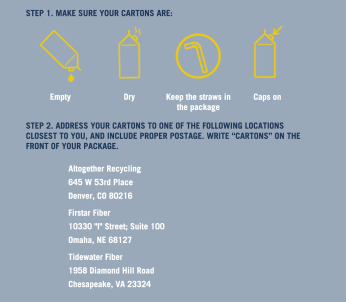
The Carton Council’s list of places you can mail your cartons to currently.

Then I just happened to take a closer look at my garbage service “recyclable” list. Waitaminute! Contrary to what the all-knowing Carton Council website had indicated, milk cartons are on the list! This was excellent news.

But what about other cartons? The Carton Council’s mail-in locations also accept lots of other cartons, i.e. the boxes that hold shelf-stable things like juice boxes, soup and chicken broth. These items are labeled “Tetra Paks.” I don’t encounter them often, because we don’t drink juice and I usually make my own broth from leftover chicken bones and freeze it, but now that I’m having trouble buying whole chickens without plastic, my broth supply has dwindled to nothing.

Perhaps I could solve this problem, I thought, by buying Tetra Paks of broth for soups and sauces? Maybe those would be the only things I’d have to mail to Denver or Omaha.

But then I noticed something else intriguing on the list for curbside recycling: they also accepted something called aseptic cartons. What was that? The lady who answers the phone for my garbage service had no idea. Back to the Internet.

AHA! It turns out there are two kinds of cartons: refrigerated “gable top” (like the kind milk comes in) and shelf stable “aseptic ” (like the kind chicken broth comes in.) Both are combinations of polyethylene and paper, but aseptic includes a layer of aluminum as well. And aseptic is the generic name for Tetra Pak, which is a brand name. They’re the same thing.

The good news is that both of these kinds of cartons, unlike other paper/plastic amalgams— such as thermal receipts—can be separated back into their components for recycling.

The bad news is that this process still requires a fair amount of energy and effort, such as trucking giant bales of the cartons hundred of miles for elaborate processing. Although it keeps these materials out of the landfill, this still seems to defeat the purpose of being sustainable and earth friendly.

Hmm. So I can put my cartons, both gable top and aseptic/Tetra Pak, in the curbside recycling, and putting them in recycling is better than not putting them in recycling. But better still would be to find alternatives. For milk, I’m looking into a local dairy that has returnable glass bottles just like those of my youth. For chicken broth, my local butcher tells me if I call him ahead of time I can purchase chicken carcasses he’s butchered for parts, and bring it home in my own container no less. Promising leads, for sure.

I do miss the mysterious ways of the Dellwood milkman, though. He made it all seem so effortless.

Beads, Beads, Beads

It’s Fat Tuesday- Happy Mardi Gras everyone! Imagine I am throwing you some invisible, purple, green and gold necklaces to wear all day long in celebration. Very sustainable. Heck, while we’re at it, have an invisible slice of King Cake on me.

Mardi Gras makes you do weird things

For many years my mom and her boyfriend have made New Orleans their home, so I’ve been lucky enough to experience the culture of Mardi Gras, which is so much more than the old stereotype of drinking and bad behavior. In my family we focus on the family-friendly parades, which go on intermittently for weeks before culminating in Fat Tuesday, an extravaganza which literally shuts the whole town down in celebration.

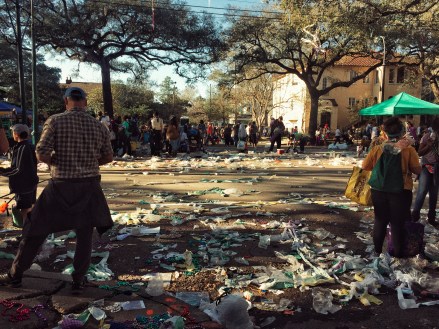
Although I’ve been to many Mardi Gras parades, which I love, there’s one aspect I’ve never quite been able to get past, something which is both incredibly apparent and kind of invisible at the same time: the colossal amount of garbage involved. If you’ve never been you wouldn’t necessarily know it, but the parades are pretty much Woodsy the Owl’s worst nightmare. This is because practically every parade throws plastic bead necklaces from practically every one of its thirty-or-so gigantic floats. If they aren’t throwing beads they’re throwing stuffed animals, beer cozies, t-shirts, coins called “doubloons,” plastic swords, rubber balls, tutus, confetti, cheap sunglasses… you get the idea. In fact, you seriously need to be paying attention because it’s literally raining stuff when some of these floats go by. When she was about eight years old my daughter Greta got seriously clocked in the head by a rather heavy, glitter-coated high-heeled shoe. (Which she treasures, by the way. A “Muses shoe” is a very prized throw.)

Yeah.

After a parade has finished you can just imagine the devastation: blocks and blocks of discarded beads, squashed throws, and all the plastic baggies this stuff comes in clogging the gutters along with bottles and other trash. Some parades leave a layer of spewed confetti decorating the streets while others have tossed rolls of toilet paper festively into the trees. Now multiply that by fifty, the approximate total number of Mardi Gras parades, and you’ll have some idea of the herculean amount of garbage we’re talking about.

But the garbage never sticks around for very long. The reason I say it’s kind of invisible is that New Orleans has been doing this a loooong time, and if they know how to do anything really well, it’s how to clean up a parade mess, fast. I’ve seen a parade route go from disaster to you’d-never-know-it-happened in the span of few hours. That’s how good they are. You might even forget all that garbage was ever generated at all.

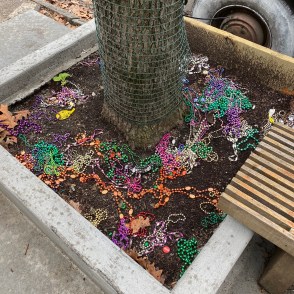
But there are other signs. People joke that New Orleans is sinking, not because of global warming, but from the weight of all those beads. This is less of an exaggeration than you might think: following street floods in 2018 the City of New Orleans removed 46 tons of Mardi Gras beads from a five block stretch.

Five blocks. 46 tons.

Turns out beads make terrible fertilizer.

Of course, that’s only a small percentage of the outlay. The vast majority of beads and throws don’t end up in the gutters because people want them: Throw me something, Mister! is the famous refrain. Every parade is in some sense a contest to see who can get the most stuff, the weirder the better and the more you can wear on your body all at once, better still. After all that jumping and screaming and triumphant catching people can get unreasonably attached to these bizarre treasures. Remind me not to tell you how many suitcases I inexplicably stuffed with pounds of parade beads and cheap stuffed animals to bring home to Vermont and keep forever because… I caught them? That makes sense, right?

I blame everything on Bead Fever.

But here’s the question: what do you do once Bead Fever has subsided? When you come to your senses and realize that you might not really want to hand down to your grandchildren seventeen pounds of plastic beads and a miniature plastic toilet that squirts water when you open the seat? The good news is that on my trip to New Orleans last week I discovered that there is a non-profit organization that is recycling Mardi Gras, plastic toilets and all. AND providing employment to intellectually or developmentally disabled people. AND using the profits thereby generated to provide other programs and support for the intellectually or developmentally disabled.

Vanna White envies me.

It’s called ArcGNO (GNO stands for Greater New Orleans) and their slogan is “We Turn Beads Into Jobs!” They’ve been collecting, sorting, and reselling Mardi Gras beads for over thirty years, but I’d never heard of them till now. That’s because they’ve been recently expanding their operation by leaps and bounds: new attention to issues of sustainability has caused many prominent parade krewes (the clubs that throw the parades) to buy recycled beads from ArcGNO. Huge metal collecting bins are placed throughout the city for receiving bead donations, and people are using them: three years ago ArcGNO had 20 tons of beads donated. Last year that figure was over nine times that amount, 186 tons.

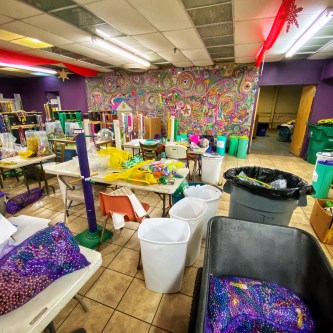
I got to visit the bead-sorting operation and store in Metairie, and was floored. I honestly found it quite moving to see so much good happening all at once. People welcomed us to watch the bead sorting, view the gigantic bead mural, and talk about other things they offer to krewes such as sustainably sourced and non-disposable throws (paper beads, colored pencils, bags of coffee). And of course if you see some especially nice beads or a plastic tiara you can’t live without everything is for sale.

In addition to the large volume of local donations, bead recycling center manager Toni Wright told me told me that ArcGNO also regularly receives mailed-in beads from all over the country.

“They don’t have to do that!” she laughed, “They could just send us a check!”

The bead sorting room at ArcGNO feels a bit like the Wonka Factory to me

I understood her point— why spend $20 to mail a boxful of plastic when you could just send them the $20?— but I also understood the impulse to return the beads to their native habitat. Mardi Gras beads never make as much sense anywhere else as they do in New Orleans. And if not back home where else can this stuff go? (I mean, besides the landfill. You know how I feel about the landfill.)

So if you’re like me and you happen to have a whole bunch of old Mardi Gras beads hanging around in your attic you can mail them in to ArcGNO and rest assured those beads will live to be flung another day (ditto any other Mardi Gras swag: cheap cups, toys, stuffed animals etc.). Or, to tread even more lightly, maybe your local elementary school would like those beads and trinkets for an art project, or as prizes for meeting reading goals, say. Either way you’re letting these objects continue their mission of spreading some festivity in the world.

Celebrations— Mardi Gras or otherwise— can be tough to reconcile with sustainability. By definition, everyone is there to have a good time, right? Don’t be such a bummer worrying about the environment, man. We may never be able to make our celebrations completely green, but we can surely feel good by doing more with what we already have.

After all, there’s more than one way to skin a Fat Tuesday.

Confessions of a Paper Towel Addict

I’m a big fan of reality television. Mind you, not just any reality television. Historical reality television. That’s the kind where they take three modern American families and have them, say, live as 19th century pioneers somewhere in the Montana wilderness.

What I just described is one of my favorites shows of all time: Frontier House, which premiered on PBS in 2002. Before being transported “back in time” the participants were asked what things they thought they’d miss most. As they listed off a whole bunch of things, the whole time I was thinking: I know what I’d say: paper towels! I mean, NO PAPER TOWELS!?! How did people live?

I have a problem

Ever since watching that episode I’ve wondered somewhere in the back of my mind if I could ever, truly wean myself from my fully absorbing paper towel addiction.

(See what I did there? I even like bad paper towel puns. Clearly, I need help.)

As if in reply to my question, some time ago on social media I came across a tutorial on how to make your own paper towels out of cloth and then sew little snaps into the sides and snap them together one by one to form a reusable roll. Like a lot of these DIY videos, the slick editing makes this idea seem completely brilliant. Wow! Look how easy it could be. And no waste!!

I’m definitely a crafty, I’ll make it myself kind of person, so at first I was captivated. However after the idea sank in a bit I was made of questions: hold on a sec here Pinterest people. How long would it take to make this gigantic reusable paper towel roll, I mean, without time-lapse photography? And once you had used the towels up and washed them all, how many hours would it take to snap all those tiny little itty-bitty snaps back together? And what if you sewed one snap just a liiiiiittle to the left or right and suddenly your lovely DIY project is NOT COOPERATING? And you accidentally throw the whole darn thing out the window? That’s not very zero waste, now is it? If you ever did manage to roll the whole thing back up again- you know, say, three weeks later- is there any possibility it wouldn’t look like a giant used wad of Frankenstein Kleenex?

I decided the chances of that were pretty much nonexistent, so I kept on using regular paper towels at a rather alarming rate, despite the fact that I have an extensive collection of dishtowels and cloth napkins that I also use. But, you know, sometimes the napkins were all dirty and I hadn’t had a chance to wash them yet. Paper towel. What if it was just a little bit inconvenient to go grab a dishtowel? Paper towel. What if it was a messy, stain-y job involving spilled wine or something that I didn’t want my pretty dishtowels being exposed to? You get the idea.

I keep dishtowels and cloth napkins in a bowl by the kitchen

So in the first few days of our Year of No Garbage, I wasn’t quite sure how it was going to go when it came to the Paper Towel Conundrum. I had discovered that paper towels are compostable, so that was good news, but it was also kind of bad news, because my kitchen compost bin was getting filled up approximately every ten minutes. People were using one-use, disposable paper towels for jobs that really could easily have been going to the reusables, silly things like drying their hands off or wiping the countertop off. It was simply out of habit and because we knew we could.

It was hard to retrain myself and virtually impossible to keep everyone else away from the siren song of old, bad habits rooted in one thing: convenience.

Should I just do away with paper towels all together? I thought. That was one solution. I kind of feel like that’s Zero Waste Ninja Level. I hope to get there someday, but for now I still want to use them for the very slimiest jobs such as wiping grease out of cast iron pans and drying off raw meat and poultry.

Instead, I decided to switch the narrative: if the problem was convenience, how could I make paper towels the most inconvenient solution? So I put them in the laundry room waaaaaay on the other side of our house from the kitchen. In a way I felt like I was just trying to hide them from myself, which seemed silly. I mean, I knew where they were. And anyway surely something that simple would never work.

It totally worked. It worked so well I was kind of shocked. One day I was sighing and emptying yet another compost containing 75% paper towels into my poor starved compost pile in the backyard, the next it was like “Paper towels? Hmmmm. I’m not sure I’m familiar with those. Could you describe them?”

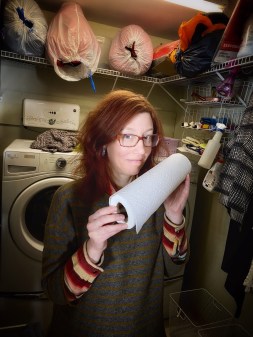
Me in my lovely laundry room

In the old days I am not kidding you, it was not unusual for us to use up an entire eight-roll package in one week. Now that the paper towels live in the laundry room, we’ve been on the same roll for the last six weeks.

Okay, I’m pretty proud of that.

Eventually I may get to a point where we’re so organized we even have a separate batch of dishrags for those few greasy, ooky jobs, along with a separate container to hold the dirty ones between washings. But for now I feel really good that this worked. It all came down to a simple idea that I need to be sure to remember: make the things you want to do easy, and the things you don’t want to do, more difficult.

Now if PBS comes knocking, I’ll be ready.