All posts by Eve Ogden Schaub

Unknown's avatar

About Eve Ogden Schaub

Serial memoirist Eve O. Schaub lives with her family in Vermont and enjoys performing experiments on them so she can write about it. Author of Year of No Sugar (2014) and Year of No Clutter (2017) and most recently Year of No GARBAGE (2023). Find her on Twitter @Eveschaub IG or eveschaub.com.

No One Expects the Garbage Inquisition

I’ve been having a hard time lately. The dips in my emotional rollercoaster have been, well, deeper. Harder to struggle out of. The other day I felt so depressed for a while I had trouble maintaining a normal telephone conversation. I just wanted to put the phone down and walk away. Maybe go to sleep.

We’ll get to THIS travesty in a minute

Of course, at this particular historical moment in time, with the Corona-warming-global-virusing-frog-raining-race-rioting Apocalypse going on and all, it is incredibly, incredibly likely that I’m not alone in this, just as it’s also likely that I have absolutely no right to be having a hard time. I mean, I know that I’m extremely lucky to be who I am, where I am, with enough food, shelter, safety, loved ones, probably a few too many dresses, definitely not enough bookshelves, and no murder hornets in sight… so what’s my problem, exactly?

I’ve had this thought before and I will have it again: people are suffering, people are dying and you’re sad? Who the hell are you to be sad?

The best part is that then, of course, I feel worse.

My rational brain knows that even people who have won the actual lottery can be sad sometimes, feel overwhelmed, depressed, or despondent. Sometimes they can’t even say why.

For me, I know one thing that contributed: The Chicken Who Lived? Died. This is one of our teenage chickens whose beak I wrote about being torn off by our friendly neighborhood raccoon. (Although I know raccoons can be lovely, intelligent animals, we have come to regard our personal backyard raccoon as the Ted Bundy of the animal kingdom.) After our chicken managed to survive The Incident for two whole weeks we had grown quite fond of her spunky attitude. We made the Huge Mistake of naming her (“Queenie”), and despite her beaklessness she had learned to feed herself again, and went hopping about the metal tub we were separating her in impatiently trying to escape. She had convinced everyone, even the vet, that she was going to make it: return to a normal life in the coop eating bugs and arguing over stray feathers. Then she developed a fever, stopped eating and died in a period of 24 hours.

Just like that.

Unfortunately Queenie wasn’t the only thing around here that seems suddenly ready to die; another is my ten year-old car. As it turns out I am a Bad Car Mom. I don’t remember to go for oil checks, ignore the check-engine light, NEVER wash my car, forget to get it inspected for never mind how long. And all of this has finally caught up with my poor, neglected Subaru, which at the quasi-youthful age of 160,000 miles is now lurching alarmingly whenever I press on the gas pedal.

Apparently this is very bad.

Meanwhile, as we inch ever-closer to the half-way mark, things have continued on a fairly even keel in the No Garbage department, although there are assuredly days when I feel I might lose my resolve. These are usually the days that are hot, sticky and uncooperative; the evenings when the various food wrappers that are necessitated by three-meals-at-home-a-day-because-quarantine have accumulated by the side of the sink each awaiting their own separate rub down and spa treatment and I’m not sure I can quite face it.

“Wow. We take such good care of our garbage,” Ilsa marveled one evening as I draped a freshly massaged and buffed piece of Saran Wrap atop the overflowing dish drainer. We do indeed.

Every once in a while there’s a bit of excitement when I become possessed by the spirit of the Spanish Inquisition: “SO WHO PUT AN ENTIRE ROLL OF SOGGY TOILET PAPER IN THE ‘HEALTH AND SAFETY GARBAGE’? HMMM? COME ON! OUT WITH IT!” I don’t know why everyone looks at me like I’m crazy when this happens.

Once Greta casually mentioned throwing out (!!!!) an empty shampoo bottle because she and her boyfriend have been staying in our AirBnb guesthouse during quarantine and she had heard someone say at some point that the guesthouse “didn’t count.”

“Are YOU an AirBnb guest?” I asked her with poorly concealed exasperation.

“No…?

“Then it counts.”

Nope. I’m not above Garbage Shaming.

My husband Steve has been known upon occasion to skirt the spirit of the project too, if not the actual rules. I’m sure he finds it adorable when I harangue him about putting the PERFECTLY RECYCLABLE TOOTHPASTE BOX in the much-discussed Health and Safety Garbage, for the reason that brushing our teeth falls under “health.” Or, discarding his foil photographic film wrappers in the “can be used for kindling” bag that we keep for campfires.

“This isn’t paper, darling!” I call to him across the kitchen, waving the foil wrapper at him as daintily as if it were a linen hankie.

“It does burn though, my love” he smiles back at me.

“But my dearest,” I say, battling my eyes sweetly, “IT SHOULDN’T.”

So to sum up:

I’m a good garbage mom,

a bad car mom,

a sad chicken mom, and

apparently even the Corona-warming-global-virusing-frog-raining-race-rioting Apocalypse will not deter… the Toilet Paper Inquisition.

 

Garbage, Garbage Burning Bright

So last night I had another garbage dream and I knew you’d want to hear about it.

In this dream, I was at the house of a friend, but for some reason there were huge, stinky garbage bags all over the place. Suddenly, as happens in dreams, we realized that the garbage bags were going to explode, sending garbage shrapnel everywhere! So we had to quickly get them all outside before that happened. Then we figured out that if you threw the bags into the air and shot them, they’d disintegrate. Then a large bear lumbered into the doorway and further panic ensued. Someone shot him and he deflated like a punctured balloon and…

Well, that was the end of the garbage portion of the dream, anyway.

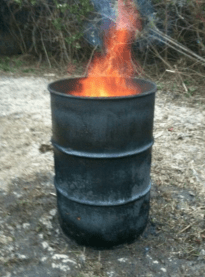
But I liked the dream-idea that it might be possible to vaporize our garbage into nothingness, if we could just find the right way. And in the country, back before the invention of plastics, there was a way to do this. It was called the “burn barrel.”

Because I grew up in the suburbs, I’d never heard of burn barrels before moving to Vermont. Essentially you put all your trash into a 55-gallon drum and light it on fire. In our town the subject had come up because it’s illegal, yet people we doing it anyway, primarily because every other way of disposing of trash here costs money, but burning is free.

So it turns out this was a bad idea

This might’ve been relatively fine a century ago, but when you introduce plastics to the mix all kinds of terrible things happen. Burning plastics create dioxins, PCBs, and something called furans, all of which are all kinds of bad— toxic, endocrine disrupting, carcinogenic— not to mention leaving behind heavy metals such as lead, mercury and arsenic.

Okay, so burning garbage is bad. Got it.

Except, since this project began I’ve learned that the two ways contemporary society deals with garbage are landfilling and incineration. Wait- but what about the furans? What about reproductive, immunological, and developmental problems? What about the frogs biologists keep finding with both sets of genitals and three legs?

Turns out the reason it is ostensibly okay for some people to burn garbage— but not you at home in your backyard— is that compared to an industrial incineration facility the temperature in a domestic burn barrel is relatively low. Which, experts online say, means more stuff gets vaporized out of existence. Plus they have fancy filters that “scrub” the exhaust emitted.

I don’t know about you, but I’m skeptical. Three legged intersex frogs don’t lie.

It’s true. We don’t lie.

Even if higher temperatures burn cleaner than a barrel in my backyard, that still doesn’t mean they burn clean. Everyone seems to agree that there is always some degree of VBS (Very Bad Stuff) left over from incineration of garbage, which ends up both as gasses in the air and as ash in the landfill.

As if all this toxic plastic burning weren’t bad enough, what’s worse still is that there is clear evidence that incinerators are much more likely to be built in low-income communities and/or communities of color. So apparently we’re fine with putting poison into the environment, as long as it takes place in someone else’s neighborhood?

The good news is that incineration plants are wildly unpopular, not to mention extremely expensive to install and maintain. (The Tischman Environment and Design Center produced a whole report about the decline of waste incineration which you can read here.) Where there used to be hundreds of industrial incineration plants across the country, there are currently only 73 left in the United States, and the number is falling all the time. In 2017 only 13% of U.S. trash was incinerated.

The bad news, however, is that there’s an effort underway to change all that. Since 2018 when China decided to stop taking recyclables from the United States, the plastic and incinerating industries have been ramping up promotion of something called “chemical recycling” using “plastic-to-fuel” technology.

The AEPW website features many pretty pictures of water

A gaggle of major corporations, including PepsiCo, Exxon Mobil, Proctor and Gamble and Shell, have combined to form the Alliance to End Plastic Waste (AEPW) and contributed over a billion dollars to the initiative. If you check out their website you’ll find lots of pretty pictures of the ocean, text about “Swift Action and Strong Leadership” and not a whole lot of specifics. Perhaps this is because, according to research by the Global Alliance for Incinerator Alternatives (GAIA), the true goal of AEPW is to reclassify waste incineration as recycling.

The GAIA website features actual information

On the EPA website they call it “Energy Recovery from Combustion.”

This is not recycling. This is a fancy name for burning plastic. But can you truly recover energy from burning plastic? Yes.

Another linear, dirty, greenhouse-gas emitting fossil fuel, with the added bonus that it is exceptionally inefficient.

Yay?

Though we might like to, we can’t burn our way out of the garbage problem. So I guess incineration isn’t the magic bullet from my dream.

Instead I think it’s the bear that shows up to make everything worse.

The Chicken Who Lived

I know the world is ending, but first I’d like to talk about something that happened at our house this week: one of our baby chickens was attacked by a raccoon and lost a good part of her face.

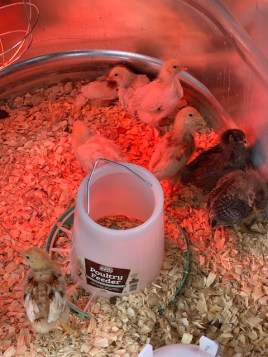
We’ve been raising baby chicks for the first time this year. We bought nine of them when they were a day and a half old, at which point they resemble little balls of fluff with legs; for the first several weeks, before it got warm enough for them to be outside, they lived in a metal tub in our dining room. There they ate and drank and were somewhat smelly and argued over who got to play with the loose feather someone found. So, you know, pretty much what we do in our dining room.

Although we’ve never raised from chicks before, we’ve kept chickens for the last ten years, so we know the deal: chickens live short, unpredictable lives, and it’s best not to get overly attached. Like, you stop letting the kids name them. We’ve had chickens carried off by fox, raccoon, hawk, and even a bobcat once. We’ve had three brand new pullets decimated in the night by a predator who left only a few gristly feathers and a foot behind. We’ve had them die of strange diseases that make their heads list mysteriously to one side, or stand in one spot all day without moving or eating.

The chicken-keepers mantra: Chickens don’t recover. They die.

So when we discovered our little half-grown chick bloody and missing key body parts (a large swath of feathers and her beak), we knew the odds of her surviving were Definitely. Not. Good. I felt woefully under skilled as we tried to clean her up and ascertain the damage. Looking at the place where her beak was supposed to be, I couldn’t make any sense of it. Splintered shards were sticking out everywhere- was that beak? Was there any beak left? What about her tongue? Or was that a piece of hay? I felt a strange mixture of anxiousness and defeat at the same time. How can I help if I don’t even know what I’m looking at?

I feel this way a lot lately, and not just about chickens. This morning I asked my husband, as he scrolled the news on his phone, “So, what’s happening in the world? Or, should not I even ask?”

I mean, here we are in the throes of the first major pandemic in a hundred years.

We’re destroying the planet.

And there’s rioting and looting in the streets of our major cities.

Have I left anything out?

When the state of the world is this chaotic and unpredictable, it’s hard to know how to feel. Is the pandemic ending now? Or is the worst yet to come? Is it too late for the planet, the polar bears and the rainforests? Or can something still be done? Why are innocent people being killed in the streets by the very folks sworn to protect us all?

How can I help if I don’t even know what I’m looking at?

Frying pan: meet fire.

Just in case I wasn’t feeling bad enough, a friend forwarded me an Op-Ed from the New York Post, making the argument that New York City should stop recycling. Yes. With all that’s wrong in the world why not just throw some gasoline on the fire?

The worst part is that the author of the article, a senior fellow from a conservative think-tank, makes a decent argument. Remember how in 2017 China stopped accepting recyclables from the United States? Have you ever wondered what happens to all that recycling now? Well New York City has been paying a small fortune for private companies to take it. According to the editorial’s figures, the city spends around $390 million to get paper, metal, glass and plastic into the hands of recyclers and consequently could save about 87% of that amount, or $340 million, if all of it just went straight to landfill.

That sounds like a lot of money. But is it? The annual budget of the city of New York is about $86 billion. Which would mean that landfilling recyclables would save New York City less than one-half of one percent of its budget. A fraction of a fraction, but still… $340 million is $340 million. Fortunately, when Mayor Bill de Blasio announced his proposed upcoming budget on April 16th, which included many slashed programs, eliminating recycling was not one of them.

But the fact remains, one of the biggest obstacles to recycling is cost. If people have to choose between, say, food and shelter and recycling? Obviously it’s no contest. Likewise New York City or any other municipality.

Tom Szaky, the founder of the innovative recycling business Terracycle, has an interesting take on this subject of recycling and cost. Recently I watched a keynote address he gave at Planet Forward, an annual student journalism conference, which is available for viewing on YouTube. In it he introduces a novel concept: there is no such thing as not recyclable.

Rather, Szaky says, it’s a matter of simple economics: if you can find someone to pay for it, then you can recycle it. No exceptions. Terracycle has proven this with a team of in-house scientists who have found ways to recycle everything from cigarette butts to dirty diapers.

But who wants to pay for this recycling when the end product is more expensive than buying new? In his presentation he offers an interesting solution: change the story.

“People want purpose,” he tells the roomful of communications majors. He gives an example: a shampoo bottle Terracycle developed with Proctor and Gamble that uses 25% recycled “beach plastic” in the packaging. He relates an anecdote in which one P&G associate is jokingly mad at Terracycle for having greater success with a 25% recycled plastic bottle than they had had previously with a 100% recycled bottle.

Why are people more interested in a 25% recycled bottle than a 100% recycled bottle? Szaky’s point here, I think, is that the story of beach plastic recycling, which conjures up powerful images of turtles with plastic straws lodged in their nostrils, is compelling to the consumer, in a way that the generalized idea of “recycling” cannot be.

“That’s one of the biggest challenges in sustainability communication I think.” Szaky elaborates. “It’s 99% ‘the world is ending’ and at the end it’s like ‘well, turn your light-bulb off when you leave your home.’ And it’s like well, those aren’t balanced concepts. And then I might as well (say) fuck it and just party because the world is gonna end and I can’t do anything about it right? We need to empower this positivity, the inspiration that there is a way to solve it. ‘Cause there is.”

How do you get people to change their behavior? To clean and sort their recyclables? To spend more money for recycled packaging? To demand their government officials continue to invest in curbside recycling? You need a powerful story they can relate to. Cleaning up ocean plastic so that sea turtles don’t have to have straws in their nostrils is one such story.

Speaking of nostrils, or lack thereof, we ended up taking our chicken to the vet. And believe me, finding a vet who sees chickens is not an easy thing to do. (See the chicken-keepers mantra, above.) We were about 85% sure he would tell us to put her down.

But he didn’t. He said “I’ve seen chickens worse off than this, that recovered.” That was all we needed to hear. Yes, it’s financially bonkers- how many farmers do you know who would pay vet bills for $4 chick, who may very well die in the end anyway? But we’re not farmers. Keeping chickens for us is about enjoying them and their eggs, not about making financial sense. Don’t get me wrong, we’re not going for the six-million dollar chicken here, but if we can manage to save her— the vet has described gluing on a new prosthetic beak— we’d really, really like to.

The Chicken Who Survived Being a Metaphor

A lot of it comes down to just paying her some extra attention, keeping her separate (she’s back in the tub in the dining room), and feeding her a couple of times a day with a dropper. She’s been through a lot, as have we all lately, and she looks a little bit like Sylvester Stallone at the end of the film Rocky. For one thing, in a world where so much is going wrong, it’s one tiny good we can do.

For another, well, we’re invested in her now. You see, she’s got a story.