All posts by Eve Ogden Schaub

Unknown's avatar

About Eve Ogden Schaub

Serial memoirist Eve O. Schaub lives with her family in Vermont and enjoys performing experiments on them so she can write about it. Author of Year of No Sugar (2014) and Year of No Clutter (2017) and most recently Year of No GARBAGE (2023). Find her on Twitter @Eveschaub IG or eveschaub.com.

Nobody Wants Your Potato Chip Bags Except Subaru and Mister Fezziwig

So. How on earth do you recycle a potato chip bag?

You’d think there’d be more good ideas out there, given how all over the place potato chips are, but no. A website called ThriftyFun recommends using them to “bury your deceased pet parakeet, fish, gerbils or hamster.” But once you’ve said a fond farewell to Kiwi, Bubbles, Biscuit and Mister Fezziwig, what else can you do?

Which is where the Subaru Loves the Earth recycling program could come in.

The idea is a simple one: think of all the single use disposable items you might use in a waiting room— a coffee cup, a chip bag or snack wrapper, some creamer capsules. Now imagine they all will be recycled.

I should point out that most of these items aren’t normally recyclable at all, even through single stream recycling, so this is kind of a big deal.

Here’s how it works: in their customer waiting area, participating Subaru dealers feature three tall, collection boxes: disposable cups, lids and straws go in Box 1, candy chip and snack wrappers go in Box 2, and coffee and creamer capsules go in Box 3. There’s also a display illustrating what happens to these items in the recycling process.

My dealership waiting area… You kind of can’t miss it

But the best part about the program? Is that it works.

I know this because Eric Lendrum, who I got on the phone, is the owner of North Country Subaru. He is JUST the person to ask about the Subaru Loves the Earth program, because he has a lot to say.

“We’ve always had a recycling bin, but it was obvious people didn’t seem to really care,” Lendrum says. People would often throw everything unsorted into the trash, even when the recycling bin was only inches away. Now? His customers are recycling. He credits the success of Subaru Loves the Earth with Terracycle’s eye-catching display, coupled with what he calls “repeat service”: he says customers who come back over time become acclimated to the Terracycle system and use it more; some have even started saving K-cups and wrappers to bring from home when they have a service appointment. They get to be “regulars” of the system.

“It used to take weeks to fill those boxes up,” he says, “now it takes days.”

Lendrum readily acknowledges it would be better if people didn’t use single use products at all, but says that, as a dealership subject to safety regulations and requirements, getting away from single use items is, “frankly kind of impossible.” And the expectations of customers play into it as well. People just don’t want to pour themselves coffee from a big communal pot anymore.

Lendrum sees this Subaru-Terracycle partnership as a step in the right direction, educating customers at the same time as contributing to a good cause: all the plastics that Subaru dealerships mail in to Terracycle get transformed into public park equipment.
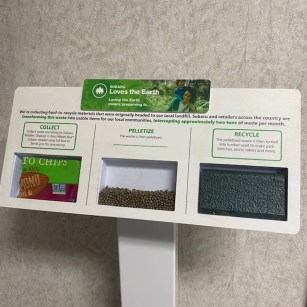
The display shows trash magically turning into park equipment

More garbage turned into less garbage is- I don’t care who you are- a good thing,” he says.

It all started three years ago at the annual Subaru conference at which Tom Szaky, founder of Terracycle, gave the keynote presentation.

“He’s a really interesting guy,” Lendrum says. And the pitch was a compelling one: dealerships who signed up for the new program got starter kits and had their first shipment subsidized. For a company like Subaru, whose brand is so strongly linked to environmentalism, it seemed like a perfect fit.

It occurs to me that when I recently was agonizing over whether or not to fix my aging Subaru, I had fixated on the fact that I was driving a machine fueled by greenhouse-gas-promoting fossil fuel, but it hadn’t occurred to me to consider the way Subaru acts as a company, which might be just as important.

Sure, I knew Subaru marketed itself as a “green” company, but I honestly didn’t know a whole lot more than that. When I looked into it I learned that Subaru has had Zero Landfill Status in their Indiana manufacturing plant since 2004 and tested waste-reduction strategies in partnership with the National Parks Conservation Association at places like Yellowstone and Denali since 2015. According to Lendrum, they also spend a large chunk of each annual convention talking about sustainability.

Lendrum doesn’t think this is just for show. He says it is driven by a corporate mindset that is slow-moving, but passionate. Can a corporation be passionate? I wondered. But if Lendrum himself is any indication of Subaru’s character as a company, then you may just be convinced.

I say this because several minutes into the conversation Lendrum mentions that even more than preserving the environment, his biggest passion is helping children’s charities, and explains that in some ways he sees his dealership as a way to support good works. “This business has to survive or none of this can happen,” he says.

Later I learn that North Country Subaru is a family business: Eric co-owns it with his brother Jared, and both of them learned the business from their father, Ken. It occurs to me that the Lendrum family is a dying breed: the family owned business that knows and cares about its community, and gives back not because they are motivated by marketing, but because they believe it’s the right thing to do.

Terracycle sends me e-mails promoting this program


I point this out because I think all these issues are related: being a responsible steward of your community or environment means you aren’t going to mistreat or exploit it. It seems perfectly natural that a family-owned business like North Country Subaru would be very involved in their community, because they live here too. Similarly, we all need to take ownership of the environment, not thinking of it as some big overwhelming earth-scale problem no one can fix, but instead as us taking care of ourselves, our own families, our own communities.

Of course, like Terracycle itself, the Terracycle-Subaru program has limits.

For one thing, it’s expensive. Although the service is free to their customers, it’s not free for the dealership, who pays shipping and processing for each and every box headed back to Terracycle.

Plus, there’s the environmental footprint of shipping all this stuff around. Does that energy expenditure outweigh the benefit of keeping these materials out of the landfill? I don’t know how you figure that sort of thing out.

And of course, it’s extremely limited. It’s a Subaru program, and Subaru dealerships are where you will find these boxes. If you find yourself drinking coffee from a single use cup somewhere else? You are out of luck. You’ll be like my 15 year old who found herself wandering around the mall for hours unable to part with her disposable smoothie cup. (She brought it home.)
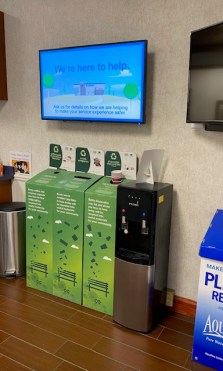
My dealership waiting area… You kind of can’t miss it

Participating dealerships are understandably a little wary about publicizing the program.

“I don’t want to be too well known for (it)!” Lendrum laughs, imagining carloads of recyclables appearing at the service-area’s doorstep. “We’re just not prepared for it… That would be a wonderful problem but I’d like to grow into that.” For now he says their customers are welcome to bring items from home, but that’s pretty much all they can reasonably handle.

Just for the record, I find nothing in any of the descriptive material from either Terracycle or Subaru that limits the program to customers. So, you know, if you just happen to live next door to a participating Subaru dealership, and you are brave enough to walk in with a handful of K-cups and snack wrappers, let me know how that works out.

Seductive, no?

For my part, I get all freaked out bringing my garbage to some public place where I may have to stand around for a few seconds being mistaken for a person who is inordinately fond of garbage, or perhaps got lost on her way to the dump. Even though I am a North Country Subaru customer, and even though Eric Lendrum has given me express permission to bring a reasonable amount of my recycling in, I’m still reluctant to do it. I don’t even really know why.

Wait. Yes I do: I’m afraid to look stupid. That’s probably the third drawback to changing behavior through a program like this: comfort level. There are always those of us who are terrified to make a mistake, to look stupid, to feel stupid.

Despite all these drawbacks, Lendrum sees the Terracycle concept as a stepping-stone, a means to an end. Even if the overall impact is relatively small, its intent is to get people thinking, and acting, differently. To push them past that “I feel stupid” part. The next challenge, he says, is making a process like this more streamlined and available in more places, like your local coffee shop for instance.

“You’ve gotta crawl before you walk,” he says.

So I’ll be heading over to Subaru with a collection of empty potato chip bags very soon. If anyone looks at me funny, I’ll just do my best impression of the dear, departed Mister Fezziwig. Works every time.

A Car is Never Just A Car

Several weeks ago my beloved but well-worn Subaru had a nervous breakdown. Ever since I’ve been faced with choosing one of three options:

  1. For a princely sum, fix my car
  2. For a differently structured princely sum, trade my car in for an electric car

OR

  1. Become a one-car household
I am only half kidding about this.

Ever since this realization sank in I’ve been stuck, both literally and figuratively. I work at home and there’s a pandemic going on, so there hasn’t been a lot of pressure to resolve the dilemma: there’s just nowhere all that pressing for me to go. So my Subaru has sat in the garage, patiently waiting.

Like all of us, I was raised with a whole bunch of cultural expectations about cars, and for me one of them was that every able-bodied driver in the household has their own car.

A car is never just a car. It’s feminism. Or independence. Or adulthood. A flashy car is youth, or youth regained. An expensive car is an assertion of class or success.

Only a few short decades ago one-car households were the norm. A spouse could drop off the commuter at the train station or the bus stop in order to “have the car for the day.” Today a combination of factors- higher costs of living requiring two incomes and poor public transportation systems among them- have lead to new norms.

Recently I spoke with my friend Rhonda on this topic, because for the last 16 years her family has had one car. In fact, she and her husband are the only adults I know in this community who don’t have “her own” and “his own” car. They have one car, and they share it. She says this revelation is sometime is met with puzzlement.

She likens the cultural expectation of multiple car households to that of neatly maintained grass lawns.

“There’s no reason to have all that grass,” she says. “But it’s just what people are used to.” Of course, she points out, the fact that she works at home makes having one car possible. Were she and her husband to both work outside the home, two cars would probably have been essential.

“We always said that if at any time it got uncomfortable we could decide to revisit the question,” Rhonda says. The decision for them was primarily environmental. “I just feel like our footprint on the planet as Americans is disproportionate already.”

And for me, that’s just it. Technically, my car doesn’t figure in to the Year of No Garbage project, because my car doesn’t generate the kind of garbage you can see. On the other hand, I think it would be near impossible to go for months on end thinking about the impact of humans on the environment and never stop to reconsider one’s mode of transport. According to the EPA, transportation was the number one U.S. contributor to greenhouse gas emissions in 2018. That fact alone should give everyone who owns a fossil-fuel burning car pause.

I’ve enjoyed the last few carless weeks, actually. Being a hermit has its charms, especially for a writer. Back when we each had our own functioning cars, my husband and I were never compelled to strategize who was going where, when. We just went. I think sometimes modern life encourages us to move so quickly that it can be destructive, not just of our environment, but of intangibles such as contentment, and creativity; do I really need to run out to buy just one thing at the store? Or could I better spend that half hour doing something else? In the last few weeks I’ve really liked being more conscious about our travel than that. I feel… more responsible.

But today I am taking my car in to the shop at last- having decided on option number one after all: fix it. I’m a little sad about losing that sense of interdependence- which we should have all the time but don’t, yet I’m also happy to regain some of my independence as well.

Soon my fifteen year old will be driving and the equation will shift yet again. Maybe by then I’ll have traded my Outback for an electric car. Or a horse-drawn carriage.

Hard to say.

Busy is a Four Letter Word

I’m guilty of this crime as much as anyone I know… but. You know what makes me crazy? When you ask people how they are and they say “Busy!

One reason it bothers me, I think, is because it says absolutely nothing. Saying you’re “busy” is another version of “I’m fine”: it pretends to be informative, but it really isn’t.

Another reason this answer bothers me, though, is because it is symptomatic of what we culturally value: busyness. God forbid we all slow down and think for a few minutes. I think one of the potential benefits we can take from a terrible, tragic event such as a 9/11 or a pandemic is that it forces people to stop, to snap out of their I’m so busy lives, step off the never-ending treadmill and actually consider what the world is like, and their lives in it.

Is this what I want? we stop to ask ourselves. Do my actions reflect my values?

I’m not saying no one out there is ever thoughtful or contemplative until catastrophe strikes, but just that normally our culture tends to discourage thoughtfulness… and I’m so busy is a symptom of what I would call a destructive tendency to carry on and not think too deeply about troublesome things.

This is why a person like Greta Thunberg is so striking, and unnerving, to many of us. She immediately understood the problem with carrying on as if nothing were wrong and decided- against incredible social pressures to go to school, to think about her grades, her future- to stop being too busy to do anything about it. Thunberg is proof that being busy isn’t always the way to be most effective. In fact sometimes stopping is the most important thing you can do.

Doing a project like a Year of No Garbage is one way to force myself to stop being busy, and instead focus on life from a new vantage point. It’s not something everyone can do, obviously, because there are mortgages to worry about and car payments to make and kids to feed, but if I can go to that strange country of Stopping, that means I can report back to everyone else what I found out in my travels.

I can report, for example that lately I find myself questioning some pretty fundamental things about the way our family lives that previously I always took for granted. For example:

  • Sure we live in a rural area, but do we really need two cars? Like, really?
  • Sure, single-stream recycling is much easier, but is separating and hauling our recycling to the local transfer station a better, more effective option? (They take more things- broken glass, batteries, small appliances- and the service is free, to residents.)
  • Is there another way we can affordably heat our house that is more earth friendly?

And I’m re-examining things I previously just accepted at face value:

  • Are most “recyclables,” in fact, being recycled? (Answer: Stay tuned.)
  • Are most “compostables” actually compostable? (Answer: Nope.)
  • How does my detergent-free laundry system actually work? Is it really harmless to myself and the environment? (Answer: This post.)

We are told so many things by our culture, and often we accept them, even when they are completely contradictory. We are told that the things we do as individuals matter in the grand scheme of things: Voting. Thinking globally and acting locally. Recycling. Shunning straws. Bringing your own bags. Voting with your checkbook by buying organic produce, supporting your local farmer, buying the more expensive product with recycled packaging.

But we’re also told that there are some things for which there is simply no solution. We just have to throw away certain materials. There is just no way to recycle everything.

Really? Because the village of Kamikatsu in Japan recycles 80 percent of their waste. Watch this video and you’ll see them doing all those things that are supposedly impossible for the average citizen to do: washing out flexible plastics, drying packaging on hanging racks, sorting recyclables into forty-five different categories.

This four minute video is worth the watch

Yes, the individual does matter, but it only goes so far; there are some things one individual cannot do alone. If the system doesn’t exist to manage forty-five different kinds of recyclables, one person can’t will it into existence- and believe me I’ve tried.

For every Zero-Waster out there wrapping cheese in burlap and string, there are a hundred more people putting perfectly good things in the landfill just because it’s easier and they have to get on with it. Because: busy. If I’m honest, I have been each of these people at different times in life. We need a system that will work for both of them.

Our society’s been talking about recycling since the seventies: fifty years. So why doesn’t such a system already exist? Compared to Kamikatsu’s 80%, why do Americans recycle only 35% of our waste? I blame too busy. We’re too busy to think more deeply about the overall way our society is constructed. When we’re too busy we throw things away because figuring it out too hard. Or the compost is icky. Or taking the trouble to bring some packaging home is inconvenient. When we’re too busy we accept the lies that “compostable” packing is actually compostable, that recyclable is truly recyclable, and that some things just can’t be recycled. When we’re too busy we fall victim to “green washing,” and practice “wishful recycling,” and accept that a picture of an arrow or a tree somewhere on a product means something, when we should know better. Too busy means something else is taking your time and attention instead of the matter at hand. Greta Thunberg is right: the environment is the matter at hand and there is nothing else that even remotely comes close to it. What could possibly be more important? Without an environment in which to take place, all those things that keep us so blissfully busy will- one day-cease to exist.

Johnny Cash does a lovely rendition of “I’m Being Swallowed by a Boa Constrictor”

It won’t happen all at once. It happens slowly, like being swallowed by a snake. Remember that old Shel Silverstein song “I’m Being Swallowed by a Boa Constrictor”? The kid keeps singing, describing different parts of him being swallowed: “Oh no, he swallowed my toe!” and “Oh me, he swallowed my knee!” The punch line comes at: “Oh dread, he’s up to my – slurp!”

So I think, if you are able to take the opportunity to stop and reevaluate how you go about your daily life, then take advantage of it. But, no matter what, be wary of being too busy. The snake smiles at that answer.

What would happen, I wonder, if the next time you were asked “How are you?” you were to answer: “I’m thinking” ?