All posts by Eve Ogden Schaub

Unknown's avatar

About Eve Ogden Schaub

Serial memoirist Eve O. Schaub lives with her family in Vermont and enjoys performing experiments on them so she can write about it. Author of Year of No Sugar (2014) and Year of No Clutter (2017) and most recently Year of No GARBAGE (2023). Find her on Twitter @Eveschaub IG or eveschaub.com.

I Am The Great Sticker Marauder

I used to adore stickers. When I was in middle school I had a whole three-ring binder full of them: puffy stickers, heart stickers, stickers with pictures of unicorns gazing meaningfully at rainbows…

Today, my thoughts about stickers are much less fanciful. And occasionally involve adult language.

That’s because stickers are one of the more confounding elements when it comes to recycling. So many questions and so few answers. I wonder:

-When is a sticker a sticker… and when is it a glued paper label?

-Will a sticker interfere with the recycling process?

– Would I rather hang out with road kill than spend time removing stickers?
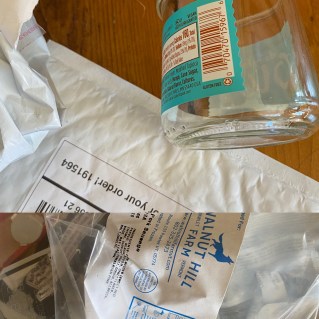
Stickers on glass aren’t a problem for recycling- but what about stickers on plastic?

I started thinking about this issue way back in May when I ordered my first Terracycle Plastic Packaging Recycling box. The website description admonished me not to send in food waste or hazardous material, which I figured I could handle.

But then it said, “Do not send in plastic with paper stickers.”

Oh. That was harder.

And now I have a confession to make. I did everything I was supposed to do: I cleaned my plastics; I made sure they were all completely dry. I sent my box in as densely packed with plastic as any box could ever be but… I did not remove any stickers.

I wondered… what would happen? Would they issue me the equivalent of a recycling speeding ticket? Would they send me my box of plastic back? Or worst of all, after all that effort from cleaning and drying to shipping and paying: in the end would they just discard my whole box into the landfill?

The Five Stages of Wish-cycling:

  1. Hope— I crossed my fingers. I really, really hoped my box was recycled.
  2. Rationalizing— After all, you used to have to remove paper labels from cans before recycling, and now you don’t anymore! Maybe it’s like that!
  3. Pretending I’m an expert— Well, they’re probably melting all these plastics down, so heat will just melt those labels too. Right?
  4. Anger— You know, how on earth are we supposed to remove all these sticky labels, anyway? It’s practically impossible! What is this my new freaking JOB? Sticker-remover??
  5. Acceptance— Who the heck knows?

The problem was I just didn’t know. There are so many things about recycling that we just don’t know, that prevent us from doing it correctly and efficiently, and I’ve pretty much spent this whole year trying to figure them all out.

Ultimately, I forgot about the sticker conundrum. That is, until recently, when I watched a video featuring a recycling expert who talked about removing stickers from the plastic films you put in the recycling bin at the supermarket. He said that sticker labels must be removed, or cut out. If not, the sticky part of the stickers will gum up the recycling machinery.

Of course, we are talking about two different things here. Plastic film recycling and Terracycle plastic packaging recycling are two different processes, so their answers to The Sticker Question may very well be different. But this was the first time I’d heard anything about sticker labels presenting a problem in plastic film recycling. There I’d been going along, blithely putting my bubble mailers and Tyvek envelopes into the supermarket bin all this time, never removing any of the shipping labels. Was that a problem?

Was I a sticker offender on multiple fronts?

So I emailed Stephanie, my e-friend at Trex who has been so helpful in the past on questions about plastic film recycling.

And then I contacted Terracycle too. Better to resolve all this sticker business once and for all. And Terracycle’s answer was actually surprising.

Customer Care Associate Angelica answered, “… oftentimes the reason we aren’t able to recycle the items is not so much due to the residue itself but rather the fact that many of these labels are made from paper-based products. (Emphasis mine) If you were to send in a clear tape, for example, this would be more easily processed through the Plastic Packaging box then something made with paper products.”

Now THIS was good news. At last, it seemed I could relax about all those label stickers in my Terracycle box, because I was pretty sure they were all plastic themselves.

And then I got more good news from Stephanie. At least as far as Trex is concerned, “paper labels are not an issue for Trex.  They can remain on the plastic packaging when dropped off for recycling.”

So either the expert video I watched was incorrect, or there are different kinds of plastic film recycling and it all depends who is collecting it. So now I have to figure out who exactly my supermarket is sending their plastic film to…?

Which brings me back to my previous point: Who has time for this nonsense? Nobody.

Recycling in this country isn’t supposed to actually work, I’m realizing. Recycling is broken.

At best, we only recycle 8% of our plastic in America. Eight percent.

Despite the sincere efforts of companies like Trex and Terracycle, these are mere drops in the ocean, an ocean of garbage Americans are tossing out every day. There simply isn’t enough of a standardized approach in this country to make recycling work in any real, effective and comprehensible way. Instead, we’re just supposed to think it works, so we keep buying the products made with materials we as a society don’t know what to do with.

Shut up and buy stuff!

At least I can relax a little on the sticker anxiety. It’s not the recycling machinery that has a problem… it’s just the whole damn system.
How I Learned to Stop Single Streaming and Love The Dump

When we first moved to Vermont I was a little dismayed when folks said: “Oh! You live on the road to The Dump!”

The Dump. It just sounded… well, scatological for one thing. For another, there’s something kind of sad and forlorn about it. This is where we dump stuff.

Back then, we didn’t even use garbage cans- we just put full bags at the end of the driveway and the “garbage service” was two guys in a pick-up truck. Recycling was NOT included and therefore involved an elaborate and grimy system of different bins in our garage for a million different categories: aluminum cans, tin cans, paper, paperboard, corrugated cardboard, certain plastics, green glass, brown glass, clear glass. Whenever our bins got to overflowing we’d load up the car till nothing else would fit and dutifully cart it all over to the dump.

My New Favorite Place. Seriously.

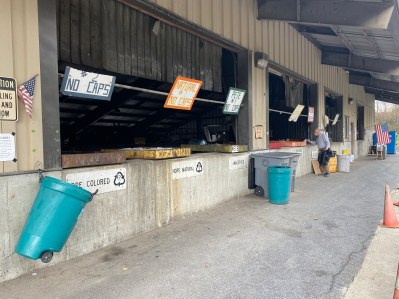
Because I’d always lived in cities with garbage trucks that magically whisked everything away, I’d never before encountered an actual transfer station before. (This is the real name for the dump, which no one uses.) I was a little shocked: residents drive right alongside a series of enormous concrete bays into which we pour our different sorted categories of recycling. If you peer over the edge you can see the cascading piles of stuff on the lower level, a cavernous open space where the trucks of contractors drive in and out, dropping off construction debris. On most days the place is filled with the sounds of crashing metal and breaking glass.

But my trips to the dump were numbered: our two guys and a truck were bought out by bigger company, and then they too were bought out, and so on, until eventually it seemed like We Had Arrived. Now we had an actual mechanized garbage truck and two shiny plastic bins: one for trash and one for a magical new service called single stream recycling.

At last! It felt like finally, modern life has got this recycling thing figured out. All reusable materials go in one bin! How civilized.

In fact, the convenience and ease of “single stream “seemed to make so much sense that, over the years, I ignored all the big, unanswerable questions that kept cropping up, like:

  • If recycling works so well, why is there something called the Great Pacific Garbage Patch?
  • If China isn’t taking our recycling anymore, where is it all going?
  • How is it that my service accepts plastic numbers one through seven, when seven is “other”? How do you recycle “other”?

It would take an amazing amount of time for me to discover that much of single stream system is based on a lie, but that was because I SO didn’t want to hear it. I was addicted to a mirage.

Recently, in search of answers that are real, I’ve been back to the dump. Not much has changed there, except it is now privately owned. They still recycle, and still only accept that for which there is an actual market. No more mirage. No more dumping our problems on other, disadvantaged countries. This is real.

So here’s my Crazy New Plan: to stop my garbage service. As of right now we have only been using it for recycling anyway, and at my New Favorite Place recycling is free. I will save $57 per month, which comes to $684 per year.

I can then devote that money to recycling the remaining items my transfer station won’t take— in particular plastics #3-7— through Terracycle. So far this year I’m on my second “Plastic Packaging” box; at $134 per box that comes to $268 for ten months worth of recycling. Sure, I’ll be putting more things in them than before, but even if I’m using Terracycle twice as much, I’d still come out ahead by about $150.

There will be some kinks to work out— what about cartons? what about convincing my husband?— but you know, I’m excited. It’s one small step for me, one giant leap closer to Zero Waste. Sure, it’s one that comes with inconvenience, smelliness, and loud noises, but I’ve decided that’s part of the charm. It’s part of understanding that things that are worthwhile are worth being inconvenienced for.

At some point we are all going to have to choose: do we want a mirage, a delusion? Or are we willing to get our hands a little dirty at The Dump?

My Mind Is Easily Blown: The Scoop on Cat Litter, Toothpaste and Reusable Bags

As a confirmed cat person, I’ve never gone terribly long without owning a cat. Or two. Three at most- I swear.

We said goodbye to our last cat one year ago, so recently we felt like we were ready for a new furry addition again. We headed to the local humane society to find a new kitty to adopt.

We came home with two.

Gratuitous picture of our new kitties.

Cat Litter

Immediately I was faced with a dilemma I had been studiously avoiding thinking about up until that very moment: what will we use in the litter box?

In the past I was, admittedly, the worst kind of cat-owner in the environmental department; when it came to cat poop and pee, I just did NOT want to deal. In the interest of minimum effort and maximum cleanliness, I bought the most high-tech (read: expensive) litter I could find: silica gel based litter. Every week, when it was time to change the litter, I wrapped it all up neatly in the plastic disposable litter pan liner before sending it on its way to live in the landfill for the next several thousand years.

I shudder to think of it now.

Several years ago my brother had suggested trying a newspaper-based litter that sounded very environmentally friendly, but it also sounded messy, smelly, dusty, and difficult to find. At that time in my life, in addition to two small cats I also had two small children, so generally speaking if it wasn’t at my supermarket, I wasn’t buying it. Period.

Fortunately times have changed and environmentally friendly litter is now less messy, more effective and more available. While at the humane society I noticed that their litter boxes contained an unfamiliar pellet mixture.

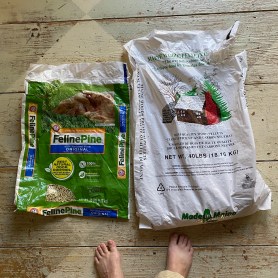
Wood pellets marketed for kitty litter on the left, and for pellet stoves on the right- it’s the same stuff.

“That? Oh, those are wood pellets,” the shelter worker said. “They work great and they’re biodegradable. You can buy them as cat litter but it’s cheaper to just use pellet stove pellets.”

Cat litter I can put in my compost?

“You can also use chicken feed.”

Mind blown.

Toothpaste

In other good news, I recently noticed that Tom’s Toothpaste has made a small but significant change to their packaging: no longer does the tube have a Terracycle logo on it. Instead, new tubes have a blue recycling triangle with caption below reading: “Once empty, replace cap and recycle with #2 plastics.”

If I was a cartoon I would’ve rubbed both eyes with my knuckles before taking a closer, saucer-eyed look. Easily recyclable toothpaste tubes? Was I dreaming?

Tom’s tubes before and after.

But no, once I looked it up on Tom’s website I found a whole page devoted to explaining that they’ve changed their packaging and that they haven’t totally broken up with Terracycle, but you know, they just want to see other people.

To recycling nerds like me, this is pretty big news, because dental care is one of the very hardest categories to recycle. Of the two things I’ve ordered from Terracycle— which due to its cost I consider to be the recycling of last resort— one is their “Oral Care Waste” envelope just for toothbrushes, floss and toothpaste tubes. Because: what else can you do with these things? This is also why Zero Waste proponents give out recipes for making your own toothpaste out of things like baking soda and bentonite clay.

But I like Tom’s Toothpaste, and don’t know where to buy bentonite clay, so I’m delighted to learn I don’t have to do any more ninja-level recycling when it comes to toothpaste tubes.

The thing that truly stopped me in my tracks, however, is the fact that Tom’s paid to develop this technology, but is sharing it with other toothpaste manufacturers. According to their website, this is because recycling facilities can’t tell the difference between a recyclable toothpaste tube and a non-recyclable one, so the sooner everyone is using this technology the better.

How utterly… sensible.

Mind blown.

Reusables

The last thing I wanted to mention is the persistent myth that reusable bags are a potential source of contagion for the coronavirus. Although this idea has been thoroughly discredited, most recently in a report issued in June, signed by over 125 health experts including virologists and epidemiologists, it is still hanging on stubbornly in some places. Although my supermarket has gone back to allowing reusable bags, I’ve heard from many folks whose stores are still banning them.

The truth is that reusable bags are not dangerous, the plastics industry would just really, really like you to think that they are. In fact, they’ve been trying to make us think this long before the appearance of COVID 19. A 2010 study funded by the American Chemistry Council, (which in turn is funded by plastics producers) looked for Salmonella, Listeria and E.Coli on reusable bags and ooo— you know what?

They didn’t find any.

But they could have! Seriously, after the study was released, that was the headline.

Here’s what Michael Hansen, senior staff scientist at Consumers Union, had to say about it back then: “A person eating an average bag of salad greens gets more exposure to these bacteria than if they had licked the insides of the dirtiest bag from this study.”

more gratuitous cat pictures

Not that I’m planning on licking any supermarket bags any time soon, but what I think is important to notice is the recurring pattern of using fear to get folks to consume more plastic:

  • reusable bags could make you sick- better use plastic!
  • Tap water could be unclean- better buy bottled!
  • Someone might have touched that sandwich bread- better put a sealed plastic bag inside the other plastic bag!

Yes, keeping everyone safe and healthy is, and should be, a paramount concern. But we don’t need to fabricate problems where they do not exist just to keep the plastic people in business. Doing so puts the health and safety of the planet at risk, which—spoiler alert! — comes back to jeopardize us as individuals in the end.

But people are starting to catch on. You can’t fool the public forever. The fact that they thought they could? Well…

It’s kind of mind blowing.