Tag Archives: Year Of No Garbage

How Hard IS a Day of No Plastic?

It seemed like everyone I’ve ever met sent me the A.J. Jacob’s article “Trying to Live a Day Without Plastic” when it came out in the New York Times a little over a week ago. I love that people thought of me when they saw an article that might as well have been entitled “Stunt Author’s Wacky Plastic Experiment!”

What also struck me as funny is the fact that I had done a similar experiment during our family’s Year of No Garbage. It turns out I am neither the first nor the last to do so, because I am told Susan Freinkel also did a ‘day of no plastic’ for her 2011 book Plastic: A Toxic Love Story (now next on my reading list!)

My Day of No Plastic: no piece of cake

The point of all these plastic-less days is not the idea that we should somehow, literally figure out how to live without plastic in our contemporary society, but rather to illustrate how very saturated we are with this material in every aspect of our lives. Anyone who tries this experiment is guaranteed to be genuinely astounded at how ubiquitous plastic really is and how quickly avoiding plastic immobilizes even the most basic aspects of daily life. Brushing your teeth, driving your car, getting dressed, eating food- in this day and age there is virtually nothing you can do that is not touched by the toxic and wasteful material plastic.
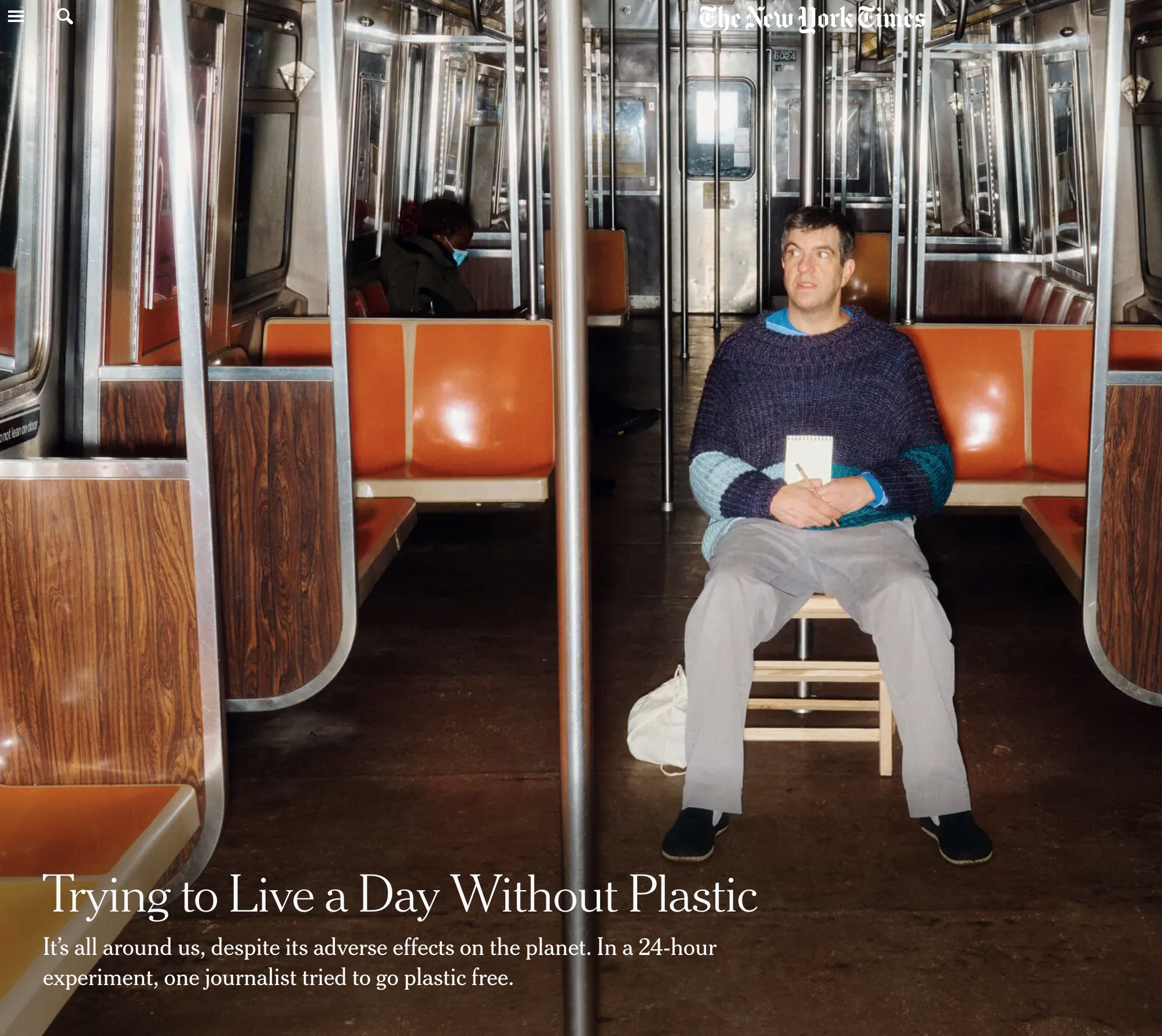
He’s got that “Oh shit, I’m surrounded” look, doesn’t he?

It reminds me of the old myth about the frog who stays in a pot of water because the temperature rises so gradually that before he knows it, he’s boiling to death. When you try to do a day of no plastic you quickly realize that we’re the frogs and what we’re being boiled to death in? Is plastic.

It begs the question: is this what we want? Did we ask for this plastic apocalypse, on some level, and if we did can we take it back? Is it possible to undo what has been done? How do we turn the stove off so we can be happy frogs again?

It seems to me that articles like Jacob’s are one of the places where we start. We start by beginning the conversation. Information leads to action. Of course, I’d love to think my upcoming book is part of that conversation as well. Speaking of which, if you haven’t already, please pre-order a copy of Year of No Garbage, because – well-— because this conversation is important, and the more information and momentum we have on this issue, the better. If you’d rather check it out of your local library, awesome. Maybe ask the librarian if they are planning to order a copy.

And speaking of which, if I haven’t mentioned it lately, thank you for being one of my readers. Without you guys I couldn’t be the Wacky Stunt Author that I am today, trying to save the world by torturing my family. Stay tuned! There is lots more to come.

And from one froggie to another—don’t let the stove water get you down. We got this.
So Why Purge Plastic?

We all know that there can be “bad” things in plastic. Most of us have heard that BPA is “bad.” But it is still legal to use BPA in plastic (except baby bottle and sippy cups) so how bad could it really be? And probably, most other additives are safe, right?

But what if I told you that it is so, so much worse than just one chemical? What if I told you that there are tens of thousands of proprietary, man-made chemicals out there being used in our plastics, and that virtually none of them have been tested for effects on human health?

World’s Nerdiest Superhero??

BPA is one of the ones that did get tested, and the results were not reassuring. Because of that testing, we know that BPA (aka bisphenol-A) is an endocrine-disruptor. The reason this is bad news is because endocrine disruptors interfere with the body’s hormones and can cause a whole host of adverse health effects, from an increased risk of cancer, to cardiovascular problems, infertility, and developmental issues.

What happened next was predictable. When it was established that BPA was an endocrine disruptor, many companies replaced BPA with another chemical: BPS (bisphenol-S). As it turns out, however, when it comes to adverse health effects, BPS is just as bad as BPA, or worse. This has been called the “whack-a-mole” approach to hazardous chemicals in plastics. What- people are upset that this chemical is dangerous? Let’s tweak the chemistry and they’ll stop worrying!

The problem comes back to the fundamental nature of plastic itself. Plastic is made from two things: fossil fuels and toxic chemicals. Those chemicals can be heavy metals (lead, antimony, mercury- which we all know is very toxic stuff) and/or persistent organic pollutants (POPs), aka manmade “forever chemicals” which persist without breaking down, whether in the environment or in the human body. In people and animals POPs don’t get excreted, but instead “bioaccumulate.” Examples of persistent organic pollutants include the notorious PFAS, which are linked to cancer, immune disorders and developmental problems.

But just because those chemicals are in the plastic, doesn’t mean they are coming out of the plastic, does it? Don’t they stay put where they’re supposed to?

They don’t and we already know this: most of us have heard that it’s not a good idea to heat plastic in the microwave. The reason is because heat causes the plastic to leak or  “shed” all those lovely endocrine disruptors, heavy metals and carcinogens right into your food.

But, you might ask, as long as we don’t heat plastics, we should be fine right? Without heat the chemicals will stay put?

Let me tell you about the Danish water bottle study. The scientists took a new plastic water bottle, filled it up and let it sit at room temperature for 24 hours. Then they tested it and identified 400 different man-made chemicals present in the water that had not been there before.

This is at room temperature.

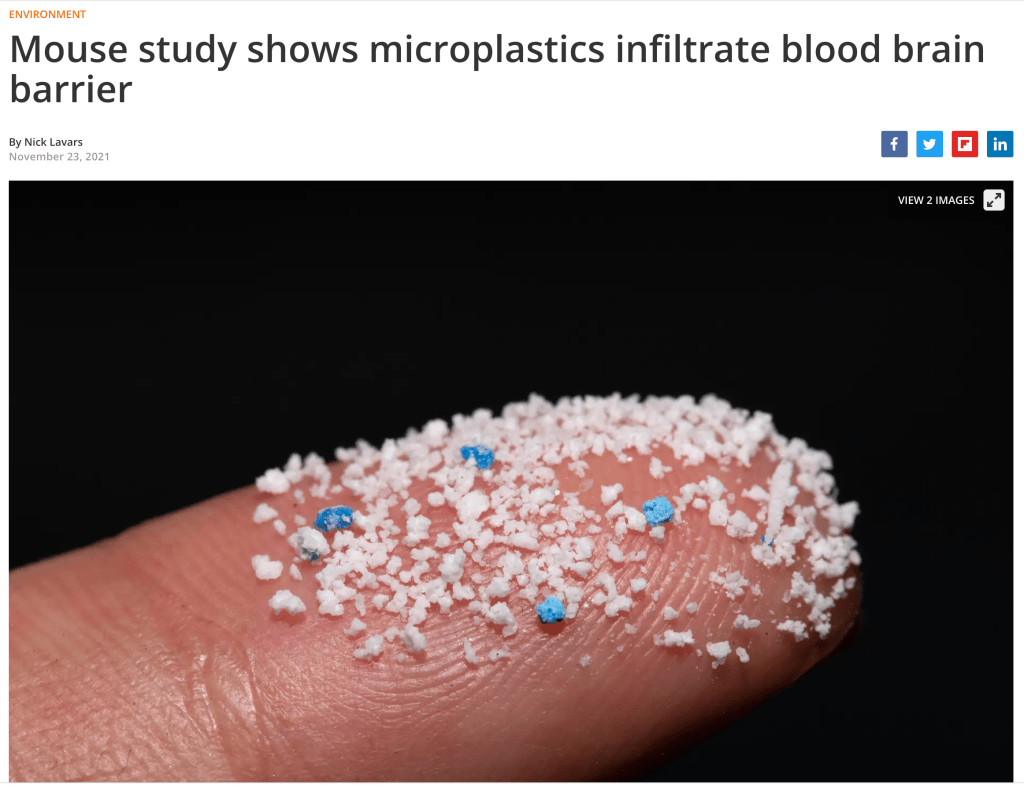
And yes, it gets still worse, because we haven’t even begun to talk about microplastics. Microplastics are the teeny-tiny bits of plastic that break off invisibly over time when you use your plastic cutting board or plastic spatula or plastic Tupperware. These microscopic bits of plastic end up in your food and in your body and are the reason we are all consuming the equivalent of a credit card’s worth of plastic per week. It’s the reason microplastics have been found by researchers to be present in our blood, lungs, poop, liver, breast milk and the placenta of unborn babies.

Inside our bodies the microplastics can cause something called “particle injury” which means they interfere with the functioning of our cells and cause inflammation. In mice, scientists have shown that microplastics pass through the blood-brain barrier, and this is very bad news. Once in the mouse’s brain, the tiny pieces of plastic start damaging and killing the cells that regulate the central nervous system.

Our central nervous system controls how we think, learn, move and feel. It is really, really freaking important. Personally, I’m crossing my fingers that mice and humans don’t have this particular propensity in common. Time will tell.

In the meantime, though, it seems to me that I should try to keep plastic as far away from my food as possible. Yes, I will still have to buy food packaged in some plastic and yes, when I go out to eat, I have no control over what plastic the restaurant is using. But given everything we know plastic should be considered, without hyperbole, to be a hazardous substance. We should be choosing to keep it away from our food whenever possible. And I’m going to try to get it the heck out of my kitchen.

I’m in Newsweek! Check it out!

I’m super excited to have received the opportunity to talk about Year of No Garbage in Newsweek. Please check it out and let me know your thoughts.

Two notes: Bear in mind that I did not choose the stock image of oil being poured back into a plastic bottle- because of microplastics I would never recommend doing this. (Use glass containers- with fully cooled oil- instead.) And, sadly, the last line of the article didn’t make the final cut- in which I asked folks to contact their political representatives and ask them to support measures that reduce plastic waste… perhaps the most important take-away from our Year of No Garbage.

Nevertheless- I’m delighted to have this message out there on such a terrific forum!