You might think, after writing for, say, eight plus months on a topic like “garbage,” you might run out of things to talk about.
Well, no. In fact, there’s so much to write about, sometimes I feel kind of breathless. I have little piles all over my office of bizarre objects waiting for me to investigate them- a detergent sample, a plastic coated paper raisin container, a broken wire coat hanger.
My Research Pile. Okay, ONE of my research piles.
I try to keep a list of questions and ideas on my desk, which generally takes the form of forty million little bits of paper and post-its and envelope backs. Among the many notes to myself:
What is the difference between biodegradable and compostable?
Investigate what to do with: Broken glass? Burned out light bulbs? Plastic produce netting? Hard plastic with no numbers?
Don’t forget to tell the Red Solo cup story!!
Why aren’t plastics infinitely recyclable?
What about “food recycling” (food cupboards)?
Look into history of grocery stores??
Today I’m thinking a lot about packaging. Of course, even for folks who order in the mail a lot, the pandemic has upped the game tremendously. Stay home! Just order everything!
Ordering more through the mail means more packing material, and soooooooo much of packing material is problematic, either because we think it is unrecyclable, is inconvenient to recycle, or it is actually unrecyclable.
But today what’s striking me is not so much the question of whether the shipping materials are recyclable, as how wasteful companies tend to be when shipping items to customers. I’ll give you an example.
These days I try to buy all my clothes at consignment shops, however I do draw the line at underthings. So I ordered a bra and some underwear from Natori, hoping that the priciness would indicate these items would not only be of high quality, but would last a good, long time.
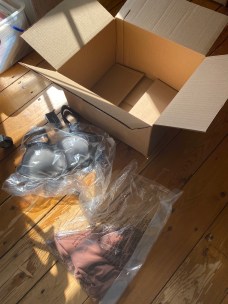
You can imagine my surprise when a box the size of a small microwave oven arrived at my doorstep. Did my underwear really require a box big enough to house an entire family of napping cats?
Two items. One ridiculously huge box.
But it got worse. Because when I opened the box I found a veritable class on packaging science. Each item came in its own separate plastic bag, inside of which was the item on a clear plastic hanger and featuring a hang tag with two layers of paper and a layer of plastic, attached with… more plastic.
Of course it’s clear that this is part of an overarching system that probably includes shipping to actual stores, where they appreciate things like hangers and price tags, not to mention plastic bags to keep product clean and sanitary. What I’m saying is, this particular plastic, in this box, at my house, had served no effective purpose whatsoever. Most people in our culture would probably have tossed all of it into the nearest trash without much thought, because that’s what we’re conditioned to do. And that plastic, then, would be delivered to a landfill where it would give off harmful chemicals that would then try to make their way to the local community’s groundwater.
And it would do another thing too.
That stupid plastic bag and plastic hanger and plastic hangtag would outlive all of us.
A paper AND plastic hangtag
So I’m trying to see that THIS plastic is meets a better fate, but it isn’t easy. Here’s my plan:
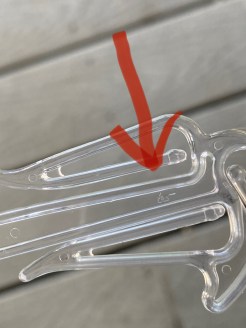
The Swift Tack (which is the name for the plastic that attaches a hang tag to a garment) will go into my jar labeled “Plastic Doohickeys.” I have yet to figure out what to do with all that stuff. Maybe a macaroni-based art project.
Can I please borrow an electron-microscope to find this recycling symbol?
On Natori’s website, under a section called “Natori Gives” you’ll find a listing a of many charitable organizations that Natori supports that “empower women, and fight racism and structural inequality around the world.” But all of those issues aren’t islands; they interrelate one with the other… just as environmentalism interrelates with issues of social justice when landfills and incinerators are placed in low-income communities and those of people of color. And women’s issues, racism and inequality have everything to do with this scenario: they are all connected.
I’m not blaming Natori as much as using them as an example of an overall system that needs rethinking. Surely there is a way around plastic hangers and plastic bags. Surely, there is a way to make sure customers receive clean, hygienic products without so much waste. We just need to make connections between these different issues we say we care about and then actually make real change to address them.
Several weeks ago my beloved but well-worn Subaru had a nervous breakdown. Ever since I’ve been faced with choosing one of three options:
For a princely sum, fix my car
For a differently structured princely sum, trade my car in for an electric car
OR
Become a one-car household
I am only half kidding about this.
Ever since this realization sank in I’ve been stuck, both literally and figuratively. I work at home and there’s a pandemic going on, so there hasn’t been a lot of pressure to resolve the dilemma: there’s just nowhere all that pressing for me to go. So my Subaru has sat in the garage, patiently waiting.
Like all of us, I was raised with a whole bunch of cultural expectations about cars, and for me one of them was that every able-bodied driver in the household has their own car.
A car is never just a car. It’s feminism. Or independence. Or adulthood. A flashy car is youth, or youth regained. An expensive car is an assertion of class or success.
Only a few short decades ago one-car households were the norm. A spouse could drop off the commuter at the train station or the bus stop in order to “have the car for the day.” Today a combination of factors- higher costs of living requiring two incomes and poor public transportation systems among them- have lead to new norms.
Recently I spoke with my friend Rhonda on this topic, because for the last 16 years her family has had one car. In fact, she and her husband are the only adults I know in this community who don’t have “her own” and “his own” car. They have one car, and they share it. She says this revelation is sometime is met with puzzlement.
She likens the cultural expectation of multiple car households to that of neatly maintained grass lawns.
“There’s no reason to have all that grass,” she says. “But it’s just what people are used to.” Of course, she points out, the fact that she works at home makes having one car possible. Were she and her husband to both work outside the home, two cars would probably have been essential.
“We always said that if at any time it got uncomfortable we could decide to revisit the question,” Rhonda says. The decision for them was primarily environmental. “I just feel like our footprint on the planet as Americans is disproportionate already.”
And for me, that’s just it. Technically, my car doesn’t figure in to the Year of No Garbage project, because my car doesn’t generate the kind of garbage you can see. On the other hand, I think it would be near impossible to go for months on end thinking about the impact of humans on the environment and never stop to reconsider one’s mode of transport. According to the EPA, transportation was the number one U.S. contributor to greenhouse gas emissions in 2018. That fact alone should give everyone who owns a fossil-fuel burning car pause.
I’ve enjoyed the last few carless weeks, actually. Being a hermit has its charms, especially for a writer. Back when we each had our own functioning cars, my husband and I were never compelled to strategize who was going where, when. We just went. I think sometimes modern life encourages us to move so quickly that it can be destructive, not just of our environment, but of intangibles such as contentment, and creativity; do I really need to run out to buy just one thing at the store? Or could I better spend that half hour doing something else? In the last few weeks I’ve really liked being more conscious about our travel than that. I feel… more responsible.
But today I am taking my car in to the shop at last- having decided on option number one after all: fix it. I’m a little sad about losing that sense of interdependence- which we should have all the time but don’t, yet I’m also happy to regain some of my independence as well.
Soon my fifteen year old will be driving and the equation will shift yet again. Maybe by then I’ll have traded my Outback for an electric car. Or a horse-drawn carriage.
Ever wonder where the wax goes when a candle burns? Or what the carbon footprint of a campfire is? How does that compare to the heating of your house? Are candles harmful? What about burning butter wrappers? Come to think of it, is burning anything okay?
These are the rabbit holes I go down. Alice would be jealous.
The Dartmouth Annual Bonfire
I’ve been thinking a lot about fire lately because we have an outdoor fireplace, and on summer evenings my husband Steve may often be found rooting around for a quick fire starter. Whenever I don’t have enough reusable bags at the grocery store, I request a paper bag, knowing that Steve will use it to start our next family campfire. Then, not too long ago, I got an idea: why not put other things in this “burn bag”? Things that are too small or too messy to otherwise recycle? After all, I ‘ve read that cardboard tubes from toilet paper are small enough to fall through the cracks at the recycling plant. Plus we’ve all heard the stories about how dirty recyclables can contaminate an entire load… food paper products are among the hardest recyclables to get clean.
Thus, the paper price tag from a new shirt, or scraps of wool from Greta’s needlepoint, and the messy pizza boxes everyone tells you not to recycle all seemed like good fodder for fire starting, and solved a problem for me in the No Garbage department.
Next, I wondered, could I add wax paper- such as butter wrappers? In the composting community there is much debate about the compostability of wax paper, and till this point I’d been cutting my wax wrappers into strips before adding them to our compost pile to aid in their decomposition- not a task that I enjoy tremendously, mind you. I was reminded that wax paper is usually made with paraffin wax, which is petroleum based. Uh-oh. Plastic is petroleum based. Did that mean burning wax paper would be as bad as… burning a piece of plastic? As I’d already learned when researching garbage incineration, burning plastic releases all kinds of bad stuff: hydrochloric acid, sulfur dioxide, dioxins, furans and heavy metals which can cause cancer, respiratory problems and possibly some forms of reality television.
So I looked up “burning paraffin” and it turns out that not only are butter wrappers made of paraffin wax, but most candles are too. In fact, there is a whole slew of blog posts out there devoted to warning you about the air-quality dangers of burning candles in your house. I had no idea.
But— and I felt stupid wondering this— the wax of the candle doesn’t actually burn, does it? It’s just the wick… right? Then again, what about “drip-less” candles? Where did I think the wax went?
Well you know, I never really thought about it.
Thanks to the National Candle Association website I now have a slightly better understanding of the physics and chemistry of a candle, and I understand that yes, candle wax does burn, along with the wick, just in a less obvious way. According to the NCA, the heat of the candlewick burning causes nearby wax to melt and become liquid. The liquid wax then is heated further and consequently turns into a gas, which breaks down into its constituent parts of hydrogen and carbon. When these hydrogen and carbon molecules react with oxygen: voila! You get heat, light, water vapor (H2O) and carbon dioxide (CO2).
Water vapor and carbon dioxide? No heavy metals or furans? So far that sounds pretty… much… okay?
But whether or not paraffin candles are okay depends a whole lot on who you are talking to. A much-cited and disputed study in 2009 at South Carolina State University showed that, over the course of burning for six hours, burning paraffin wax released cancer-causing chemicals. On the other hand, a European study published in 2018 found that if candles are burned for one hour there were no significant traces of cancer-causing chemicals. So there’s debate.
Everyone, however, seems to agree on two things: first, that avoiding paraffin wax helps. Beeswax or soy candles generally do not emit “unwanted chemicals” into the air, so they are a less toxic way to go. Second, that burning anything indoors will negatively affect air quality to some degree, creating particulate matter (PM) and volatile organic compounds (VOCs). But then again, so does lighting a match or cooking dinner.
The answer to my original question seemed to be no: even though plastic and paraffin wax are both petroleum products, burning paraffin wax paper didn’t seem any worse than burning a regular piece of paper.
But Wait
So I can burn my butter wrappers in peace. Phew, right? Except I’m afraid this brought me to the doorstep of an even larger and more uncomfortable question, one that I’ve been studiously trying to avoid till now, and here it is:
“to burn or not to burn?”
If I wanted to be chicken about it, I could say this question is beyond my purview. After all, our project this year is very intentionally specific and literal: not to throw anything away. As long as we don’t produce anything evil or harmful we can skirt the question and say, carbon footprint or no, we’ve abided by the rules. Just a little burn pile here! Don’t mind us!
But I don’t want to be chicken, so I’m gonna ask: If burning anything at all releases carbon dioxide, and too much carbon dioxide in the atmosphere is a major cause of global warming, is burning anything okay? Anything at all, ever? I mean, whether it’s coal or propane or wood or paper or butter wrappers, you’re still releasing carbon dioxide into the air, right?
So let’s look at it.
Is ANY Kind Of Burning Okay?
We burn things for lots of reasons: to get rid of things, to cook food, to celebrate, to stay warm. I suppose one might reason that burning fuel to heat our homes is something we need, making it ethically acceptable, whereas having a campfire or bonfire is “just for fun,” and therefore something we don’t need and thereby not as acceptable.
This thought led me to another question: in terms of carbon footprint, how does heating my house actually compare to our nighttime campfire? Looking it up I find that the average Vermont home uses 700 gallons of heating oil annually, producing 16,800 pounds of carbon dioxide, per house. It’s hard to find statistics about how much carbon dioxide is produced by the average campfire, but the highly questionable source of a Reddit thread suggested that a campfire consisting of 22 pounds of wood might release about 21 pounds of carbon dioxide. Assuming this is true, and saying at our house we have perhaps two campfires per week all summer long- equaling 32 campfires; this would mean releasing maybe 672 pounds of CO2 annually… 4% of the amount used to heat the average Vermont home for a year.
Admittedly, these numbers are wildly sketchy, but I’m trying to get a relative handle on something here and even very inexact numbers like these can help. Because what this information tells me is that I’m focusing on the wrong things. If our annual campfire carbon dioxide output is such a tiny fraction of that of our heating oil, I shouldn’t be worrying about the campfires; I should be worrying about the heating oil. It’s like being scared of a mouse and failing to notice there’s also a rabid, drooling hyena in the room. With a machete.
I think it’s human nature to want to focus on the things we feel we have greater control over and can change more easily— I will change the planet by buying a different dish sponge! — but the danger is that when we focus on the manageable we may do so at the expense of the big picture. Maybe it makes more sense to keep the frivolous, the things we don’t “need” and rethink the essentials, instead. So I’m keeping campfires.
But I’m going to research a better way to heat my house.
Postscript
Life involves carbon dioxide. We breathe it out all day long, every day, all our lives. I suppose if we really want to reduce our carbon dioxide emissions we could all just jump off the nearest bridge, but I have no intention of doing that. Instead, I’d rather manage my life and activities thoughtfully. What do I want to spend my carbon dioxide on? In the grand scheme of things, what’s worthwhile, and what isn’t?
In 1991 the environmental thinker, Dartmouth professor Donella Meadows responded to criticism about the college’s annual homecoming bonfire, which was being decried by some students as polluting and wasteful. She said:
Nature can handle bonfires. Nature makes bonfires all the time…The environmental lesson in a bonfire is not that it’s wasteful or polluting, but that, if human beings don’t curb their wastefulness and their penchant for constant expansion, there will come a time when the planet will provide neither the sources nor the sinks for bonfires.
She pointed out an example of a place where this is already happening: Los Angeles, which due to air pollution even back in 1991 had “190 days each year when it’s not safe to breathe.”
A lot has changed in the three decades of climate struggle since Meadows wrote this, but I think her words still make sense. When I looked it up, I was happy to see that the bonfire tradition at Dartmouth survives to this day. Humans have long gathered around the fireside and I’m not quite ready to give that up just yet. There will certainly be those who disagree with me on this, who feel no concession is not worth it to make their carbon footprint ever smaller, who feel that once you justify campfires in the name of fun you can justify almost anything else too, and they will have a point. But the fact is that as humans we can never eliminate our impact entirely. There is always going to be a line drawn, and the question is where that line goes.
Being a good citizen of the world right now means we have to change the way we think about things, the way we do things, but – as I learned during our Year of No Sugar- nothing is sustainable if it feels like a series of endless deprivations. Just as much as we still need to breathe, we still need joy.
And marshmallows. If all else fails we can feed them to the rabid hyena.




 Eve O. Schaub