Tag Archives: microplastics

It’s a Plastic-Sucks Summer For Sure

It feels like everyone wants to rename summer these days: if it isn’t Hot Girl Summer its must be Rat Boy Summer or Brat Summer…

Can I formally suggest we make it the Plastic Sucks Summer?

Because it really does seem like that is already happening. Hardly a day goes by without another article or study or film coming out to explain to everyone just how very bad plastic is for humans AND the environment. Here are just a few examples:

FIRST, have you been hearing the euphemisms “Waste to Energy” or “Gasification” or “Advanced Recycling” lately? These terms all mean burning plastic. Everyone needs to know that burning plastic is bad for everyone, it is not recycling, and it should definitely not be subsidized by the government. Watch this compelling 15 minute film (below) by The Story of Stuff Project, about Latino activists battling to shut down a garbage incinerator in California.

Watch it free on YouTube

IN OTHER NEWS, The Washington Post did a very thorough article on microplastics and why we need to consider them a health threat in this article, which has excellent explanatory graphics. If you missed it definitely, definitely check it out.

The Washington Post article with lots of nifty graphics

THERE’S A LOT plastic news these days but I’d like to be sure to celebrate the fact that more and more hotels are switching from tiny disposable shampoo and conditioner bottles to refillable large bottles- have you seen them?

Even better, soon New York hotels soon will no longer be able to distribute tiny plastic shampoo bottles.

IN CASE you were wondering if Plastic Sucks Summer is limited to the United States- not so! I was recently interviewed for Russian television on the subject of microplastics. Although I definitely don’t speak Russian, I could get the gist enough to be impressed with the thoroughness of the piece. Here is the link the the program. (The segment about plastic begins at 56:20 and I show up at 1:02:31)

Yes, this is the best screen shot I could get

HERE’S ANOTHER great article which details the lawsuit going on against water bottlers who claim their product is “natural” even though 93 % of bottled water has been found to contain microplastics. Since tap water reliably contains far fewer microplastics, it’s even been suggested that bottled water come with a microplastic warning.

A SIMILAR question I’ve been wondering about lately is: can compost truly be considered “organic” if it contains bioplastics, or so-called “compostable plastics”? Unfortunately, in a compost these items behave very much like regular plastics, and contain many of the same toxic chemicals. This article details the discussion.

AND FINALLY I’d like to plug my next UPCOMING TALK! On August 8th at 6PM I’ll be featured at MassMOCA in North Adams MA in conversation with Research and Development Store Manager Chris Conti on the topic of my Year of No Garbage. Come by and be part of this lively conversation and celebration afterwards— I promise to draw tiny weird pictures of trash cans on everyone’s books.

Happy Plastic Sucks Summer!

So Why Purge Plastic?

We all know that there can be “bad” things in plastic. Most of us have heard that BPA is “bad.” But it is still legal to use BPA in plastic (except baby bottle and sippy cups) so how bad could it really be? And probably, most other additives are safe, right?

But what if I told you that it is so, so much worse than just one chemical? What if I told you that there are tens of thousands of proprietary, man-made chemicals out there being used in our plastics, and that virtually none of them have been tested for effects on human health?

World’s Nerdiest Superhero??

BPA is one of the ones that did get tested, and the results were not reassuring. Because of that testing, we know that BPA (aka bisphenol-A) is an endocrine-disruptor. The reason this is bad news is because endocrine disruptors interfere with the body’s hormones and can cause a whole host of adverse health effects, from an increased risk of cancer, to cardiovascular problems, infertility, and developmental issues.

What happened next was predictable. When it was established that BPA was an endocrine disruptor, many companies replaced BPA with another chemical: BPS (bisphenol-S). As it turns out, however, when it comes to adverse health effects, BPS is just as bad as BPA, or worse. This has been called the “whack-a-mole” approach to hazardous chemicals in plastics. What- people are upset that this chemical is dangerous? Let’s tweak the chemistry and they’ll stop worrying!

The problem comes back to the fundamental nature of plastic itself. Plastic is made from two things: fossil fuels and toxic chemicals. Those chemicals can be heavy metals (lead, antimony, mercury- which we all know is very toxic stuff) and/or persistent organic pollutants (POPs), aka manmade “forever chemicals” which persist without breaking down, whether in the environment or in the human body. In people and animals POPs don’t get excreted, but instead “bioaccumulate.” Examples of persistent organic pollutants include the notorious PFAS, which are linked to cancer, immune disorders and developmental problems.

But just because those chemicals are in the plastic, doesn’t mean they are coming out of the plastic, does it? Don’t they stay put where they’re supposed to?

They don’t and we already know this: most of us have heard that it’s not a good idea to heat plastic in the microwave. The reason is because heat causes the plastic to leak or  “shed” all those lovely endocrine disruptors, heavy metals and carcinogens right into your food.

But, you might ask, as long as we don’t heat plastics, we should be fine right? Without heat the chemicals will stay put?

Let me tell you about the Danish water bottle study. The scientists took a new plastic water bottle, filled it up and let it sit at room temperature for 24 hours. Then they tested it and identified 400 different man-made chemicals present in the water that had not been there before.

This is at room temperature.

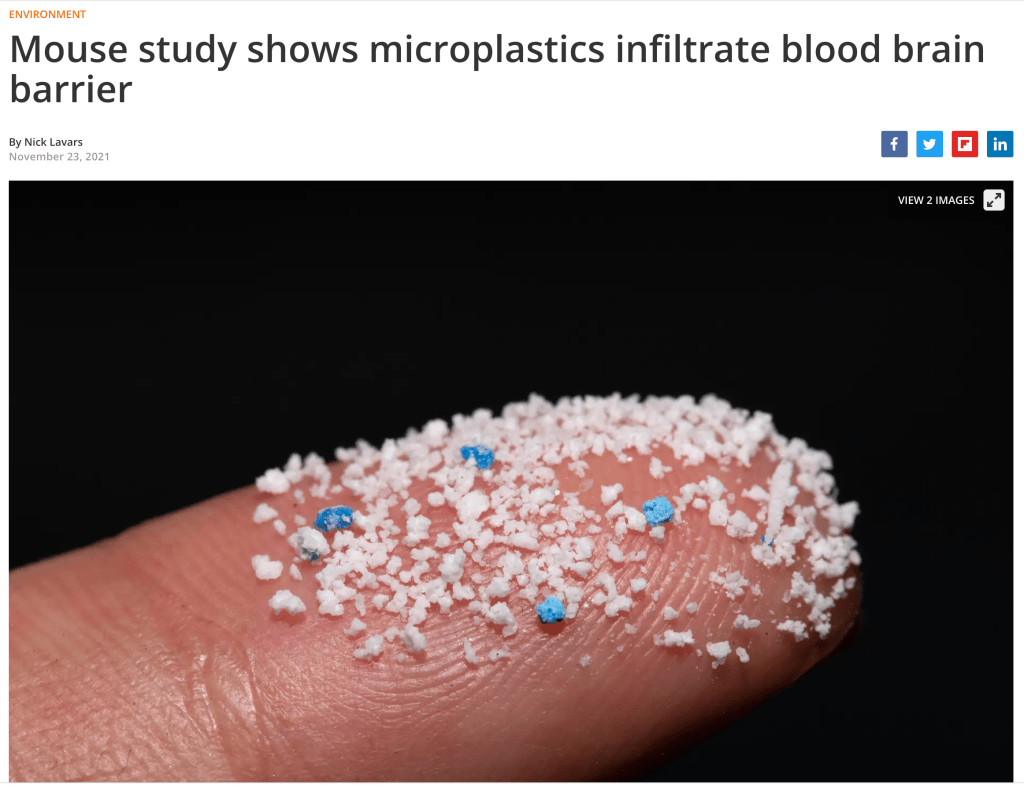
And yes, it gets still worse, because we haven’t even begun to talk about microplastics. Microplastics are the teeny-tiny bits of plastic that break off invisibly over time when you use your plastic cutting board or plastic spatula or plastic Tupperware. These microscopic bits of plastic end up in your food and in your body and are the reason we are all consuming the equivalent of a credit card’s worth of plastic per week. It’s the reason microplastics have been found by researchers to be present in our blood, lungs, poop, liver, breast milk and the placenta of unborn babies.

Inside our bodies the microplastics can cause something called “particle injury” which means they interfere with the functioning of our cells and cause inflammation. In mice, scientists have shown that microplastics pass through the blood-brain barrier, and this is very bad news. Once in the mouse’s brain, the tiny pieces of plastic start damaging and killing the cells that regulate the central nervous system.

Our central nervous system controls how we think, learn, move and feel. It is really, really freaking important. Personally, I’m crossing my fingers that mice and humans don’t have this particular propensity in common. Time will tell.

In the meantime, though, it seems to me that I should try to keep plastic as far away from my food as possible. Yes, I will still have to buy food packaged in some plastic and yes, when I go out to eat, I have no control over what plastic the restaurant is using. But given everything we know plastic should be considered, without hyperbole, to be a hazardous substance. We should be choosing to keep it away from our food whenever possible. And I’m going to try to get it the heck out of my kitchen.

I’m in Newsweek! Check it out!

I’m super excited to have received the opportunity to talk about Year of No Garbage in Newsweek. Please check it out and let me know your thoughts.

Two notes: Bear in mind that I did not choose the stock image of oil being poured back into a plastic bottle- because of microplastics I would never recommend doing this. (Use glass containers- with fully cooled oil- instead.) And, sadly, the last line of the article didn’t make the final cut- in which I asked folks to contact their political representatives and ask them to support measures that reduce plastic waste… perhaps the most important take-away from our Year of No Garbage.

Nevertheless- I’m delighted to have this message out there on such a terrific forum!