During our Year of No Garbage I’ve come to realize that plastic is Public Enemy Number One: it doesn’t degrade, it often can’t— or won’t— be recycled, and it is doing all kinds of bad things in our bodies and in our environment. We have invented a monster, and the monster is everywhere.
So it occurred to me to wonder: How long could a person today avoid plastic? For example, how hard would it be to avoid plastic for… a single day?
I decided to try it. After assuring my family I would attempt this particular challenge solo, I laid out a quick set of rules. It would be very literal: I couldn’t touch plastic. It would last from the moment I got up until the moment I went to bed. And no obvious cheats —like wearing gloves.
Leading up to this Day of No Plastic I was super excited: weird experiments, of course, are my idea of a good time.
But I also began to get a little concerned. Every day I realized more and more things I wouldn’t be able to use. Not only could I not touch pens, my alarm clock, my hairbrush, the computer, or pretty much any food packaging, but I also couldn’t touch key items such as the toilet seat, the telephone, or even medication bottles. Most of my clothes were off limits because of synthetic fibers, including all tights, socks and bras.
I couldn’t drive anywhere, because cars are made of 50% plastic. This was probably just as well though, because I also couldn’t wear my glasses.
Still, I had no idea. Not really. I woke up on the morning of the appointed day and after carefully hovering over the freezing cold porcelain, automatically used the plastic soap dispenser to wash my hands. I was barely awake and already I had made MISTAKE #1.
At breakfast my family exclaimed over realizations of all the things I wouldn’t be able to touch that day.
“You can’t answer the phone!”
“Hey Mom, you may not be able to turn on a light switch… but you can use an oil lamp!”
I couldn’t do any of my normal exercise, because my yoga mat, our mini-trampoline, and the Bowflex are all made of plastic. A walk was possible, but I wasn’t sure I had any shoes without plastic. Or a coat without polyester.
There was an extended discussion over whether I would be allowed to walk on our floor, which is painted—thankfully resolved when my husband Steve recalled that the latex paint is covered by a natural finish made of whey protein— and whether I could sit in my chair in the living room—The label says it’s made of “mohair”? What is mohair? Turns out mohair is goat wool.
So I wouldn’t have to learn how to fly, or be required to relax by sitting on the wood coffee table. That was good.
Greta helpfully pointed out I couldn’t even get out of my own pajamas since the buttons are made of plastic. A few minutes later I went upstairs, forgot this entirely, and made MISTAKE #2.
Lucky for me our shower is tile. But I had to ask the girls to pour shampoo out of the plastic container for me. I was starting to feel like an invalid. It was as I got dressed in a pre-selected outfit composed entirely of cotton and wool— in the dark because I couldn’t turn on the light switch in my closet— that I began to get a sinking feeling.
There I was, without bra, make-up, or brushed hair. I made MISTAKE #3 while trying button my own sweater. Plastic buttons, AGAIN.
Now that I was at least clothed, what would I do with myself all day? Normally I’d write or do research, but the computer is all plastic. Magazines and books were off-limits, since most use plastic in the glossy pages and covers. Doing laundry was verboten, since all the washing machine dials are plastic, and who knew so many of our clothes and sheets are blended fabrics that use synthetic plastic materials? I couldn’t clean, because even my homemade cleaning solutions are in plastic bottles, and the vacuum cleaner is plastic.
I thought, at least I can clean up the kitchen.
MISTAKE #4: Picked up a plastic container.
MISTAKE #5: Pulled out plastic shelf of the dishwasher.
I found myself moving in slow motion, in an attempt to think before automatically touching something. Maybe I could veeeeeeeery carefully get ingredients out for making dinner later…
MISTAKE #6: the cap of a spice container.
A welcome diversion was the arrival of the mail, which gave me the chance to make
MISTAKE #7: Touching plastic tape while trying to open a box.
Lunch came and along with it MISTAKE #8: I touched a plastic bag trying to get a chip to eat. Ilsa ends up feeding me one and I feel like a toddler. I am five.
By this point I was walking through the house like a ghost with no power to affect the physical world: leaving lights on, leaving dishes at the table, leaving laundry unfolded. Without my glasses nothing was sharp and I walked around in a kind of a fog.
By mid-afternoon I’d become actively paranoid. Are you sure the chicken coop door handle isn’t plastic coated? I asked Steve anxiously. REALLY? I touched it gingerly and was relieved: the black handle was cold, the way metal should be.
At this point I had come to the realization I couldn’t do anything I normally do. Exercise, cooking, cleaning, writing, research, email… it was kind of like having a vacation day, but the worst, most frustrating vacation day ever.
My only solace was my embroidery project. I’d checked the thread and confirmed it was 100% cotton, thank goodness, and the towel, I knew, was cotton. Then it happened. I chanced upon the tag on the towel and read with dismay: 57% cotton, 32% polyester, 11% rayon.
Sighing, I finished my thread, folded the towel up and put aside MISTAKE #9.
Was it too early to go to bed? It was 2:30 PM.
“You could knit!” Ilsa suggested. “I could open the knitting book for you!” I slumped. Having people do so many menial things for me was unfamiliar and exhausting. It felt like a weird new kind of meditation retreat: I just sat in my armchair and watched other people do things: wrap Christmas presents, make coffee, scroll on their phones, do homework, open mail… not touching plastic meant I couldn’t do any of it.
MISTAKE #10 came when I tried to make dinner and automatically touched the kitchen timer. This was followed in rapid succession by:
MISTAKE #11: dishwasher rack. AGAIN.
MISTAKE #12: colander handle.
MISTAKE #13: cheese grater.
By the end of the day I had resorted to averting extreme boredom by reading the classifieds in the free newspaper circular that comes every week with our mail. I also perused a jaunty article entitled The Various Types of Glaucoma and Their Symptoms.
When I headed to bed, my hand stopped by the lamp on the nightstand, hovering by the plastic switch— HA! — it almost got me.
I still hate plastic and everything it is doing to us, but now I have a newfound understanding of what we are really up against. Who knew that in only a few short decades our society could have so thoroughly encased ourselves in mysterious plastic chemicals, to the point that doing without them immobilizes us?
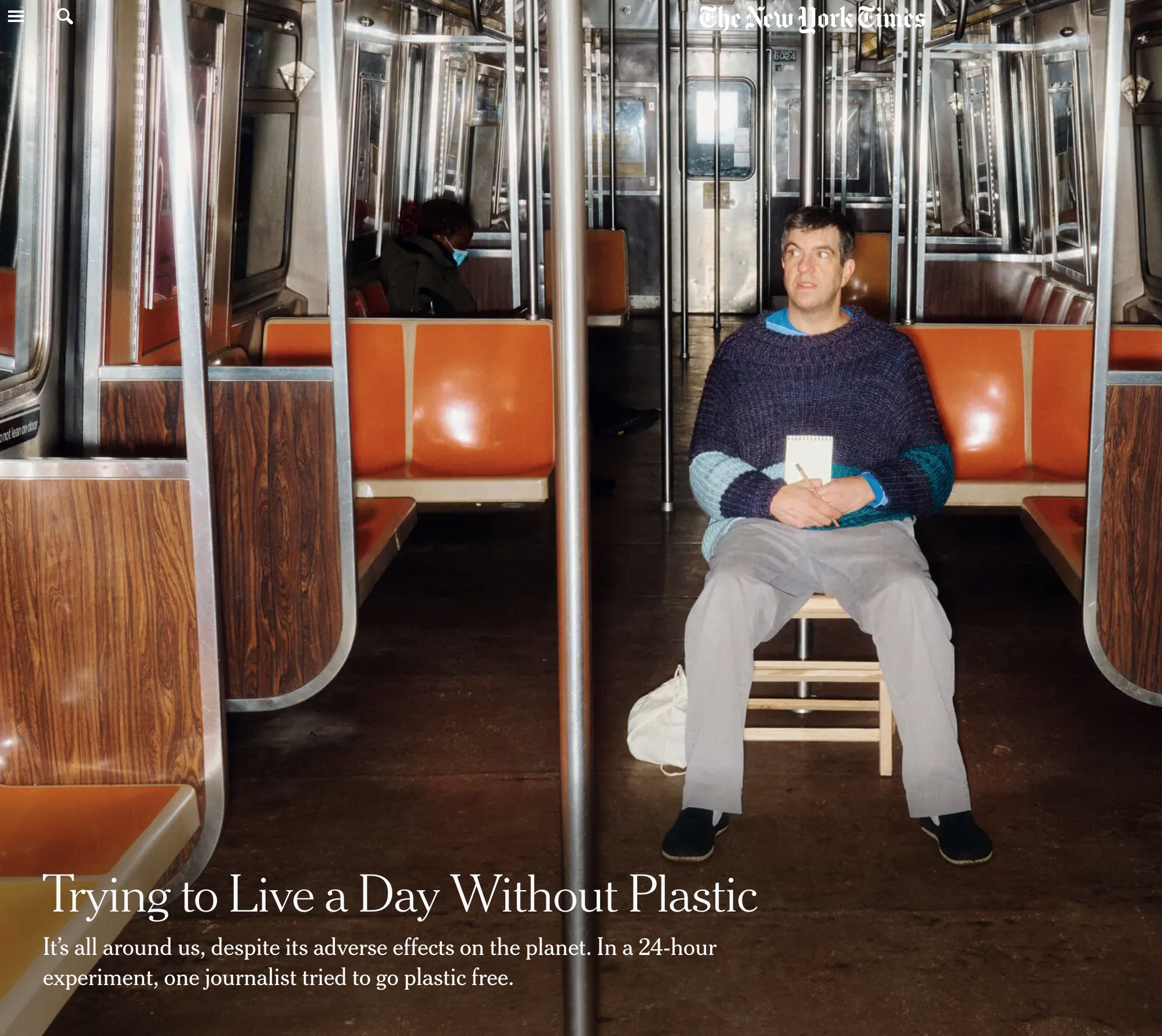
Recently I happened upon an article that was published in the New York Times entitled Life Without Plastic Is Possible. It’s Just Very Hard.
I beg to differ- and I speak from experience.

 Eve O. Schaub