Category Archives: Year Of No Garbage

Confessions of a Paper Towel Addict

I’m a big fan of reality television. Mind you, not just any reality television. Historical reality television. That’s the kind where they take three modern American families and have them, say, live as 19th century pioneers somewhere in the Montana wilderness.

What I just described is one of my favorites shows of all time: Frontier House, which premiered on PBS in 2002. Before being transported “back in time” the participants were asked what things they thought they’d miss most. As they listed off a whole bunch of things, the whole time I was thinking: I know what I’d say: paper towels! I mean, NO PAPER TOWELS!?! How did people live?

I have a problem

Ever since watching that episode I’ve wondered somewhere in the back of my mind if I could ever, truly wean myself from my fully absorbing paper towel addiction.

(See what I did there? I even like bad paper towel puns. Clearly, I need help.)

As if in reply to my question, some time ago on social media I came across a tutorial on how to make your own paper towels out of cloth and then sew little snaps into the sides and snap them together one by one to form a reusable roll. Like a lot of these DIY videos, the slick editing makes this idea seem completely brilliant. Wow! Look how easy it could be. And no waste!!

I’m definitely a crafty, I’ll make it myself kind of person, so at first I was captivated. However after the idea sank in a bit I was made of questions: hold on a sec here Pinterest people. How long would it take to make this gigantic reusable paper towel roll, I mean, without time-lapse photography? And once you had used the towels up and washed them all, how many hours would it take to snap all those tiny little itty-bitty snaps back together? And what if you sewed one snap just a liiiiiittle to the left or right and suddenly your lovely DIY project is NOT COOPERATING? And you accidentally throw the whole darn thing out the window? That’s not very zero waste, now is it? If you ever did manage to roll the whole thing back up again- you know, say, three weeks later- is there any possibility it wouldn’t look like a giant used wad of Frankenstein Kleenex?

I decided the chances of that were pretty much nonexistent, so I kept on using regular paper towels at a rather alarming rate, despite the fact that I have an extensive collection of dishtowels and cloth napkins that I also use. But, you know, sometimes the napkins were all dirty and I hadn’t had a chance to wash them yet. Paper towel. What if it was just a little bit inconvenient to go grab a dishtowel? Paper towel. What if it was a messy, stain-y job involving spilled wine or something that I didn’t want my pretty dishtowels being exposed to? You get the idea.

I keep dishtowels and cloth napkins in a bowl by the kitchen

So in the first few days of our Year of No Garbage, I wasn’t quite sure how it was going to go when it came to the Paper Towel Conundrum. I had discovered that paper towels are compostable, so that was good news, but it was also kind of bad news, because my kitchen compost bin was getting filled up approximately every ten minutes. People were using one-use, disposable paper towels for jobs that really could easily have been going to the reusables, silly things like drying their hands off or wiping the countertop off. It was simply out of habit and because we knew we could.

It was hard to retrain myself and virtually impossible to keep everyone else away from the siren song of old, bad habits rooted in one thing: convenience.

Should I just do away with paper towels all together? I thought. That was one solution. I kind of feel like that’s Zero Waste Ninja Level. I hope to get there someday, but for now I still want to use them for the very slimiest jobs such as wiping grease out of cast iron pans and drying off raw meat and poultry.

Instead, I decided to switch the narrative: if the problem was convenience, how could I make paper towels the most inconvenient solution? So I put them in the laundry room waaaaaay on the other side of our house from the kitchen. In a way I felt like I was just trying to hide them from myself, which seemed silly. I mean, I knew where they were. And anyway surely something that simple would never work.

It totally worked. It worked so well I was kind of shocked. One day I was sighing and emptying yet another compost containing 75% paper towels into my poor starved compost pile in the backyard, the next it was like “Paper towels? Hmmmm. I’m not sure I’m familiar with those. Could you describe them?”
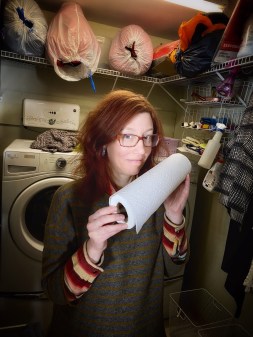
Me in my lovely laundry room

In the old days I am not kidding you, it was not unusual for us to use up an entire eight-roll package in one week. Now that the paper towels live in the laundry room, we’ve been on the same roll for the last six weeks.

Okay, I’m pretty proud of that.

Eventually I may get to a point where we’re so organized we even have a separate batch of dishrags for those few greasy, ooky jobs, along with a separate container to hold the dirty ones between washings. But for now I feel really good that this worked. It all came down to a simple idea that I need to be sure to remember: make the things you want to do easy, and the things you don’t want to do, more difficult.

Now if PBS comes knocking, I’ll be ready.
It’s the Little Things

I’ve been having a lot of weird thoughts lately. Like, the fact that I’ve been throwing stuff away my entire life. This now strikes me as a crazy thing. Or wondering, how much garbage in a landfill somewhere is directly from my own hand? Then, I think to wonder, what was the first thing I ever threw away? The largest? The worst? How does my invisible pile of lifetime trash stack up against everyone else’s?

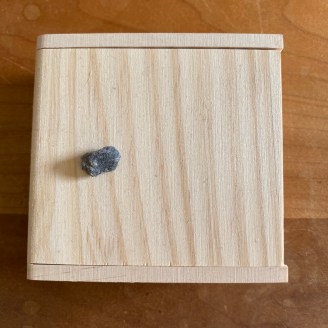
Be honest. Is it weird that I am inspired by a piece of gravel?

I suppose such thoughts are bound to be inspired in the stopping, because the whole practice of throwing things away is like a kind of forgetting, a physical amnesia. I forget YOU milk carton! And I forget YOU granola bar wrapper! We all enact this ritual all day long, every day. Which makes a kind of sense: if we all had to keep and look at everything we’d normally throw away, we’d probably go insane, right? I’m imagining nightmares of being chased by every milk carton I’ve ever known.

But sometimes I like to keep objects just to help me remember things- it’s the hoarder in me. So on the desk by my computer I have a tiny little shrine composed of a wood box and a piece of gravel. One day recently, as I was walking through our house I stepped on this piece of gravel, tracked in from our driveway as sometimes happens, and picked it up with annoyance. Without thinking, I headed for the trash, when I realized (as I have done nearly every day over the last month) that there was no trash to put it in. I stopped, stymied.

I looked at the piece of gravel. What the heck was I doing? What, I wondered, had I ever been doing?

Turns out? Fixable.

I mean, seriously. It’s a freaking rock, Eve, I admonished myself. Rocks aren’t garbage… they’re nature. Why would I throw a rock in the trash? To be trapped in a non-degrading plastic bag, hauled to the landfill and sit there, smothered for the next umpteen zillion years? Sure it’s tiny, about the size of a plain M&M, but how many times have I thrown away a piece of gravel, and how many other people have done just the same thing? That, like anything, adds up.

How much more effort would it really have been for me to open the front door and toss that pebble out into the yard? At some point I must have made the mental calculation-oh I’ll just put gravel in the trash because that’s easier, but the difference was truly miniscule: between opening a door and not opening a door. And I know I’m guilty of myriad other, similar infractions… how many times have I tossed out a paperclip or a safety pin just because the trash was closer than the drawer or box where I keep these things? How many pencils have I thrown away because they were missing erasers, or simply weren’t sharpened, because we already had a handful that were? We live in a time of material abundance unprecedented in human history and clutter is the thoroughly modern phenomenon that comes along with it. Surely I can’t be the only person who has ever thrown “perfectly good” things into the trash out of a strange sense of pure, unadulterated self-defense?

But what gives me the right, I wondered for the first time, to send something to the landfill? When did we become such masters of the universe? When did we become so careless with our resources?

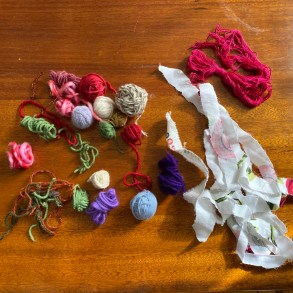
The horrific yarn mess before…
…and after.

The piece-of-gravel revelation has played out in our house over the last few weeks in dozens of different ways: what once we would have thrown out, now we are, for the first time, compelled to really look at… and find another way. I’m sheepish to admit that in the past whenever a clothespin came apart I considered it “broken” and would pitch it: too hard to fix! Probably impossible. I’d think. But when that happened to me the other day I sat down and in about a minute and a half figured out how to put it back together. I felt quite unreasonably proud about it, too.

And when my older daughter Greta came across a huge entanglement of random yarns and craft scraps that had somehow all been shoved together in the bottom of a tote bag, she looked at me questioningly… what on earth were we going to do with this? Any other year, we would certainly have thrown it away. Instead, we sat down and started untangling. It sat on the coffee table for a few days getting progressively better in installments until one day it was no longer a horrible mess at all, but instead a neat pile of several different balls of yarns and fabric strips. Again I felt both proud and a little ridiculous for feeling proud. I keep thinking: those bits and pieces can now be used. Used! I felt like an alchemist who had discovered how to turn trash into gold nuggets.

But the real discovery, I think, is that it was never trash in the first place. Trash is a made-up idea, invented in the name of convenience, which I’m coming to view as a dirty word. Because that lovely idea, as it turns out, comes at a terrible, terrible cost.

So sure, I saved a teeny, tiny rock from the landfill and who cares. But it’s a teeny, tiny rock that represents something much bigger, and that’s why I keep it on my desk, to remind myself that just because our culture accepts something, doesn’t mean it makes any sense. Sometimes it’s just a matter of stopping to really look at something for the first time that can change your point of view entirely.

Sometimes it can even be something right underfoot.

Demystifying the Big Supermarket Box

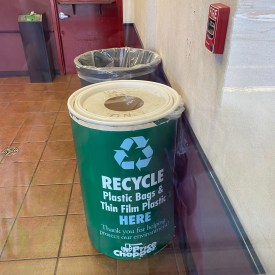
For a while now I’ve wondered what the deal is with those mysterious boxes at the front of the supermarket offering to recycle your plastic shopping bags. Often they’re just big cartons or barrels with a slot in the top and a green recycling arrow on the side. I can’t imagine I’m the only person who’s ever wondered, yeah, but what is this? I mean:

A Mystery Worthy of a Scooby Doo Episode?
Admit it. You’ve wondered.

Who collects the bags?

Where do they go?

What can you make plastic bags into anyway- more plastic bags?

Can you recycle other plastics in these boxes?

But after a little research the other day, I was able to call up Stephanie, who helped me to sort it all out. Stephanie works for Trex, and Trex is the answer to the question “Who wants a bunch of empty plastic shopping bags?” This is because Trex turns them into composite decking for outdoor porches and railings.

Yes! There is a company that really does want these plastic shopping bags, and that really will do something constructive with them. Best of all, none of this is part of an elaborate hoax to relieve our guilt at having forgotten the reusable bags at home. Again.

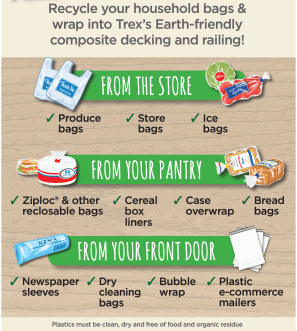
But it gets even better, because Trex doesn’t just want your plastic shopping bags; they want all your polyethylene, which is a science-y word for plastic film, and includes a whole lot of things you’re probably throwing away right now. I found a fabulous poster on the Trex website that I printed out and am hanging in our kitchen to remind us of all the many things that— as long as they are clean and dry— can go into this magical box at our supermarket, including:

  • bread bags
  • ice bags
  • produce bags (both the kind that come on rolls in the store and the kind apples and oranges are already bagged in)
  • plastic overwrap from things like paper towels, toilet paper and water bottle cases
  • bubble wrap, bubble mailers and air pillows (deflated)
  • dry cleaning bags
  • Ziploc bags
  • newspaper bags
  • cereal box liners (unless they tear like paper)


If you don’t find that list super exciting, then you clearly are not me. For one thing, this opens up a whole host of products I thought I wouldn’t be able to buy at all this year, from sandwich bread to cereal. Yes, I’ll still make my own bread and buy it from the bakery. Yes, I’ll still be bringing my reusable mesh produce bags with me on my shopping expeditions.

Print the full poster by clicking here

Yes, I will still always choose the lowest-plastic option of any product, because at 300 million tons of new plastic made per year the world certainly doesn’t need my encouragement to make any more, whether it gets recycled or not. But still. The other day when my daughter Ilsa felt crappy and asked for toast, it was a relief not to have to drive for an hour or wait for bread dough to rise all afternoon- I could just buy her a loaf at the store ten minutes away.

(When your kid is sick, not having to make a choice between them and the entire planetary ecosystem can be worth a lot.)

Now if you are like me you’ve tried to be good. When you read various recycling instructions you inevitably read the recycling warnings too. This is the part that says, in effect: IF YOU PUT ONE WRONG ITEM IN HERE YOU WILL DESTROY AN ENTIRE BATCH OF RECYCLING AND PROBABLY MURDER A POLAR BEAR IN THE PROCESS. These dire warnings all send the same message: “when it doubt, throw it out.” I take issue with this. We don’t need more encouragement to throw things into the landfill. What we need is better information.

Which is why I like people like Stephanie at Trex so much. Her job has everything to do with giving people more information so they can recycle correctly. More companies should have a Stephanie, to answer questions from the public not just about their products, but about their product packaging, and what exactly they expect us to do with it so as to not strangle the planet.

Stephanie answered other questions I had too. She told me that when the plastic film recycling boxes are full they get returned to the supermarket’s distribution centers, where they are converted into 1000-pound bales. She explained that most distribution centers ship one semi-load of these plastic bales to Trex every two weeks.

Oh, this is WAY too small for you to read! Instead check here to see if your supermarket sends its Plastic Film to Trex

Wow. That’s a lot of not-landfill.

Most importantly, she told me some simple steps to help people avoid putting the wrong kind of plastic film into the Trex boxes. First, check if it is marked with a #2 or #4 plastics recycling number. If so, this is polyethylene and YES! Trex wants it.

If, however, there is no number to be found, here is an easy test:

  1. Is the plastic able to be stretched? YES! Trex wants it.
  2. Is it shiny or crinkly? NO!! Trex cannot use this.

Things that fall into the shiny/crinkly NO!! category include:

  • pre-washed salad mix bags
  • frozen food bags
  • candy wrappers
  • chip bags
  • 6-pack rings.

So there you have it: some bona-fide good news, courtesy a company that is totally getting a Valentine from me this year. On recycled paper, of course.