Category Archives: Year Of No Garbage

A Horse Walks into a Recycling Center

Say, for the sake of argument that you plan to take your family on a waterskiing trip.

You are excited. You do the planning, strategizing, packing and at last, you get everybody out there on the boat. Ready to take the first run of the day you look up from the water to gaze upon your family, and suddenly you realize they are… on their phones. They are bored. They are sweaty and— quite possibly— annoyed.
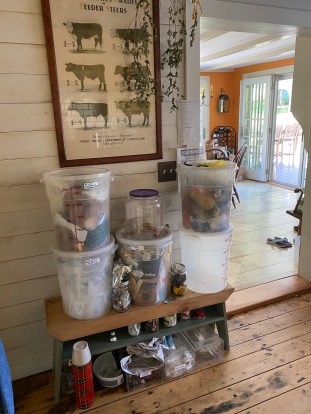
My system: so simple even an astrophysicist could figure it out. Eventually.

Suddenly a thought hits you that hadn’t occurred to you before: maybe no one wanted to go waterskiing but you.

This is the feeling I’d been having lately with regard to my family and the Year of No Garbage. Partly, I think this can be blamed on the nature of the project: whereas our Year of No Sugar entailed the bond of experiencing something together practically every single time we ate food, three times a day, for 365 consecutive days, living No Garbage is more… ephemeral than that. Sure, you throw garbage away more often than you eat food, but it isn’t an activity you do as a group, usually. Disposing of trash is generally a solitary act.

I also think this is in part because figuring out what products and packaging are made of is even harder than figuring out what ingredients are in our food. Sure, there are at least 61 different names for sugar, but there seem to be infinite combinations of plastics in the world, and unlike with food products, packaging corporations are under no obligation to list ingredients used in a little informational box on the side.

Consequently what I’d been finding was that instead of throwing things in the trash, people in my family were instead throwing things at me. And then I’d take care of getting it to where it needed to go.

I’ll give you a for instance. Like many people, in an effort to avoid pandemic exposure, we are probably now getting more packages delivered to us than ever before. The good news is that I have figured out how virtually all mailing materials may be recycled.

But I didn’t get the feeling anyone else in the house had absorbed this knowledge. When my husband Steve tried to hand me a bubble-wrap mailer the other day, I told him he could put it in the recycling himself. Steve protested he was afraid he’d do it wrong.

Then a little while later Greta did a very similar thing. A cellophane bag needed disposing of, so instead of taking care of it for her, I gave her a quiz: where do you think this goes? She guessed Polyethylene recycling, which was close but no cigar. No, I explained, any plastic that is stretchy may go to Polyethylene (supermarket plastic bag) recycling, but any plastic that is crinkly must go into the Terracycle box.

I realize my reactions sound suspiciously like the ravings of a Recycling-Obsessed Lunatic: No! Not the Low Density Polyethylene bin, you cretins! But I genuinely was surprised to realize that just because I have been consumed by thinking and writing about Zero Waste for the last six and a half months, didn’t necessarily mean that my family had absorbed that information. But come to think of it, why would it?

Here’s why I think this matters— and I ask this not out of irritation or pessimism but because I really was beginning to wonder— if my own participating family didn’t internalize the hard won lessons learned from a Year of No Garbage, than who would? If I was the only one actually living No Garbage in our house, then wasn’t that a failure of the project on some fundamental level?

Which isn’t important in the grand scheme of things, except for what it may bode for the future of our landfills and our planet. The $64,000 question being: can people change?

You can lead a horse to water, but can you make him recycle?

It was at this point I read the beginning of this blog to Steve and Greta. Was I wrong to interpret their behavior as lack of interest?

The answers were enlightening. Steve described it like this: “You know how you are about technology? The internet, the computer, the television, the telephone?”

“Sure,” I said. “I don’t touch them with a ten-foot pole. That’s your domain. I don’t know what I’m doing, and I’m afraid I’ll… mess up something you’re working on.”

Oh.

So I’m realizing a few things, most importantly that learning doesn’t take place by osmosis. Hanging up recycling info in the kitchen and placing neat labels on bins isn’t enough. I need to actually talk to my family when they have something to discard. Every time. For a while. Change takes not only time but investment, and I realize I had made some assumptions that just didn’t follow.

So now that we’ve cleared the air things are changing. I’m trying to be more communicative about my beloved system, and they, for their part, aren’t just handing me stuff anymore. I’ve already noticed Greta checking in with me when discarding packaging. “Mom? This goes in polyethylene, right?”

I’m so proud.
On Banana Guilt and Other Wise Words

I inherited from my Dad an affinity for collecting quotes. He has long been known to randomly hand me, and other family members, what turns out to be a quotation typed up on a plain piece of paper, simply because he thought I’d appreciate it. It’s just a thing he does.

So now that I’m grown up, I collect quotes too. My family is pretty much used to pausing the movie we are watching long enough for me to scribble a quote on the nearest envelope or scrap of paper. They hardly even roll their eyes anymore.

And of course, I especially love finding quotes that are relevant to the topic I’m obsessing about at the moment. Recycling? Garbage? Big, huge, overwhelming, impossible projects? Check.

Often, great quotes seem to leap out and ambush me when I least expect it, from the most unlikely of sources. In fact, the most unlikely sources are often the best, because they point out connections between things that didn’t occur to you before. Yes, I definitely have some awesome quotes about trash and sustainable living from the books I’ve been reading on those subjects, but the quotes that really grab me by the throat are the ones relevant to our Year of No Garbage but show up in other things: a book about handcraft, folksy wisdom from Mister Rogers, a documentary about Bill Gates. If nothing else, this proves to me how bizarrely random my reading list must appear to everyone else.

So here, in no particular order, are a few of the favorite quotes I’ve gathered so far in reference to our Year of No Garbage… I hope you enjoy them:

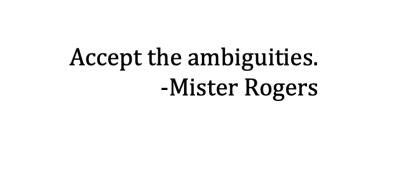
I’ve often hesitated in beginning a project because I’ve thought, “it’ll never turn out to be even remotely like the good idea I have as I start.” I could just “feel” how good it could be. But I decided that, for the present, I would create the best way I know how and accept the ambiguities.

-Fred Rogers, You Are Special

The United States is the home office of waste and always has been. The country was built on waste. We wasted land, wasted people, wasted resources and wasted fortunes that were built on wasting land, people and resources… We all looked at energy-wasting squarely in the eye a long time ago and decided to keep it as part of the American tradition.

-Russell Baker, So This is Depravity

In the moment we all do the best we can do at the moment. It’s in retrospect that you see what the impact was.

– Marc Porat, Tech Entrepeneur, in the documentary General Magic

…make something well, and from good materials, and it will last beyond one generation. But what do you do when everyone already has a highly durable blanket? This is every weaver’s dilemma, though it rarely affects the standard of their work. Not compromising on quality is a philosophy of production that is, of course, the antithesis of the modern textile industry whose capital returns rely on heavy turnover, a throwaway culture in which every item has a planned obsolescence and barely lasts a lifetime, let alone long enough to be passed down to future generations.

-Alexander Langlands, Craeft: An Inquiry into the Origins and True Meaning of Traditional Crafts 

In what ways are our values, goals, and aspirations being invigorated or violated by our present life system? How many parts of our personality can we live out, and what parts are we suppressing? How do we feel about our way of living in the world at any given time?

-Gail Sheehy, Passages: Predictable Crisis of Adult Life

The truth is that the environment never makes it into most Americans’ top-ten list of things to worry about. They support protecting the environment; they just don’t support it very strongly.

-Michael Shellenberger and Ted Nordhaus, “The Death of Environmentalism” in The Sun magazine

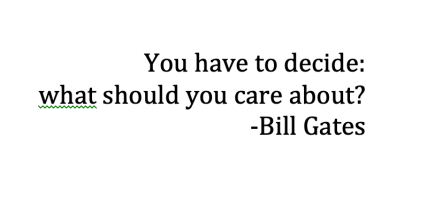
You have to pick a pretty finite number of things to tell your mind to work on. You have to decide: what should you care about?

-Bill Gates, “Inside Bill’s Brain: Decoding Bill Gates” Netflix docuseries

The future will come at us invisibly, frame by frame, as it always does— comprehensible only when run together and projected retrospectively at some distant moment. But it is coming.

-James Carroll, “To Save the Church, Dismantle the Priesthood,” in the Atlantic

BONUS! Favorite Year of No Garbage Quotes From My Family Thus Far:

Can’t this (project) wait till I go to college? That’s only, like, five years from now.

– Ilsa

I have banana guilt! I accidentally threw a banana peel away at school and then I realized and then I stood there trying to figure out if I should put my hand in the garbage to take it back out! And my friends were like what’s wrong why are you so upset looking and I told them and they’re like GRETA. You do not put your hand in the garbageno.

-Greta

I’m very proud of our family; this week we had no garbage. Because it’s all on the kitchen counter.

-Steve


When No Garbage Went Camping

One of the great things about camping is that it is a relatively safe way to vacation during a pandemic and pretend for a few hours that the world isn’t currently behaving like a gasoline fire at a fireworks stand full of frogs. So this week we made a short camping trip up to the islands of Lake Champlain.

Moment of Proud Camping Weirdness: hanging “disposable” plastic bags to dry

As anyone whose ever been camping knows, garbage is no small part of the experience. Along with the obligatory playground, nature center, and non-functional bathroom mirrors, most campgrounds also have giant, readily available dumpsters for landfilling all that single-use crap we brought along to keep us dry, clean and fed while we commune with nature.

Yes, it’s ironic. But I understand. When you are camping and you find yourself, say, suddenly and unexpectedly wet, priorities change. Maybe it’s the fact that you can’t actually see yourself in the bathroom mirrors. Sometimes the grit in your socks makes you crazy. I don’t know. Patience, like potable water, is often in short supply. But something about the endeavor of camping lends itself all too well to disposability.

So, rather than using up all the water, and spending precious vacation time washing dishes (I mean, I’m on vacation!), campers switch to plastic plates and cookware. Rather than separate recyclables and use valuable water to rinse them they go right into big plastic bags of trash. Composting? Pretty much out of the question. We feel efficient when we make our regular trips to the dumpster before bed. We’re being good campers! We are keeping the campsite nice, clean, and free of animal-attracting food! So the dumpsters at campsites are filled up with everything you can possibly imagine camping-related: from red Solo cups and oceans of plastic silverware to Styrofoam coolers, whole tents with one broken pole, punctured pool floaties, you name it. They even have signs saying please don’t dispose of weird non-camping-related stuff here like old paint and car parts. I mean heck, it’s free and it’s anonymous, right? So you can tell that people apparently feel justified to throw away juuuuuust about anything here.

But we all conveniently forget about this not very environmentally-friendly aspect of appreciating the Great Outdoors, because so many of us love the Great Outdoors. In our family we like camping so much that a few years ago we invested in a small tow-behind Airstream that allows a tiny fridge, a tiny sink, and a tiny bed to be part of the experience. You can even fold the tiny dining table into another, smaller bed, but now that the girls are older, and tired of kicking each other in the face all night long, they pitch tents outside for more spacious accommodations. Yes, Airstreaming is, by camping standards, what my 15 year old would call “bougie” but don’t worry: we still get wet. We still get sand in our socks, and we walk around smelling like a burnt offering to the god of mosquito repellant.

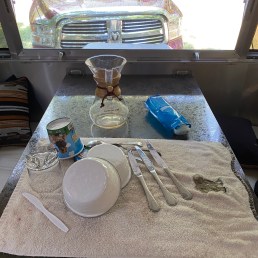
No Garbage Camping means everything gets either washed, burned or composted

Of course, as we finished packing for this particular trip I off-handedly mentioned to my husband Steve that this camping experience would be especially interesting since, after all, we’d be keeping our campsite garbage-free. There was a short, conversational pause. Then Steve gave me that look he reserves for when he knows I’m about to try something midway between bonkers and impossible, and there is clearly no talking me out of it.

I’m amazed to report, however, that it was nowhere near as hard to camp No Garbage as I actually expected, at least for this particular trip. I found all I needed to do was modify our home system for the much-smaller confines of the camper. Using paper plates and napkins that could be burned up in the campfire saved our limited water supply for the other, more messy and annoying tasks I never would’ve bothered with before, such as washing plastic hot dog wrappers. Our campground had an easily accessible recycling bin for things like glass bottles and ordinary plastic recyclables. For the more difficult recycling I’d have to do at home (such as stretchy and crinkly plastics) I collected these in a plastic bag hung on a hook.

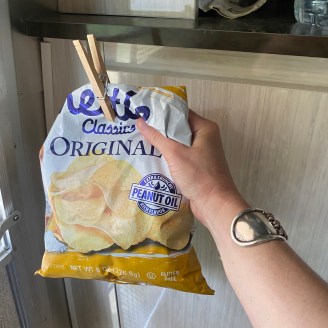
Lastly, I repurposed a large foil-lined potato chip bag as our compost container for things like orange peels and egg shells and folded it closed with a clothespin; this stayed in the camper with us. Fortunately we camped only two nights and so it didn’t start to smell. Also fortunately, we weren’t in an area where we’d worry about animals trying to get to those food remnants. If we had been only in tents, or a more remote or bear-filled area, this would not have been possible.

Foil-lined Potato Chip bags make excellent on-the-fly compost containers

I have to admit I was pretty pleased with myself as I pinned the little washed bits of plastics to our towel-drying clothesline, already envisioning them clean and dry and ready to be sorted at home into supermarket-bag recycling (stretchy) and my large Terracycle box (crinkly).

I thought, I’m doing it!!

Then, because the weather forecast called for zero percent chance of rain, it rained. Our clothesline got wet, our campsite got wet, Ilsa’s entire tent got wet. Now we weren’t worried about drying the little plastic bag the cold cuts came in so much as we were worried about drying Ilsa’s wool sleeping blankets, pillow and two paperback books.

See what I mean? The gods of camping have a way of reminding you you’re in their universe now and quickly making you reconsider your priorities.

Priority-rearrangement notwithstanding, I’m proud to say that by the time we were packing up to head home, exactly nothing from our trip had contributed to that enormous campground dumpster. By some small miracle the food wrappers were mostly dry and ready to be shuffled into my byzantine recycling system. Although a longer trip would surely have presented more serious challenges to my No Garbage agenda (the compost becomes odiferous… the “take-home” recycling refuses to dry… uncooperative weather puts out our campfire and prevents the burning of any paper products…) Still. I felt that sense of victory one has when you manage something, even a small thing, that you weren’t entirely sure was possible.

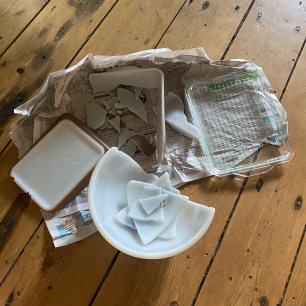
I’m not sure anyone else really noticed. The kids in their tents had gotten about fourteen minutes of sleep between them, we were all sooty and in desperate need of a shower. Ilsa was cold, Greta had a stomachache, and Greta’s boyfriend Stephen hadn’t been able to post on Tic-Toc in TWO WHOLE DAYS. Suddenly “zero-rain” gave way to muggy, hot, and gross. Then midway home I discovered that the pretty Pyrex refrigerator dishes I had been so delighted to find at a roadside antique barn had fallen in the camper and broken, as if I needed reminding why plastic Tupperware so easily replaced Pyrex dishes for food storage several decades ago.

Aaaand then I cut my hand trying to ascertain the damage.

We may have to give this Pyrex a decent burial

It was a little much and I could feel my eyes getting hot like I wanted to cry. It had been a long three days, and even in a fancy-pants set-up like ours, tears can be a surprisingly common side effect of camping. Sometimes nature— with its sudden bursts of weather, temperature, gravity, and overall lack of spider-free toilets—can be a little much for us people-from-houses.

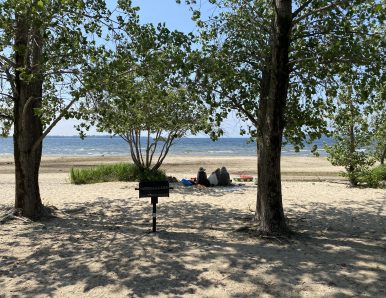
But no tears came. I knew then that when we remembered this trip we’d forget the cranky moments, thinking only of the funny stories. Or, more likely, that the cranky moments would become the funny stories. We’d recall reading The Hitchhiker’s Guide to the Galaxy around the campfire, and the amazement one morning of having a pretty, popular, local beach entirely to ourselves.

Seriously- we were the only people there

I may have lost my Pyrex, and a pint or two of blood to the resident mosquito population, but then again I had a bag full of decomposing food and hard-to-recycle plastics. I suppose that’s enough to cheer anyone up.