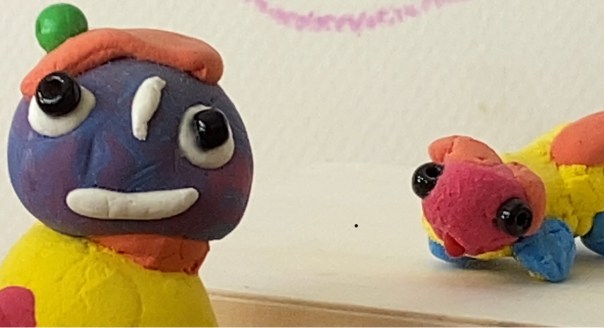
You know how it is: there you are writing your book and Whoops! you end up creating a puppet show about the environment.
If you, or some ridiculously young person you know, are on TikTok please check out my account @eveoschaub where you can meet Hamburger and Max, two super awesome puppets who just want to do good things for the environment.
(Click the link below to watch one)
WARNING: EXTREME SILLINESS AHEAD. PROCEED WITH CAUTION.
AND if you aren’t already, please follow me on your favorite social media:
How far are you willing to go to save the planet? How about as far as the bathroom?
I ask because a search for “reusable toilet paper” on Etsy reveals 1,645 results. Yes, you read that right.
Regular toilet paper— at 1.5 pounds of wood and 37 gallons of water per roll— is surprisingly wasteful. Most of us would hear this and say: sure, but what is the alternative? Well, a few months ago I stumbled upon the concept of the “family cloth.” I mean, reusable toilet paper sounds like a horrible idea, but… I was going to keep an open mind. I did some research, read articles both for and against.
In the interest of environmentalism, recycled toilet paper would seem to be the next best option, right? But my experience has consistently been that recycled brands are harder to find, cost more and— just as a bonus—suck. They were usually too thin, too rough or both. And either way, toilet paper goes down the toilet and disappears, so it didn’t present much of an immediate problem for our Year of No Garbage.
What was a problem: the plastic overwrap.
Lots of TP means LOTS of plastic overwrap
Inexplicably, even the recycled toilet paper at my store comes with plastic overwrap. Seriously- why do companies think we’ll buy recycled paper to save trees but ignore the This-Will-Outlive-Your-Great-Grandchildren-Overwrap? I’m looking at you Seventh Generation.
Yes, you can recycle plastic overwraps of all kinds in the plastic bag recycling at the supermarket, but many people won’t, and more plastic is always bad. Not creating it in the first place is far preferable.
Enter the Australian-based company Who Gives a Crap, which besides having a terrifically easy to remember name, is a solution I’m liking right now. Some things I like about them:
They donate 50% of their profits to help build toilets for people who need them. 800 children die every day from poor water and sanitation.
Their products are 100% plastic free.
They have a sense of humor. To draw attention to their 2012 crowd-funding campaign, co-founder Simon Griffiths sat on a toilet for 50 hours; he wrote contributors thank you notes on pieces of toilet paper.
Who Gives a Crap arrives at my house
As you might expect— when you’re ordering your sustainably sourced toilet tissue— it is expensive. Just how expensive? I ordered 48 bamboo rolls for $52, which means I’m paying just over a dollar a roll. According to the toilet paper math mavens of the Internet, of which there are greater numbers than I imagined, this is nearly twice what I should be paying for an ordinary roll of TP.
A slightly cheaper option is Who Gives a Crap‘s recycled paper line, for which you are paying about a third more.
The expense is one obvious downside. Then there’s a global footprint involved in home shipping, but where is it really coming from? Australia? A production facility in the U.S.? And how does that compare to the shipping of products like Cottonelle or Charmin to my supermarket? As of now, I don’t know.
The upside is that I like their product a lot: it is thick, soft and comfortable to use. And their subscription service means you never have to worry about forgetting to buy toilet paper at the store ever again. Just like supporting local businesses or buying organic food, if you’re willing and able to pay the higher price for things you believe in, then it is worth checking these guys out.
My bottom line (so to speak?)? The plastic packaging overwrap is gone. So I’m pretty happy.
When I’m not preoccupied with how undeniably awesome 2021 is turning out to be, I’m preoccupied with one of the biggest remaining questions left from our Year of No Garbage:
What REALLY happens to the stuff I send to Terracycle?
The reason this is a terribly important question is because I know our family could not have survived this year without our Zero Waste boxes from Terracycle. Like it or not, one of the biggest lessons of our Year of No Garbage was: if all else fails, send it to Terracycle. And when we said this, we were almost always talking about plastic food packaging.
You’d think plastic food packaging wouldn’t be such a big deal. After all, our family doesn’t buy lots of prepared or convenience foods: like any self-respecting food lover I shop the perimeter, focus on whole foods, and make as much as I can myself, from tortillas and chicken broth to yogurt. Given all that, how bad could the packaging really be?
Nobody here but me and several thousand pieces of plastic
The answer is really, really bad. All one has to do is look around my kitchen to see the evidence of plastic wrappers, containers, seals, caps, bags and boxes of every shape and variety in various states of being washed, dried and sorted— and this is all while I’m actively thinking about avoiding plastic all the time.
I mean, how much plastic would we be going through if I paid no attention?
Admittedly, the pandemic makes it worse. Normally I’d be able to mitigate packaging by bringing my own containers to specialty stores, buying in bulk, requesting paper-and-string wrapping for my cheese and meat. But once the pandemic began I made the decision to limit my shopping excursions to one, once a week trip to the supermarket where, of course, no reusable containers are allowed and nobody gives you fun wrapping choices. According to this new scenario, it turned out there were entire aisles of food we simply couldn’t buy at all without involving plastic packaging: Cheese. Bread. Cereal. Meat. Once I got past the produce section with my reusable mesh bags, it was all downhill from there.
We all know what happens to metal and glass in the recycling process, it gets made into new cans and bottles. But what was Terracycle doing with all this used plastic? My husband Steve was definitely suspicious. Was this for real, or just some kind of expensive feel-good?
He wasn’t alone. Everyone I talked to about Terracycle found it to be something of an enigma, a mirage that sounded too good to be true, including many of the folks in the Beyond Plastic Pollution class I took through Bennington College last fall taught by former EPA regional administrator Judith Enck. This class was composed of serious environmental activists, the kind of folks who looked forward to spending an evening watching a Power Point presentation on the evils of plastic. If these people doubted the legitimacy of the enterprise, then Terracycle had a serious credibility problem.
At the beginning of last year I had called to ask if Terracycle conducted tours of their recycling facility; they didn’t. I then turned to Terracycle’s website and watched videos posted there, many of which are old (posted 8, 9, 10) years ago— and others which were beside the point (how to make a bracelet out of used coffee capsules!)
I am not hip enough to work at Terracycle
I watched several tours of their office space in Trenton, New Jersey which features graffiti murals and partitions made out of old vinyl records. Over and over I listened to Tom Szaky tell different interviewers how he started the business in his college dorm room, putting fertilizer into old soda bottles— which is a great story. But I wanted more.
After getting diverted by other things I stopped looking, and time went by. Then this week, I returned to the search. Geez- it was right there! How could I have missed it? It appears they posted it this year, after I had originally looked for it. But there it was: what happens when Terracycle opens your Zero Waste box:
Okay, so now we know what they do with our plastic packaging: they turn it into plastic pellets to turn into things like park benches and picnic tables. (This is very similar to what Trex is doing with all that #2 and 4 plastic film we are bringing to the supermarket plastic bag recycling container, turning it into outdoor plastic decking material.)
How you feel about this revelation depends a whole lot on who you are. Is this “upcycling”: creating a product of higher value than the original? A picnic bench is surely more valuable than any amount of disposable food packaging after all. Are you delighted that our otherwise-useless plastics are being turned into something useful, a fate so much better than being landfilled, ending up in our oceans, or burned in toxic incinerators?
Or do you see this as “downcycling”: creating a product of lesser quality than the original? When melted or chipped into new products, most plastics lose “integrity,” and the number of things they can be turned into dwindles. The plastic used in the picnic tables is of a lesser quality because it can be used for fewer things. And don’t forget it still leaches chemicals into the environment and breaks off into microplastics that infiltrate our environment, the food chain, and our bodies.
Terracycle seems like an unquestionably good thing. But when we look closer, we must ask: does recycling with a program like Terracycle do more harm than good? Is it truly better for our planet and environment? Or, does it serve to assuage our environmental conscience, so we don’t have to do the harder work of committing to bigger, more meaningful change?
Moving plastic around like this without working for actual change to the system is like rearranging the deck chairs on the Titanic- it’s not going to matter unless we find a way to right the ship. Plastic is our looming environmental iceberg and despite some recent positive changes— plastic bag and styrofoam bans being the best examples— so far we are still full steam ahead.
We need to stop saying “It’s okay- It’s recyclable!” When it comes to plastic, it’s not okay, and it isn’t recyclable… not really.
Yes, I’ll still use Terracycle, and they are for real. But is that good enough? I still admire them for attempting to save the world, and for insisting that there’s no such thing as “garbage.” But what we need to work towards, and look forward to, is the day when we won’t have any reason to use them at all.


 Eve O. Schaub