Yeah. But what about…?
There are LOTS of “but what about…?”s that have cropped up over the last three-plus months of the No Sugar Project that I keep meaning to address, so here we go…
Medicine: as an obsessive and over-protective mom, medicine is off the table, as far as I’m concerned. Sugar Project or no, if my child is sick I am not, repeat NOT going to quibble about trying to find no-sugar Tylenol to quell their fever or some effective alternative to a tablespoon or two of canned fruit syrup to quiet a seriously upset tummy (did you know about that one? It works.) Nope. Medicine is not food, it’s a whole other category. However, as I’ve mentioned before, we have enjoyed remarkable health these past three months, given the time of year and the fact that we have not one but two children in elementary school, which as we all know is Club Med for germs.
All that being said, I’m still fully prepared to bitch about it. Do you remember the days when taking medicine was just awful? Like, gag-reflex-inducing-awful? I’m not saying we should bring back the bad-old-days, but it is troubling to notice that standard medicine cabinet items such as Children’s Tylenol and cough drops have truly been transformed into candy by the addition of HFCS. Ask any mom: it’s to the point where kids beg to have additional unnecessary doses. Now that kind of scares me.
(Thank you to Kate for bringing up this important subject! PS: Hope you are feeling much better.)
Lastly: what about vitamins? Thank you to Katrina- I think- for pointing out that the children’s chewable vitamins prescribed by our pediatrician almost certainly have sugar in them to make them palatable. This is a tougher one: are vitamins “medicine” or “food”?
Lemon and Lime Juice: Also tricky. Technically, we’re not drinking fruit juice, or consuming anything sweetened with fruit juice. However, what about when you aren’t sweetening, such as when you add lemon or lime juice? Technically, there’s still fructose involved, and technically, as fruit juice, that amount is going to be concentrated and minus the fiber and other micronutrients we’d be getting if we were eating the whole fruit, right?
Currently, I use lemon juice quite a bit: in salad dressing, hummus, and several pasta and vegetable recipes. Because of the lack of sweetness, it took a while for me to remember that it is still “fruit juice,” nonetheless. But can this fruit juice be justified on the No Sugar Project?
So I did some research. According to the handy dandy nutrient calculator found on the USDA National Nutrient Database, http://www.nal.usda.gov/fnic/foodcomp/search/index.html) there is 0.53 grams of fructose in the 48 grams of juice in an average lemon, and 0.27 grams fructose for 48 grams of lime juice.
So if we try to compare apples to apples (ha ha), by using that same amount (48 grams) how do other fruits measure up? If I am using this nutrient calculator right- of which there is absolutely no guarantee- unsweetened apple juice comes in at 2.75 grams of fructose. For unsweetened grape juice you get a whopping 3.53 grams of fructose. Orange juice, for some reason on this website only lists “sugars” (rather than breaking that down into separate components of fructose, lactose, glucose and so on.) Still, at 4.03 grams “sugars” per 48 grams raw orange juice… wow!
Okay, so I’m not sure how to handle this one. Do we have a “fructose threshold”? I don’t know. I don’t want to give up my hummus, so help me out here people. Comments? Rationalizations? Anyone?
Coconut Water: Just the other day I was in the health food store and picked up a bottle of coconut water to drink. Remember how very many 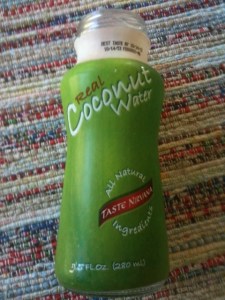 drinks are verboten on No Added Sugar? Practically all of them… we can drink water, milk, and for the grown-ups: coffee and (our no added sugar exception) wine. Hmmmm…. I thought. Does “coconut water” count as “fruit juice?” After doing some research the answer seems to be yes. According to Livestrong.com, a serving of coconut water has 5.4 grams of combined simple sugars: glucose and fructose. No matter how you slice it, that’s got to be quite a bit of fructose. Too bad.
Dextrose: Remember my “ose” debate? I consulted with Dr. Robert Lustig, who kindly responded that “dextrose is glucose,” and therefore for our fructose-free purposes, fine. It was nice to have at least one “what about?” question end with a “why, yes, you can have that!” even if it was dextrose and not hot fudge sundaes.
Brown Rice Syrup: I have yet to encounter this ingredient, but I have found some recipes calling for it online, so it seems worth investigating. According to Wikipedia, it is “a sweetener derived by culturing cooked rice with enzymes” which is composed of maltose, glucose and maltotriose. Woo-hoo! No fructose in sight!
On the other hand, my friend Katrina weighed in: “Yeah, too bad it tastes like dog poo.” Oh. Well, then again she also thought our beloved GoRaw raisin granola bars tasted like “bird seed” (like that’s a bad thing!?) so who knows? She’s going to give me some to try out- stay tuned.
Malted Barley: My dear friend Wikipedia informs me that “barley malt syrup” is “produced from sprouted barley” and is made up of maltose, complex carbohydrate and protein. It is described as roughly half as sweet as refined sugar, but with a “malty” taste, “best used in combination with other natural sweeteners.” Yeah, well, so much for that part.
Now I must take a moment to once more explain how NOT SAVVY I am with regard to nutritional matters: full disclosure… science and my brain don’t like one another much. So, honestly, I had to read further to realize why “complex carbohydrate” couldn’t mean “fructose” in disguise. Well, you probably paid attention in health class and already know the answer: fructose is a “simple sugar” aka “monosaccharide,” which is to say not complex. Complex carbohydrates are chains of three or more sugar molecules linked together, which apparently makes all the difference.
Which brings us back to the “-ose” question. The suffix “-ose” refers to simple sugar, again according to Wikipedia: “For example, blood sugar is the monosaccharide glucose, table sugar is the disaccharide sucrose, and milk sugar is the disaccharide lactose.”
So complex carbohydrates are fine. Simple carbohydrates, aka simple sugars, aka mono- and di-saccharides are also fine, as long as we avoid that one nasty, bad seed mono-saccharide: fructose. Well when we put it that way, it doesn’t sound so very hard, does it?
Agave: I had been wondering about agave/ agave nectar/ agave syrup… first of all, what is it? Thanks to Wikipedia I now know that it is a Mexican perennial succulent, similar to ornamental Yucca plants. Yum.
Second of all, terms like “nectar” and “syrup” would seem to indicate the extraction of the sweet “juice” of the plant, leaving behind the fiber and any other beneficial micronutrients. So I wondered- is there a a form of agave which includes the plant fiber? Turns out no, unless you consider razor strops or hand soap (two of the uses for the non-sap parts of the plant) edible. Oh well.
“Contains Less Than 2 percent Of The Following”: A friend of ours who is a doctor recently pointed out, and rightly so, that abstaining from products with a vanishingly small amount of sugar doesn’t really do anything nutritionally… meanwhile we are still having wine (my and my husband’s one “exception” item) which has comparatively significant amounts of fructose, being fermented fruit juice, of course. (According to the USDA website listed above an average 5 oz glass of red wine contains .91 grams of total sugars- it is not broken down further into glucose and fructose.)
Well, true. I suppose, in the alternative we could say that we could eat any food for which the sugar falls in the “less than 2 percent” category, and have that be our exception, except that that sounds awfully clinical to me. Plus, I’d sorely miss my nightly glass of wine, and feeling more deprived than I already do now is not very high on my list of things to do. I don’t know. What do you think?


 Eve O. Schaub