All posts by Eve Ogden Schaub

Unknown's avatar

About Eve Ogden Schaub

Serial memoirist Eve O. Schaub lives with her family in Vermont and enjoys performing experiments on them so she can write about it. Author of Year of No Sugar (2014) and Year of No Clutter (2017) and most recently Year of No GARBAGE (2023). Find her on Twitter @Eveschaub IG or eveschaub.com.

It’s the Little Things

I’ve been having a lot of weird thoughts lately. Like, the fact that I’ve been throwing stuff away my entire life. This now strikes me as a crazy thing. Or wondering, how much garbage in a landfill somewhere is directly from my own hand? Then, I think to wonder, what was the first thing I ever threw away? The largest? The worst? How does my invisible pile of lifetime trash stack up against everyone else’s?
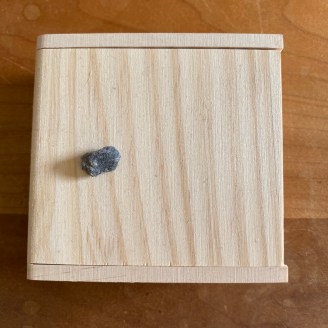
Be honest. Is it weird that I am inspired by a piece of gravel?

I suppose such thoughts are bound to be inspired in the stopping, because the whole practice of throwing things away is like a kind of forgetting, a physical amnesia. I forget YOU milk carton! And I forget YOU granola bar wrapper! We all enact this ritual all day long, every day. Which makes a kind of sense: if we all had to keep and look at everything we’d normally throw away, we’d probably go insane, right? I’m imagining nightmares of being chased by every milk carton I’ve ever known.

But sometimes I like to keep objects just to help me remember things- it’s the hoarder in me. So on the desk by my computer I have a tiny little shrine composed of a wood box and a piece of gravel. One day recently, as I was walking through our house I stepped on this piece of gravel, tracked in from our driveway as sometimes happens, and picked it up with annoyance. Without thinking, I headed for the trash, when I realized (as I have done nearly every day over the last month) that there was no trash to put it in. I stopped, stymied.

I looked at the piece of gravel. What the heck was I doing? What, I wondered, had I ever been doing?

Turns out? Fixable.

I mean, seriously. It’s a freaking rock, Eve, I admonished myself. Rocks aren’t garbage… they’re nature. Why would I throw a rock in the trash? To be trapped in a non-degrading plastic bag, hauled to the landfill and sit there, smothered for the next umpteen zillion years? Sure it’s tiny, about the size of a plain M&M, but how many times have I thrown away a piece of gravel, and how many other people have done just the same thing? That, like anything, adds up.

How much more effort would it really have been for me to open the front door and toss that pebble out into the yard? At some point I must have made the mental calculation-oh I’ll just put gravel in the trash because that’s easier, but the difference was truly miniscule: between opening a door and not opening a door. And I know I’m guilty of myriad other, similar infractions… how many times have I tossed out a paperclip or a safety pin just because the trash was closer than the drawer or box where I keep these things? How many pencils have I thrown away because they were missing erasers, or simply weren’t sharpened, because we already had a handful that were? We live in a time of material abundance unprecedented in human history and clutter is the thoroughly modern phenomenon that comes along with it. Surely I can’t be the only person who has ever thrown “perfectly good” things into the trash out of a strange sense of pure, unadulterated self-defense?

But what gives me the right, I wondered for the first time, to send something to the landfill? When did we become such masters of the universe? When did we become so careless with our resources?

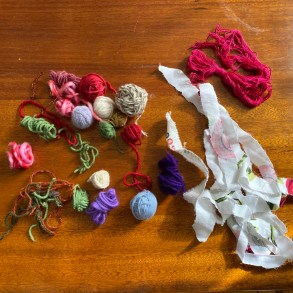
The horrific yarn mess before…
…and after.

The piece-of-gravel revelation has played out in our house over the last few weeks in dozens of different ways: what once we would have thrown out, now we are, for the first time, compelled to really look at… and find another way. I’m sheepish to admit that in the past whenever a clothespin came apart I considered it “broken” and would pitch it: too hard to fix! Probably impossible. I’d think. But when that happened to me the other day I sat down and in about a minute and a half figured out how to put it back together. I felt quite unreasonably proud about it, too.

And when my older daughter Greta came across a huge entanglement of random yarns and craft scraps that had somehow all been shoved together in the bottom of a tote bag, she looked at me questioningly… what on earth were we going to do with this? Any other year, we would certainly have thrown it away. Instead, we sat down and started untangling. It sat on the coffee table for a few days getting progressively better in installments until one day it was no longer a horrible mess at all, but instead a neat pile of several different balls of yarns and fabric strips. Again I felt both proud and a little ridiculous for feeling proud. I keep thinking: those bits and pieces can now be used. Used! I felt like an alchemist who had discovered how to turn trash into gold nuggets.

But the real discovery, I think, is that it was never trash in the first place. Trash is a made-up idea, invented in the name of convenience, which I’m coming to view as a dirty word. Because that lovely idea, as it turns out, comes at a terrible, terrible cost.

So sure, I saved a teeny, tiny rock from the landfill and who cares. But it’s a teeny, tiny rock that represents something much bigger, and that’s why I keep it on my desk, to remind myself that just because our culture accepts something, doesn’t mean it makes any sense. Sometimes it’s just a matter of stopping to really look at something for the first time that can change your point of view entirely.

Sometimes it can even be something right underfoot.
Demystifying the Big Supermarket Box

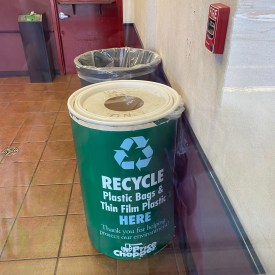
For a while now I’ve wondered what the deal is with those mysterious boxes at the front of the supermarket offering to recycle your plastic shopping bags. Often they’re just big cartons or barrels with a slot in the top and a green recycling arrow on the side. I can’t imagine I’m the only person who’s ever wondered, yeah, but what is this? I mean:

A Mystery Worthy of a Scooby Doo Episode?
Admit it. You’ve wondered.

Who collects the bags?

Where do they go?

What can you make plastic bags into anyway- more plastic bags?

Can you recycle other plastics in these boxes?

But after a little research the other day, I was able to call up Stephanie, who helped me to sort it all out. Stephanie works for Trex, and Trex is the answer to the question “Who wants a bunch of empty plastic shopping bags?” This is because Trex turns them into composite decking for outdoor porches and railings.

Yes! There is a company that really does want these plastic shopping bags, and that really will do something constructive with them. Best of all, none of this is part of an elaborate hoax to relieve our guilt at having forgotten the reusable bags at home. Again.

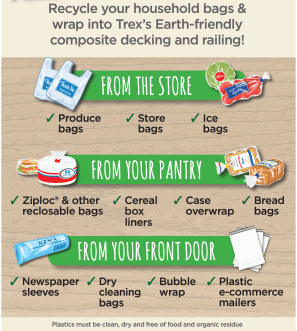
But it gets even better, because Trex doesn’t just want your plastic shopping bags; they want all your polyethylene, which is a science-y word for plastic film, and includes a whole lot of things you’re probably throwing away right now. I found a fabulous poster on the Trex website that I printed out and am hanging in our kitchen to remind us of all the many things that— as long as they are clean and dry— can go into this magical box at our supermarket, including:

  • bread bags
  • ice bags
  • produce bags (both the kind that come on rolls in the store and the kind apples and oranges are already bagged in)
  • plastic overwrap from things like paper towels, toilet paper and water bottle cases
  • bubble wrap, bubble mailers and air pillows (deflated)
  • dry cleaning bags
  • Ziploc bags
  • newspaper bags
  • cereal box liners (unless they tear like paper)


If you don’t find that list super exciting, then you clearly are not me. For one thing, this opens up a whole host of products I thought I wouldn’t be able to buy at all this year, from sandwich bread to cereal. Yes, I’ll still make my own bread and buy it from the bakery. Yes, I’ll still be bringing my reusable mesh produce bags with me on my shopping expeditions.

Print the full poster by clicking here

Yes, I will still always choose the lowest-plastic option of any product, because at 300 million tons of new plastic made per year the world certainly doesn’t need my encouragement to make any more, whether it gets recycled or not. But still. The other day when my daughter Ilsa felt crappy and asked for toast, it was a relief not to have to drive for an hour or wait for bread dough to rise all afternoon- I could just buy her a loaf at the store ten minutes away.

(When your kid is sick, not having to make a choice between them and the entire planetary ecosystem can be worth a lot.)

Now if you are like me you’ve tried to be good. When you read various recycling instructions you inevitably read the recycling warnings too. This is the part that says, in effect: IF YOU PUT ONE WRONG ITEM IN HERE YOU WILL DESTROY AN ENTIRE BATCH OF RECYCLING AND PROBABLY MURDER A POLAR BEAR IN THE PROCESS. These dire warnings all send the same message: “when it doubt, throw it out.” I take issue with this. We don’t need more encouragement to throw things into the landfill. What we need is better information.

Which is why I like people like Stephanie at Trex so much. Her job has everything to do with giving people more information so they can recycle correctly. More companies should have a Stephanie, to answer questions from the public not just about their products, but about their product packaging, and what exactly they expect us to do with it so as to not strangle the planet.

Stephanie answered other questions I had too. She told me that when the plastic film recycling boxes are full they get returned to the supermarket’s distribution centers, where they are converted into 1000-pound bales. She explained that most distribution centers ship one semi-load of these plastic bales to Trex every two weeks.

Oh, this is WAY too small for you to read! Instead check here to see if your supermarket sends its Plastic Film to Trex

Wow. That’s a lot of not-landfill.

Most importantly, she told me some simple steps to help people avoid putting the wrong kind of plastic film into the Trex boxes. First, check if it is marked with a #2 or #4 plastics recycling number. If so, this is polyethylene and YES! Trex wants it.

If, however, there is no number to be found, here is an easy test:

  1. Is the plastic able to be stretched? YES! Trex wants it.
  2. Is it shiny or crinkly? NO!! Trex cannot use this.

Things that fall into the shiny/crinkly NO!! category include:

  • pre-washed salad mix bags
  • frozen food bags
  • candy wrappers
  • chip bags
  • 6-pack rings.

So there you have it: some bona-fide good news, courtesy a company that is totally getting a Valentine from me this year. On recycled paper, of course.

If You Need Me, I’ll Be At The Store

I guess, over time, everyone develops a system. The way one goes about regular weekly tasks in order to get the ordinary stuff done efficiently— perhaps almost mindlessly— while we focus our brain power on other, more important things. I certainly have one. I mean I did.

Years ago, when our family decided to do a Year of No Sugar, I had a different routine, a different system, and a significant portion of the discomfort of that year-long project was trying to find a way to develop and establish new norms that fit our lives’ new parameters. At the time I wrote about doubling the time I spent at the grocery store: overnight I went from buying the week’s groceries in one hour, to buying the week’s groceries in two hours.

My weekly grocery shopping used to entail one stop- now it requires five.

At the time I thought that was pretty impressive, but that alteration seems like a cakewalk to me in comparison with what’s happening now.

I’m including a photo of the weekly grocery list I made up this morning. In my system, I loosely plan out the week’s menus on the left-hand side, and list the ingredients for each dinner on the right. The new rub in my shopping, of course, is that I have to go wherever the disposable packaging isn’t, and very frequently that place is not the supermarket.

So where once I would get pretty much everything in one fell swoop, place it all neatly in my reusable bags and come home, now I am running all over town, and occasionally, all over our county, trying to get things like produce and meat and cheese without the landfill fodder. Take tonight’s dinner: shrimp risotto.

Normally I buy one pound bags of frozen wild-caught shrimp, deveined and shelled. I’ve bought it so many times I could probably find it in the fish freezer blindfolded. But I know this product has both an inner and an outer plastic bag, and I’m still unsure if these can be recycled in any way. A trip to the local fish market down the road might be the solution, but can I convince them to put shrimp in, if not my own container, at least a recyclable plastic container, rather than a disposable bag? Cross fingers.

My health food store has compostable produce bags!! Why can’t the supermarket?

Then I’ll head on to the next town over where there is an actual free-standing butcher. They sold me meat in butcher paper last week, so I’m hopeful to get the beef for my beef stew, if I get an amiable counter-person. Cross fingers.

Then I’ll head to the health food store. There I can get things like carrots and celery without plastic bags- perhaps a rubber band or a twist-tie will be involved here or there, which I keep and reuse. I bring my own mesh bags, but if I run out they have a roll of biodegradable bags on hand. YES!! I try to limit how much produce I buy there since it is significantly more expensive than the supermarket, which sometimes translates to better quality, but not always. Things like garlic and lemons can probably be found without packaging at the supermarket for less. Cross fingers.

But first I will head to the Italian specialty shop Al Ducci’s, which I’ve discovered will sell me both bread and cheese wrapped in paper, just paper. Again- it isn’t cheap bread and cheese, but it is fabulous, and I can get by without plastic wrap or cellophane windows, which is huge.

So now I can go to the supermarket, having exhausted all other shopping options. When I’m done I’ve visited five different stores, all in a town thirty minutes from my house (except the butcher which is another 15 minutes further). You can understand why, if I run out of bread at home like I did yesterday, I found it easier to make bread than get in the car to go buy it. An hour’s trip for bread? Forget it.

During our Year of No Sugar, after I got past the initial learning curve I found that I got much more efficient— there were only so many things I could buy after all— and my shopping trips fell to only thirty minutes a week. I’m not sure such a simplification will be possible for Year of No Garbage, however. Rather, what’s required in thinking about groceries reminds me of a more European sensibility. When I was a college exchange student in Italy years ago I was quite amazed at how many different specialty stores the Italians went to just to gather their basic meal ingredients: butcher, baker, outdoor markets with special hours for vegetables… the supermarket was a small, uninspiring affair, and seemed to exist primarily for things like toilet paper and sad-looking frozen dinners.

A lot of this comes down to a European emphasis on very high quality, very fresh ingredients, made by hand. Everyone loves this idea in principle, of course, but for Americans factors like cost and convenience clearly outweigh healthier, fresher, more delicious food. We’re busy. We’re on a budget. Food has to fit in around the important things; it must be practical.

My grocery cart last week. Please notice my reusable mesh bag with onions- I am very proud of it.

For many Europeans I’ve met, practical can take a flying leap. Food doesn’t fit in around the more important things- it is the important thing. A few years ago we were lucky enough to be invited to a wedding in Paris and I noticed that the things Americans tend to spend all their wedding budget on were done comparatively minimally: the dress, the flowers were all tasteful but… simple. The father of the bride proudly explained to us that essentially all of the budget had been spent on THE FOOD.

And what food it was. How many wedding dinners would figure in your most memorable meals? But that’s what was important.

So, to summarize: we’re eating more… carefully. There isn’t a lot of extra food around the house these days (want a snack? If you aren’t up for apples with peanut butter you’re out of luck) and I’ve temporarily stopped packing Ilsa lunches- luckily her school has some pretty good food options as school lunches go. I just haven’t gotten the hang of it enough yet. I still haven’t figured out how to buy chicken at all. Red meat from the butcher or fish from the fish market, in addition to being more expensive and inconvenient, isn’t cryo-shrink-wrapped in fourteen kinds of plastic, so I’m not buying as far in advance as I once did: I no longer buy a pound of ground beef if I don’t think I’ll use it for six days. And yes, this all involves an extra amount of driving around in my gas-powered car, so there’s that environmental impact to consider.

Oh my. But I have faith that, with time, I will develop some strategies. I’ll get a new system.

Cross fingers.