All posts by Eve Ogden Schaub

Unknown's avatar

About Eve Ogden Schaub

Serial memoirist Eve O. Schaub lives with her family in Vermont and enjoys performing experiments on them so she can write about it. Author of Year of No Sugar (2014) and Year of No Clutter (2017) and most recently Year of No GARBAGE (2023). Find her on Twitter @Eveschaub IG or eveschaub.com.

The Problem With Getting Dressed

We’ve all got to wear clothes, darn it. And clearly, we LOVE clothes made with plastic.

Name a popular clothing item today— yoga pants, fleece pullovers, stretchy denim— and odds are that item is made softer, more durable, more shrink- stain- and wrinkle-resistant through the use of synthetics. Which is to say, plastic.
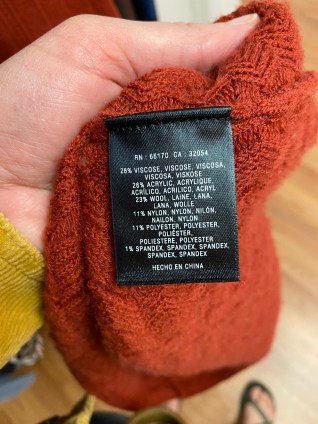
Would you like some plastic with your plastic?

Have you ever tried to wade through the vocabulary of synthetics on your clothing tags? It’s worse than chemistry class. Here’s a super simplified guide:

  • polyester
  • nylon
  • acrylic
  • polypropylene
  • elastane
  • spandex
  • lycra

The above materials are all forms of plastic.

Here are some other mysterious terms you’ll encounter:

  • rayon/viscose (two names for the same thing)
  • acetate
  • triacetate

These materials are also considered “synthetic,” although they are not made with plastic. Rather, they are the results of chemically manipulating and extruding cellulose or wood pulp. Still bad, but perhaps not quite as bad.

Approximately half the clothes on the market today are made from plastic, (see charts below: 65% of our clothing materials in 2016 were synthetics, and at least 87% of those were plastics.) These plastics come from fossil fuels, whose production is a source of greenhouse gases.
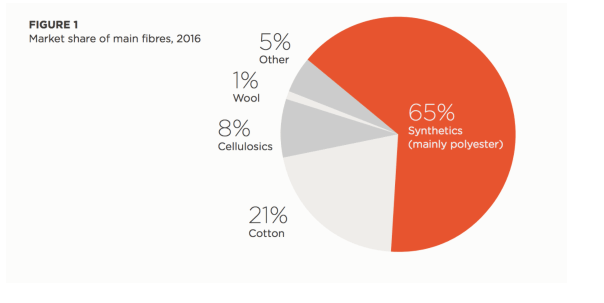
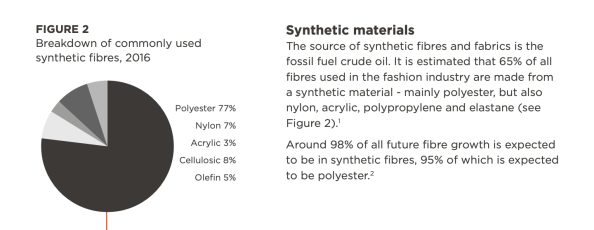
 

Graphics from: https://www.commonobjective.co/article/what-are-our-clothes-made-from

But it’s worse than that.

We all heard not so long ago about the startling study proving that we’re all ingesting “a credit card’s worth of plastic a week.” So, where do these tiny plastics come from? In part, it is likely that we are breathing them in, from our clothes. As we are just starting to learn, plastic clothes regularly shed micro-plastics thinner than a human hair. The longer we own them, and the more times they are washed, the more these clothes shed: into the water of our washing machine and into the air around us.

I’ll admit it. I own all the plastic-filled clothes I listed above and more. In fact, I just realized that everything I am wearing right now as I type this is made with plastic: from the polyester in my t-shirt and jeans to the nylon and spandex in my bra and underwear… down to the plastic soles of the slippers on my feet.

All this is very bad indeed, but how does it figure in to a Year of No Garbage?

Beyond the concerns about climate change and micro-plastics, plastic clothes have much the same downside as plastic packaging does: each has a short useful life followed by an eternal afterlife. Unlike natural clothing materials from throughout history, plastic is permanent.

Thanks to “fast fashion,” that short useful life seems to get shorter all the time. Most of us are aware that today’s ever-cheaper clothes require poor conditions for workers around the world who are exploited, endangered, and underpaid. But it also means those clothes are usually made to a very low standard; much of “fast fashion” is intended to be worn only a few times before it starts to fall apart.

When these clothes do fall apart, they are much harder to fix than those made with materials like wool or cotton. When yoga pants develop a rip, hiding the stitching to fix the hole? Is virtually impossible.

I suppose it’s no coincidence, then, that the longest-lived items in my closet are not made with synthetic materials but natural materials such as cotton and wool. The cream-colored cardigan my mother bought for me on a trip in 1988, back when most Irish fisherman sweaters were actually knit in Ireland, is still going strong. After three decades of use it is only now starting to sprout the occasional hole or pulled stitch that needs darning, which is easily done.

Now that’s a sweater.

Was it expensive when my mom bought it? I’m sure it was‑ and for the knitter’s sake I hope it was. On the other hand, you don’t have to invest a fortune to wear real clothing like this, clothing that is made to last from natural materials. You’d be amazed what turns up at the consignment shop or thrift store for a fraction of the cost of buying new. On the right day you can get a gorgeous hand-knit sweater that will outlive you- and I mean in its usefulness, not at the landfill. I know this because my daughter Greta, who is twenty, has been dragging her family to vintage and secondhand clothing stores since she was fourteen. While I wait for her to try on a fabulous bead-encrusted 1940s-era something she’s dug out of the clothing racks, I’ll inevitably find a stack of Dale of Norway sweaters being sold for $20 or $40 (new they cost hundreds), or a gorgeous hand-knit pullover someone’s grandmother made, for $5. (Many of them still have the “Handknit especially for you…” tags sewn inside.)
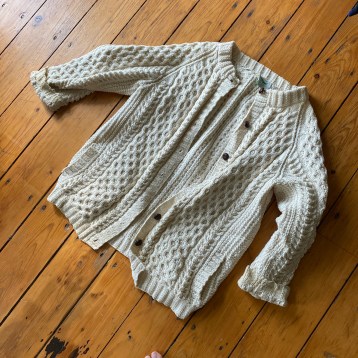
Someday this sweater will be in the Smithsonian.

When good quality wool sweaters like these have lived a long life, passed from person to person, some day they will inevitably be beyond repair. When that happens, there are still lots of options. If you’re a crafty person they could be unraveled and reknit into other things, or cut up and sewn into pillows. Plus, there are innovative companies such as Smartwool instituting programs to reuse reclaimed wool fibers in new products, which is awesome.

But if worst comes to worst? Wool fibers are biodegradable, unlike plastic.

Yes, companies such as Patagonia are making fleece out of recycled plastic bottles, which is well-intentioned. But: that means you still have the problem that every time you wear and wash that fleece, micro-plastics are shedding into your wash water and maybe your breakfast cereal. Ew.

So I’m pledging to buy no more clothes containing plastic, old, or new. If I’ve learned anything watching my daughter Greta collect vintage clothing it’s that there are a lot of lovely clothes already in the world, made with natural materials. Wearing them doesn’t have to be about what’s “in” today and “out” tomorrow.

Instead it could be about what’s fun, beautiful, natural and well-made. We could spend less and get more. Better for both the environment and our bodies we could make better use of the tremendous abundance we already have.

It won’t always be easy. Greta’s favorite vintage clothing period is the 1940s, but have I mentioned what mine is? That’s right! The seventies. So if you find a crazy-patterned maxi-dress out there not made from 100% polyester, you will let me know, won’t you?




Single Stream Recycling is a Lie, and Other Recycling Facts No One Wants To Tell You

It’s taken me months to get to the bottom of these Recycling Mysteries, and some of them are pretty shocking, so let’s get right to it:

  • The only plastic numbers that actually get recycled are Numbers 1 and 2, and possibly 5.

This is because 1 and 2 are the only varieties of plastic for which there is an actual market/ monetary value. Regardless of what your service provider is telling you, numbers 3, 4, 6 and 7 are not getting recycled. They are getting shipped to some unfortunate country to junk up their environment.

  • Plastics with no numbers don’t get recycled.

They end up in either the landfill or the incinerator. One form of “wishful recycling” I’ve heard a lot is “but it’s rigid plastic! That’s always recyclable, right?” The sad answer is: nope.

  • All screw-off caps should be removed.

 They make the containers difficult to crush and cause them to pop out of the machines. Anything that pops out of the machines is probably going to get trashed.

  • Anything smaller than 2 inches doesn’t get recycled.

These items are too small to go through the recycling machines, and will end up on the processing facility floor. Anything that ends up on the floor is probably going to get trashed.

  • Plastic films must have all labels and stickers removed before they can be recycled in the plastic film bin at the supermarket.

If you can’t pull stickers and labels off they must be cut out, or the glue on the sticker will contaminate the recycling and mess it up. Then the whole batch gets trashed. The sticker is not recyclable.

  • “Compostables” are pretty much a total lie.

They are not compostable, (at least not in the backyard compost sense,) not recyclable, (#7 gets trashed,) and do not degrade in a landfill.


At long last: ACTUAL FACTS. Depressing facts, but still.

If you are a person who pays any attention to the issue of recycling, you’ve likely been frustrated by how elusive basic principles of recycling can be.

You’ve heard “When in doubt, throw it out!” or “just ask your garbage/recycling service provider!” But these are not “recycling principles;” these are cop-outs. Real answers, like the ones above, are slipperier than an eel at a banana factory.

But why?

Because the system is much worse than just confusing. The system is broken. And worse than that, it’s dangerous: to us and to our planet.

Much of current, single stream recycling is, in fact, a lie, at least when it comes to plastic. The seas are filling up with plastic. Humans are drinking water and eating food contaminated by micro-plastics. The environment and our bodies alike are suffering the results of this onslaught of a material that never degrades, never goes away. Did you know they are finding micro-plastics in human poop now? We’ve all become walking micro-processing plants of trash.

As any environmental expert will tell you, the plastic recycling problem all comes down to who pays. Even when you’re talking about the plastics #1 and 2, China stopped accepting our plastic waste in 2018, leaving our cities and counties to make the choice between paying to landfill or burn it, paying to send this stuff away and make it some poorer country’s problem, or paying to recycle it (the most expensive option).

Sure, we as consumers can pay: we can contact Terracycle and go through a somewhat elaborate process to pay them to recycle, if we can afford that luxury. But in either of these two scenarios, the taxpayer is ultimately footing the bill for the packaging a large company is dumping on us.

It’s like we’re paying for our products twice.

When I look at the facts above, I have to wonder why companies are allowed to produce literally thousands of different varieties of plastics, with no responsibility for where they end up. I have to wonder why it is such a hush-hush secret that out of seven plastic categories, only two are legitimately getting recycled- sometimes.

Final Thought: What is the responsibility of the companies who are making this stuff?

A Scandalous Post About Underwear. Packaging.

You might think, after writing for, say, eight plus months on a topic like “garbage,” you might run out of things to talk about.

Well, no. In fact, there’s so much to write about, sometimes I feel kind of breathless. I have little piles all over my office of bizarre objects waiting for me to investigate them- a detergent sample, a plastic coated paper raisin container, a broken wire coat hanger.

My Research Pile.
Okay, ONE of my research piles.

I try to keep a list of questions and ideas on my desk, which generally takes the form of forty million little bits of paper and post-its and envelope backs. Among the many notes to myself:

  • What is the difference between biodegradable and compostable?
  •  Investigate what to do with: Broken glass? Burned out light bulbs? Plastic produce netting? Hard plastic with no numbers?
  • Don’t forget to tell the Red Solo cup story!!
  • Why aren’t plastics infinitely recyclable?
  • What about “food recycling” (food cupboards)?
  • Look into history of grocery stores??

Today I’m thinking a lot about packaging. Of course, even for folks who order in the mail a lot, the pandemic has upped the game tremendously. Stay home! Just order everything!

Ordering more through the mail means more packing material, and soooooooo much of packing material is problematic, either because we think it is unrecyclable, is inconvenient to recycle, or it is actually unrecyclable.

But today what’s striking me is not so much the question of whether the shipping materials are recyclable, as how wasteful companies tend to be when shipping items to customers. I’ll give you an example.

These days I try to buy all my clothes at consignment shops, however I do draw the line at underthings. So I ordered a bra and some underwear from Natori, hoping that the priciness would indicate these items would not only be of high quality, but would last a good, long time.

You can imagine my surprise when a box the size of a small microwave oven arrived at my doorstep. Did my underwear really require a box big enough to house an entire family of napping cats?

Two items. One ridiculously huge box.

But it got worse. Because when I opened the box I found a veritable class on packaging science. Each item came in its own separate plastic bag, inside of which was the item on a clear plastic hanger and featuring a hang tag with two layers of paper and a layer of plastic, attached with… more plastic.

Of course it’s clear that this is part of an overarching system that probably includes shipping to actual stores, where they appreciate things like hangers and price tags, not to mention plastic bags to keep product clean and sanitary. What I’m saying is, this particular plastic, in this box, at my house, had served no effective purpose whatsoever. Most people in our culture would probably have tossed all of it into the nearest trash without much thought, because that’s what we’re conditioned to do. And that plastic, then, would be delivered to a landfill where it would give off harmful chemicals that would then try to make their way to the local community’s groundwater.

And it would do another thing too.

That stupid plastic bag and plastic hanger and plastic hangtag would outlive all of us.

A paper AND plastic hangtag

 So I’m trying to see that THIS plastic is meets a better fate, but it isn’t easy. Here’s my plan:

  • The plastic bag will be dropped off at the supermarket plastic bag recycling bin, to be turned into outdoor decking by companies like Trex.
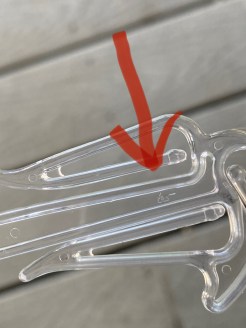
  • The hanger, which incidentally wins for the smallest recycling triangle I’ve ever seen, will go into single stream recycling.
  • The paper part of the hangtag will get burned in our fireplace. The transparent plastic part will get added to our next Terracycle “plastic packaging” box which we pay to get recycled.
  • The Swift Tack (which is the name for the plastic that attaches a hang tag to a garment) will go into my jar labeled “Plastic Doohickeys.” I have yet to figure out what to do with all that stuff. Maybe a macaroni-based art project.

    Can I please borrow an electron-microscope to find this recycling symbol?

On Natori’s website, under a section called “Natori Gives” you’ll find a listing a of many charitable organizations that Natori supports that “empower women, and fight racism and structural inequality around the world.” But all of those issues aren’t islands; they interrelate one with the other… just as environmentalism interrelates with issues of social justice when landfills and incinerators are placed in low-income communities and those of people of color. And women’s issues, racism and inequality have everything to do with this scenario: they are all connected.

I’m not blaming Natori as much as using them as an example of an overall system that needs rethinking. Surely there is a way around plastic hangers and plastic bags. Surely, there is a way to make sure customers receive clean, hygienic products without so much waste. We just need to make connections between these different issues we say we care about and then actually make real change to address them.